
Post-Earnings Momentum in High-Growth Tech Stocks: Decoding After-Hours Trading Patterns
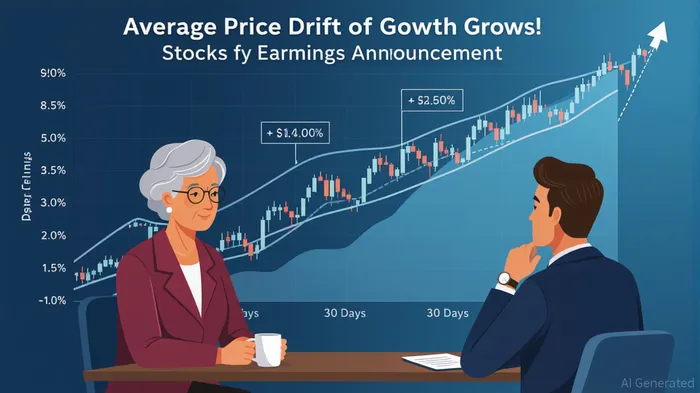
The post-earnings announcement drift (PEAD) phenomenon has long perplexed investors and academics alike. For high-growth tech stocks—companies often valued more for potential than present earnings—this drift is not just a statistical curiosity but a critical factor shaping near-term performance. Recent research underscores how after-hours trading patterns, though understudied, may serve as a leading indicator of post-earnings momentum, offering actionable insights for investors navigating this volatile sector.
The PEAD Paradox and High-Growth Tech Stocks
According to a review of PEAD literature, stock prices often drift in the direction of earnings surprises for weeks or even months after announcements, challenging the efficient market hypothesis [1]. For high-growth tech stocks, this effect is amplified. A study on seasonal patterns of earnings releases reveals that firms announcing results during "busy weeks" (e.g., overlapping with macroeconomic data or other earnings reports) experience stronger PEAD effects, likely due to delayed information processing by investors [3]. This delay creates opportunities for those who monitor after-hours activity, where initial price reactions may foreshadow longer-term trends.
After-Hours Trading: A Window Into Market Psychology
While no direct studies link specific after-hours metrics (e.g., volume, price gaps) to near-term performance, indirect evidence suggests their predictive power. For instance, post-earnings gapGAP-- trading strategies—where stocks gap up or down by more than 3%—are most effective when accompanied by strong pre-market volume [2]. High-growth tech stocks, with their inherently speculative valuations, often exhibit extreme volatility during after-hours trading. Data from Tradefundrr indicates that these stocks see average price moves of 5-10% on earnings days, compared to 1-2% for broader markets [2]. Such volatility is frequently mirrored in elevated options premiums and trading volumes, signaling heightened investor sentiment.
The role of institutional investors further complicates the picture. Firms with fewer institutional shareholders—common in the high-growth tech space—tend to under-react to earnings news initially, creating a "slow diffusion" of information that prolongs price drift [3]. After-hours trading, dominated by retail investors and algorithmic traders, may thus act as an early barometer of this under-reaction. For example, a sharp price surge in after-hours trading without proportional volume could indicate unsustainable momentum, while a surge supported by robust volume might presage a durable trend.
Limitations and the Path Forward
Despite these insights, gaps remain. No empirical studies explicitly analyze how after-hours volume, price action, or order flow predict near-term performance for high-growth tech stocks post-earnings . This absence highlights the need for more granular data, particularly on order flow dynamics and retail investor behavior in after-hours sessions. Investors should also consider contextual factors: a stock's earnings quality, analyst coverage, and broader market conditions all modulate the reliability of after-hours signals.
Conclusion
For investors, the key takeaway is clear: after-hours trading patterns, while not a crystal ball, offer a lens into the psychological and structural forces driving post-earnings momentum. By combining these patterns with traditional PEAD metrics and firm-specific fundamentals, investors can better navigate the high-risk, high-reward landscape of high-growth tech stocks. As the market evolves, so too must our tools for interpreting its signals—starting with a closer look at what happens after the bell.







Comentarios
Aún no hay comentarios