
Post-Disaster Economic Recovery: Unlocking Opportunities in Emergency Response and Infrastructure Investment
The global landscape of post-disaster economic recovery has evolved dramatically in recent years, driven by the dual imperatives of climate resilience and technological innovation. As natural disasters and pandemics increasingly disrupt economies, infrastructure investment has emerged as a cornerstone for rebuilding communities and fostering long-term growth. This article examines the opportunities within the emergency response and reconstruction sectors, drawing on recent case studies, market trends, and innovative financing mechanisms to outline a compelling investment thesis.
The Economic Imperative of Infrastructure Investment
Post-disaster recovery is no longer just about restoring what was lost-it is about building back better. A 2025 U.S. Chamber study underscores that every $1 invested in disaster preparedness saves an average of $13 in damages, cleanup costs, and economic losses. This ROI is amplified when infrastructure projects integrate sustainability and resilience. For example, Paradise and Santa Rosa, California, faced prolonged recovery after wildfires due to rising absentee homeownership, which destabilized local housing markets, as noted in a ScienceDirect study. These cases highlight the interdependence of housing, employment, and infrastructure in post-disaster scenarios.
Strategic investments in renewable energy, digital infrastructure, and resilient transportation networks are proving critical. According to a report by The Infrastructurist, such projects not only create immediate jobs in construction and engineering but also lay the groundwork for industries like green technology and smart cities. The U.S. Chamber of Commerce further notes that proactive infrastructure spending mitigates future risks, a lesson reinforced by a Mordor Intelligence forecast that projects a $244.38 billion global emergency and disaster response market by 2030.
Market Growth and Key Players in Emergency Response
The emergency response and reconstruction sector is expanding rapidly, with a compound annual growth rate (CAGR) of 6.58% from 2023 to 2030, according to a Data Insights report. This growth is fueled by urbanization, climate change, and technological advancements. The Asia-Pacific region leads in growth potential, driven by countries like India and Indonesia, where rapid development intersects with high disaster vulnerability, the report notes. North America, meanwhile, remains the largest market, leveraging advanced technologies and established infrastructure.
Key players are redefining the sector. Honeywell and Lockheed Martin dominate with integrated safety systems and satellite communication solutions, highlighted in a Zekond roundup. The roundup also highlights IBM's AI-powered disaster recovery platforms and Airbus's drone-assisted rescue operations, while startups such as Everbridge are advancing mass notification systems and AI-driven threat detection. These companies reflect a broader trend: the integration of artificial intelligence (AI), IoT, and cloud-based platforms to enhance coordination and real-time decision-making, as discussed in a Firehouse article.
Innovative Financing and Sustainable Models
Financing post-disaster projects requires creative solutions. Chaffee County, Colorado, demonstrated success by pairing a voter-approved 0.25% sales tax increase with $36 million in federal matching funds, enabling wildfire risk mitigation and reforestation, according to Pew research. Similarly, Maryland's Resilience Authority leveraged public-private partnerships (PPPs) to fund floodplain restoration and wetland expansion, as Pew reports. These models highlight the potential of hybrid financing, where green bonds and PPPs align private capital with public resilience goals.
Green bonds, in particular, are gaining traction. A 2024 World Bank report emphasizes their role in funding renewable energy and climate-resilient infrastructure, offering investors both financial returns and measurable environmental impact, as outlined in a Paulson & Partners analysis. For instance, a government might issue green bonds to finance solar energy projects in disaster-prone regions, ensuring energy security while reducing carbon footprints, the analysis suggests.
Technology as a Catalyst for Resilience
Emerging technologies are revolutionizing reconstruction. AI-driven predictive analytics optimize resource allocation during crises, while GIS and BIM streamline project planning and execution, according to a ScienceDirect article. In Q4 2025, AI adoption in emergency operations centers (EOCs) surged, enabling real-time data analysis from weather reports, IoT sensors, and social media, the Firehouse piece reports. These tools not only improve response times but also enhance scenario simulations for training personnel.
Drones and virtual reality (VR) are also transforming construction. Post-disaster rebuilding in Paradise, California, utilized drone mapping to assess damage and prioritize repairs, noted in a Meridian report. Meanwhile, VR is being used to train workers in safety protocols, addressing labor shortages in the construction sector.
Conclusion: A Path Forward
The convergence of market demand, technological innovation, and sustainable financing presents a unique window for investors. By targeting sectors like AI-driven emergency response, green infrastructure, and PPPs, stakeholders can capitalize on both financial returns and societal impact. As disasters become more frequent, the ability to rebuild resiliently-and profitably-will define the next decade of economic recovery. 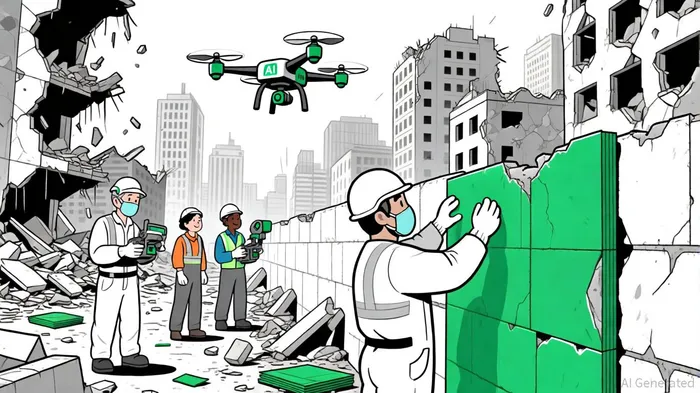







Comentarios
Aún no hay comentarios