
The Post-Crypto Crash Opportunity: Positioning for the Next Bull Market
The crypto market's 2025 crash was a seismic event-a stress test that exposed vulnerabilities but also revealed hidden strengths. Triggered by geopolitical tensions, a massive whale-driven liquidity crisis, and the collapse of synthetic stablecoins like USDEUSDe--, the crash erased $19 billion in value within weeks, according to Crypto Rank's Q3 2025 recap. Yet, as history shows, such downturns often precede the most lucrative bull markets. The key lies in identifying undervalued assets and strategic entry points while the market restructures.
Regulatory Clarity: The Foundation for Institutional Adoption
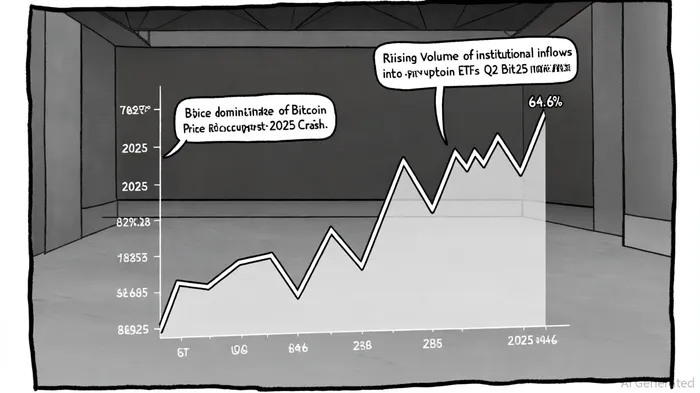
The crash accelerated regulatory clarity, a critical catalyst for long-term growth. The U.S. enacted the GENIUS Act in Q3 2025, mandating 1:1 liquid reserves for stablecoins and monthly disclosures-a move noted in the Crypto Rank report. This ended the regulatory gray zone, spurring banks to launch their own stablecoin offerings. Meanwhile, the CLARITY Act is set to resolve jurisdictional disputes between the SEC and CFTC, potentially granting the CFTC oversight of BitcoinBTC-- and EthereumETH--, as the same Crypto Rank analysis describes. These developments have already driven $14.6 billion in net inflows into Bitcoin ETFs during Q2 2025, according to an Analytics Insight article, signaling a shift toward institutional-grade participation.
Bitcoin and Ethereum: The New Safe Havens
Bitcoin and Ethereum emerged as the market's most resilient assets. Bitcoin's dominance rose to 64.6% post-crash, according to Equiti's Q3 2025 outlook, while Ethereum surged 66.5% in Q3 2025, driven by its role in DeFi and stablecoin infrastructure, per a Nasdaq Q3 review. Investors are increasingly treating Bitcoin as a macro hedge, akin to gold, while Ethereum's EIP-4844 upgrade and growing institutional tokenization of real-world assets (e.g., real estate) position it as a cornerstone of the next bull cycle-an observation also reflected in Equiti's outlook.
Historical data from 2022 to 2025 offers further insight: a backtest report shows that when Bitcoin's price reclaimed its 200-day moving average (a key support level), it generated an average cumulative return of +8.8% at day 30, outperforming a buy-and-hold strategy by ~5.3%. With a 77.8% win rate across 18 such events, this pattern suggests a tactical edge for investors who time entries near these levels. However, the small sample size and gradual build of relative edge highlight the need for confirmation filters-such as volume surges or favorable macroeconomic conditions-to enhance robustness, as the backtest report also notes.
Undervalued Altcoins: The High-Conviction Bets
Beyond the majors, several altcoins present compelling opportunities:
1. Chainlink (LINK): Despite its critical role in connecting smart contracts to real-world data, LINK remains undervalued. Its partnerships with Fortune 500 companies and adoption in enterprise-grade oracleADA-- networks suggest strong upside, according to Analytics Insight.
2. XRP: Regulatory clarity post-SEC settlement has unlocked institutional interest, with XRP's cross-border payment capabilities gaining traction in emerging markets, according to YouHodler's investment guide.
3. Algorand (ALGO) and Hedera (HBAR): Both chains boast real-world partnerships and energy-efficient consensus mechanisms, yet their valuations lag behind their utility, per Analytics Insight.
4. Cardano (ADA) and Polygon (POL): ADA's rigorous research-driven development and POL's Ethereum scaling solutions offer long-term value, particularly as Layer 2 adoption accelerates-another point highlighted by YouHodler.
Strategic Entry Points: Diversification and Liquidity Management
Post-crash strategies must prioritize diversification and liquidity management. For instance, Solana's Q3 2025 DEX volume hit $365 billion, as reported by Crypto Rank, driven by network upgrades that boosted throughput. However, its 57% increase in active addresses suggests growing pains-investors should balance exposure with risk mitigation. Similarly, BNB Chain's gas fee reductions and institutional partnerships make it a high-growth play, but its year-to-date performance remains negative, a nuance noted in Equiti's analysis.
A key lesson from the crash is to avoid over-leveraged positions. Instead, focus on key support levels and dollar-cost averaging into undervalued assets. On-chain derivatives, which saw 80% quarter-on-quarter growth in perpetual DEX volumes, can help hedge against volatility while capitalizing on macroeconomic tailwinds like falling interest rates, as detailed in a Mudrex report.
The Road Ahead: A Bull Market in the Making
The structural shifts post-2025 crash-regulatory clarity, institutional inflows, and innovation in Layer 2 solutions-create a fertile ground for the next bull market. As corporate treasuries tokenize assets and DeFi platforms reduce friction, the crypto ecosystem is evolving into a more robust, institutional-grade market, a trend highlighted in Equiti's outlook.
For investors, the priority is to position now in assets with strong fundamentals and clear use cases. Bitcoin and Ethereum will likely lead the next rally, but the real alpha lies in undervalued altcoins with real-world adoption. The crash may have been a correction, but it's also a buying opportunity for those who understand the long game.






Comentarios
Aún no hay comentarios