
Post-Crash Resilience in Crypto Exchanges: Risk Management and Trust Restoration in a Fractured Market
The cryptocurrency market has long been a theater of extremes-soaring valuations, speculative frenzies, and catastrophic collapses. Yet, as the industry matures, a clearer narrative is emerging: post-crash resilience is not just possible but increasingly necessary for survival. From the TerraUSD/Luna implosion in 2022 to the $OM token crash in 2025, crypto exchanges have faced relentless scrutiny over their risk management practices and ability to restore institutional trust. This analysis examines how leading platforms are adapting to these challenges, offering lessons for investors navigating a volatile yet evolving landscape.
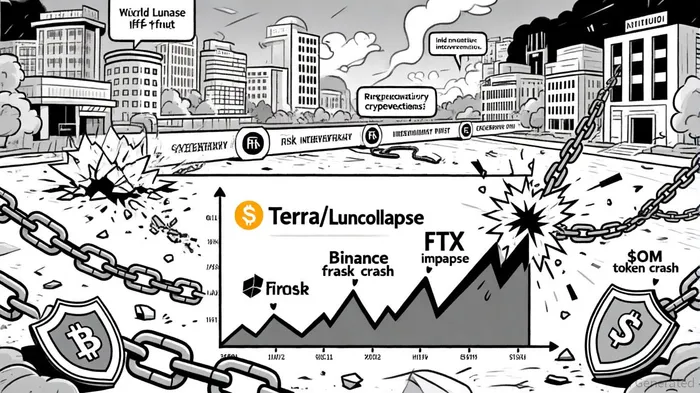
The Anatomy of Systemic Risk: Lessons from Past Crashes
The collapse of TerraUSD and LunaLUNA-- in May 2022 exposed the fragility of algorithmic stablecoins and their cascading effects on the broader market. A ScienceDirect study found that the event triggered bidirectional risk transmissions between major cryptocurrencies and traditional financial systems, underscoring the need for advanced modeling frameworks like the DCC-GARCH-Copula-ΔCoVaR model to quantify systemic vulnerabilities. This collapse also revealed how interconnected crypto-native institutions are, as seen in the subsequent FTX implosion in late 2022.
FTX's failure was not merely a technical or operational misstep but a systemic breakdown of trust. The domino effect saw related entities like BlockFi and Silvergate Bank suffer severe losses, with the latter reporting a 52% drop in deposits, as documented by Crypto Expanse. These events highlighted the critical importance of counterparty risk evaluation and due diligence-a lesson that has since influenced institutional behavior.
Risk Management in Action: Binance and Bitget's Proactive Stance
The Binance flash crash in October 2023, caused by system overcapacity and leveraged trading imbalances, served as a wake-up call for technological infrastructure resilience, as detailed in a Medium article. In response, Binance and other exchanges have since upgraded their systems to handle extreme volatility, including real-time liquidity monitoring and circuit breakers.
A more recent case study in risk management is Bitget's decision to decline listing the $OM token in April 2025. Despite market hype, Bitget prioritized rigorous due diligence, citing concerns over the token's fundamentals and potential risks to users, a decision noted in the Medium analysis. This move, while short-term costly in terms of missed trading volume, reinforced Bitget's commitment to user protection-a critical factor in rebuilding institutional trust.
Trust Restoration: From Retail Hype to Institutional Credibility
Post-crash recovery is not just about technical fixes; it requires rebuilding trust with both retail and institutional stakeholders. During the 2023 banking crisis, BitcoinBTC-- and EtherETH-- saw price increases, reflecting a growing perception of crypto as a stable alternative to traditional banking, according to a Ceffu case study. This shift was supported by surging app downloads for crypto wallets, indicating a broader acceptance of digital assets as a hedge against systemic instability.
However, trust restoration also demands transparency. Case studies collected by Crypto Expanse show how investors who lost funds due to errors or scams have successfully recovered assets through professional assistance, emphasizing the role of education and expert support in overcoming crypto-related losses. For exchanges, this means investing in user education and robust dispute-resolution mechanisms.
The Role of Regulation: Balancing Innovation and Oversight
Regulatory frameworks are evolving to address the lessons of past crashes. As noted in a LinkedIn analysis, the post-2022 era has seen a push for transparency and compliance, with regulators aiming to balance innovation with risk mitigation. This includes stricter requirements for stablecoin reserves, enhanced reporting standards, and cross-border collaboration to address jurisdictional gaps.
Yet, regulation alone is insufficient. The DCC-GARCH-Copula-ΔCoVaR model, which captures time-varying correlations and directional spillovers, remains a vital tool for exchanges to assess network resilience under stress; the ScienceDirect study described above explains how such models help platforms better anticipate and mitigate cascading failures.
Conclusion: Resilience as a Competitive Advantage
The crypto market's post-crash resilience hinges on three pillars: robust risk management, trust restoration through transparency, and adaptive regulatory frameworks. While the industry remains prone to volatility, the lessons of TerraLUNA--, FTX, and $OM demonstrate that survival is possible for exchanges that prioritize long-term stability over short-term gains. For investors, this means favoring platforms with proven risk mitigation strategies and a commitment to institutional credibility.
As the market matures, resilience will no longer be a differentiator-it will be a baseline expectation.






Comentarios
Aún no hay comentarios