
Post-Conflict Reconstruction in the Middle East: Geopolitical Shifts and Infrastructure Investment Opportunities
The Middle East's post-conflict reconstruction landscape has emerged as a focal point for global investors, driven by a confluence of geopolitical realignments, economic diversification strategies, and urgent infrastructure needs. From Lebanon's $11 billion recovery plan to Syria's $14 billion Gulf-backed deals, the region's reconstruction efforts are reshaping investment flows-and with them, the balance of power.
Lebanon: A Fragile Path to Recovery
Lebanon's post-2020 economic collapse has left its infrastructure in dire need of repair. The World Bank's Lebanon Emergency Assistance Project, approved in June 2025, targets transport, water, energy, and health sectors as part of a broader $11 billion reconstruction plan. However, political gridlock-rooted in the 1943 power-sharing agreement-has stymied long-term planning and foreign investment, as The Word360 reports. Unlike Gulf states, Lebanon's instability deters capital, with donors conditioning aid on anti-corruption reforms and Hezbollah disarmament, the World Bank notes. This highlights a critical lesson: even with international support, weak governance and geopolitical tensions can undermine reconstruction.
Syria: Gulf Geopolitics and the Race for Influence
Syria's war-torn economy requires $250–$500 billion in reconstruction, with Gulf states emerging as key players. In August 2025, Damascus secured $14 billion in infrastructure deals, including a $4 billion Qatar-funded airport and a $2 billion UAE-backed metro system, as Al Jazeera reported. These investments reflect a strategic shift: Gulf nations like Saudi Arabia and the UAE are countering Iran's regional influence by positioning themselves as Syria's economic lifeline, The Word360 argues. Yet, U.S. sanctions like the Caesar Act have long hindered such efforts, and while recent sanctions relief post-Assad's ouster has opened doors, risks persist. Political uncertainty and extremist threats remain, as noted by the Atlas Institute.
Gulf Ambitions: Diversification and Regional Stability
Gulf states are not only funding reconstruction abroad but also transforming their own infrastructure. Saudi Arabia's NEOM project, valued at $500 billion, and the UAE's Noor Abu Dhabi solar plant exemplify a push toward economic diversification, according to MASTT. With over $3 trillion in active infrastructure projects across the GCC, the region is leveraging stability-bolstered by U.S. military alliances and clear policy frameworks-to attract global capital, The Word360 notes. Qatar's $45 billion LNG and green energy investments further underscore this trend, Southwest Journal reports. These projects are not just about growth; they are about securing regional dominance in a volatile landscape.
Geopolitical Risks: Sanctions, Sanctions, and Spillover Effects
Despite optimism, risks loom large. The Strait of Hormuz-a critical energy artery-remains vulnerable to Iranian or Houthi attacks, which could disrupt $1.7 trillion in annual oil shipments, according to J.P. Morgan. In Iraq, U.S. troop withdrawals and Iran-backed militia attacks threaten stability, Geopolitical Monitor reports, while Yemen's Houthi strikes on Red Sea shipping routes have spiked global freight costs, Geopolitical Monitor adds. Investors must also navigate conditional funding, as seen in Lebanon and Syria, where political reforms are prerequisites for aid, the World Bank observes.
Conclusion: Calculated Opportunities in a Shifting Landscape
The Middle East's post-conflict reconstruction presents high-reward opportunities, but success hinges on navigating geopolitical signals. Gulf states' strategic investments in Syria and Lebanon are as much about regional influence as economic gain. For investors, the key lies in aligning with projects that balance geopolitical stability-such as UAE-backed smart cities or Saudi energy diversification-with risk mitigation strategies. As the IMF advocates for conflict-resilient infrastructure frameworks, the Conflict-Resilience Framework provides guidance, and the region's reconstruction will likely remain a barometer of global capital's appetite for navigating complex political terrain.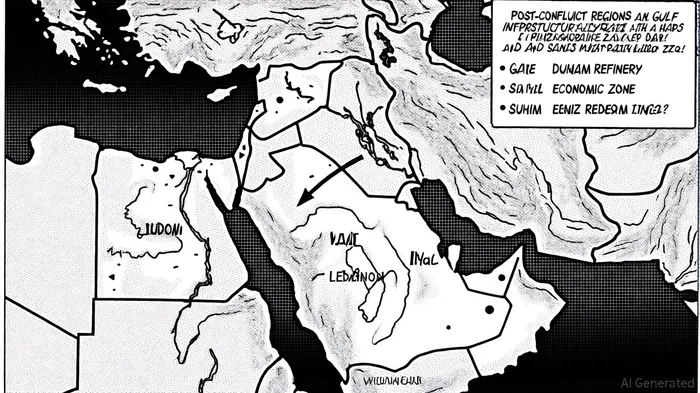







Comentarios
Aún no hay comentarios