
Post-Conflict Economic Reintegration: Unlocking Undervalued Infrastructure Sectors in a New Geopolitical Era
The global landscape of post-conflict economic reintegration is undergoing a transformation, driven by historic political agreements that are reshaping infrastructure and services sectors in previously unstable regions. From the Abraham Accords in the Middle East to localized peace deals in Colombia, these agreements are creating high-conviction entry points for long-term capital appreciation. Investors who recognize the interplay between geopolitical stability and infrastructure development can capitalize on undervalued sectors poised for exponential growth.
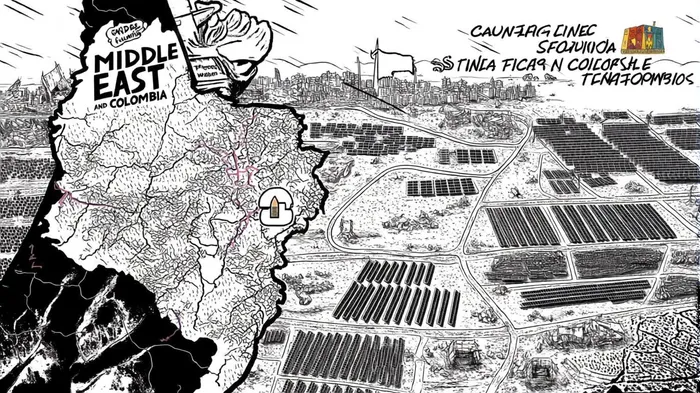
Renewable Energy: The Middle East's Solar Revolution
The Abraham Accords have catalyzed a shift in Middle Eastern economic cooperation, with renewable energy emerging as a cornerstone of post-conflict reintegration. The UAE and Israel's free-trade agreement, for instance, includes ambitious renewable energy partnerships. The UAE's Mohammed bin Rashid Al Maktoum Solar Park, targeting 5,000 MW by 2030, exemplifies this trend. With solar tariffs as low as $0.013 per kWh, the project's return on investment (ROI) is bolstered by government subsidies and declining technology costs, according to a Grand View Research report. Similarly, Saudi Arabia's Vision 2030 aims to generate 50% of its electricity from renewables by 2030, with projects like the Sakaka PV plant already contributing 2,631 MW to the grid, according to a Middle East Briefing article.
The region's renewable energy market, valued at $52.03 billion in 2024, is projected to grow at a 9.5% CAGR to $109.56 billion by 2033, according to that same Grand View Research report. This expansion is not merely speculative: the IMF notes that renewable energy adoption in the Middle East could contribute to long-term GDP growth by reducing fossil fuel dependence and attracting foreign direct investment (FDI), as outlined in a Kataeb analysis. For investors, the combination of geopolitical stability (via the Abraham Accords) and renewable energy megaprojects presents a compelling case for capital deployment.
Digital Infrastructure: Colombia's Post-Conflict Digital Leap
In Colombia, the National Digital Strategy 2023-2026 is transforming post-conflict regions into hubs for digital innovation. Internet penetration has surged from 38% in 2014 to 63% in 2023, with rural areas benefiting from expanded broadband connectivity, according to an International Trade Administration guide. The strategy emphasizes closing the digital divide through public-private partnerships, which are critical for rebuilding infrastructure in regions like Nariño and Cauca, historically affected by conflict.
Digital infrastructure's GDP impact is quantifiable: a Lincoln Institute study finds that a 10% increase in broadband penetration in developing economies correlates with a 1.38% rise in GDP growth. Colombia's digital economy, already contributing to national economic recovery, is projected to expand further as cloud computing and AI adoption accelerate. However, challenges such as regulatory complexities and limited access for 40% of households underscore the need for sustained investment, as highlighted in a World Bank blog post.
Quantifying the Opportunity
The ROI for post-conflict infrastructure projects is often underestimated due to their long-term nature. In the Middle East, decentralized solar projects in Yemen and Syria have demonstrated resilience, with community-based models achieving 77.8% sustainability beyond initial funding cycles, according to a PubMed Central article. Similarly, Colombia's integration of former combatants into construction workforces has reduced labor costs while accelerating infrastructure recovery, as discussed in an IHRB report.
Risks and Mitigation
Investors must navigate risks such as political instability (e.g., Sudan's incomplete normalization with Israel) and funding shortfalls. The OECD reports a 7.1% decline in official development assistance (ODA) in 2024, complicating post-conflict recovery, according to a New Humanitarian analysis. However, data-driven frameworks like the conflict-resilience model-using remote sensing and crowdsourcing to prioritize infrastructure-can mitigate these risks by ensuring efficient resource allocation, as shown in a ScienceDirect paper.
Conclusion
Post-conflict regions are no longer peripheral to global economic growth. The Middle East's solar revolution and Colombia's digital infrastructure push are emblematic of a broader trend: peace-driven policy reforms creating fertile ground for high-conviction investments. By targeting undervalued sectors with quantifiable ROI and GDP impact metrics, investors can align with geopolitical shifts while fostering long-term stability. The next decade will reward those who recognize that infrastructure in post-conflict zones is not just a moral imperative but a financial opportunity.







Comentarios
Aún no hay comentarios