
Post-Bitcoin Cycles: Identifying the Next High-Growth Digital Asset
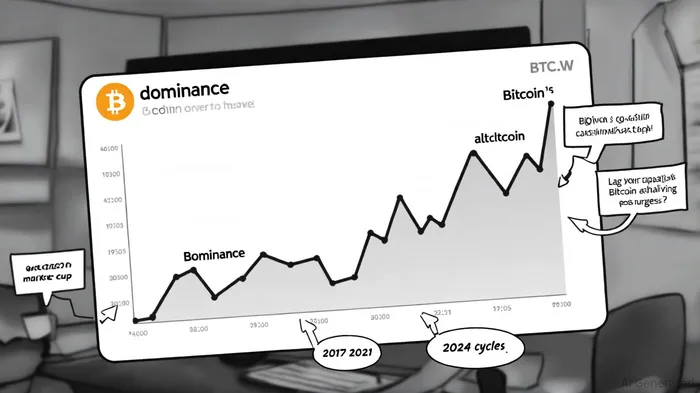
The cryptocurrency market has long operated on a cyclical rhythm, driven by Bitcoin's price action and the subsequent reallocation of capital into altcoins. As Bitcoin's dominance wanes during bull cycles, investors pivot toward alternative assets, seeking higher returns in a landscape of evolving narratives and technological innovation. In 2025, this pattern is accelerating, shaped by macroeconomic shifts, institutional adoption, and the structural changes introduced by stablecoin-driven liquidity. To identify the next high-growth digital asset, we must dissect the interplay of timing, supply-demand imbalances, and capital flows in post-Bitcoin cycles.
The BitcoinBTC-- Cycle: A Framework for Capital Reallocation
Bitcoin's four-phase cycle—accumulation, growth, bubble, and crash—has historically dictated the broader crypto market's trajectory. During accumulation, early adopters and institutional investors build positions in Bitcoin, often coinciding with halving events that reduce supply and drive scarcity. For example, the 2024 halving reduced Bitcoin's block reward to 3.125 BTC, creating a supply shock that pushed prices toward $110,000 by mid-2025 [1]. As Bitcoin enters the growth phase, its dominance peaks, but this is often followed by a decline in the bubble phase, as capital shifts to altcoins.
Data from the 2020 and 2024 cycles shows a consistent pattern: Bitcoin dominance drops by 40–60% post-halving, creating a vacuum for altcoins to fill [2]. In 2024, EthereumETH-- (ETH) and SolanaSOL-- (SOL) surged as Bitcoin's rally consolidated, with Ethereum's price reaching $4,815 and Solana hitting $268.86 [3]. This reallocation is not random—it is driven by supply-demand imbalances. When Bitcoin's supply becomes constrained (e.g., post-halving), demand for alternative assets with utility and growth potential rises, particularly in sectors like AI, DeFi, and tokenized real-world assets (RWAs) [4].
Timing the Shift: Lagging Indicators and Market Sentiment
The timing of capital reallocation is critical. Historical data reveals a 6–12 month lag between Bitcoin's peak and altcoin surges. After the 2020 halving, Bitcoin dominance fell to 40% by 2021, enabling altcoins like AvalancheAVAX-- (AVAX) and PolkadotDOT-- (DOT) to achieve 50–100% gains [5]. Similarly, the 2024 halving triggered a 6% drop in Bitcoin dominance in late 2025, signaling a shift toward mid- and low-cap altcoins [6].
This lag is amplified by macroeconomic factors. In 2025, the U.S. M2 money supply hit $22 trillion, injecting liquidity into risk-on assets [7]. Meanwhile, institutional demand for Bitcoin outpaced supply, with 690,000 BTC absorbed by institutional investors compared to just 109,000 BTC in new supply [8]. This imbalance reinforced Bitcoin's role as a store of value, while altcoins became vehicles for speculative growth.
Supply-Demand Dynamics in High-Growth Altcoins
To identify the next high-growth asset, we must analyze supply-demand imbalances in specific altcoins. Ethereum, for instance, has a fixed supply of 120.7 million coins, with its post-2024 price surge driven by the Pectra upgrade and staking yields of 5–10% APY [9]. Solana's supply expanded from 177.9 million to 497.4 million between 2021 and 2025, but its high transaction speed and DeFi infrastructure attracted institutional capital, pushing its price up 15% in Q3 2025 [10].
Chainlink (LINK), on the other hand, benefits from Ethereum's DeFi ecosystem, with demand for its oracle services rising as smart contracts integrate real-world data [11]. Projects with low supply, like Kaanch Network ($KNCH), also stand out: its fixed 58 million token supply and robust staking infrastructure have created a buy-side imbalance, driving rapid price appreciation [12].
2025 Trends: Stablecoins and Narrative-Driven Capital Flows
The 2025 bull cycle diverges from previous patterns. Unlike the 2017 and 2021 cycles, where capital flowed sequentially from Bitcoin to altcoins, today's market is dominated by stablecoin-driven liquidity. Altcoins are now traded primarily against USDTUSDT-- and USDCUSDC--, with stablecoin pairs accounting for 58.4% of institutional deployments [13]. This shift has fragmented altcoin rallies into niche sectors, such as AI-powered tokens and RWA platforms, rather than broad-based surges.
Regulatory clarity has also accelerated reallocation. The approval of Ethereum and Solana ETFs in 2025 has legitimized altcoins for institutional portfolios, with the first U.S.-based Solana + Staking ETF (SSK) attracting $2.7 billion in inflows [14]. Meanwhile, projects like XRPXRP-- and ChainlinkLINK-- have benefited from SEC settlements, reducing legal uncertainty and boosting demand [15].
Conclusion: Positioning for the Next Cycle
The post-Bitcoin cycle of 2025 is defined by three key dynamics:
1. Timing: Capital shifts to altcoins 6–12 months post-halving, as Bitcoin's rally consolidates.
2. Supply-Demand Imbalances: Altcoins with constrained supply and strong utility (e.g., Ethereum, Solana, Chainlink) outperform.
3. Narrative-Driven Liquidity: Stablecoins and regulatory clarity are reshaping capital flows, favoring AI, RWA, and DeFi infrastructure.
For investors, the next high-growth asset will likely emerge from projects that align with these trends—those with robust fundamentals, low supply, and alignment with macroeconomic tailwinds. As Bitcoin's dominance continues to wane in 2025, the stage is set for a new wave of altcoin innovation.






Comentarios
Aún no hay comentarios