
Positioning for a Fed Rate Cut: Strategic Asset Allocation in a Shifting Policy Environment
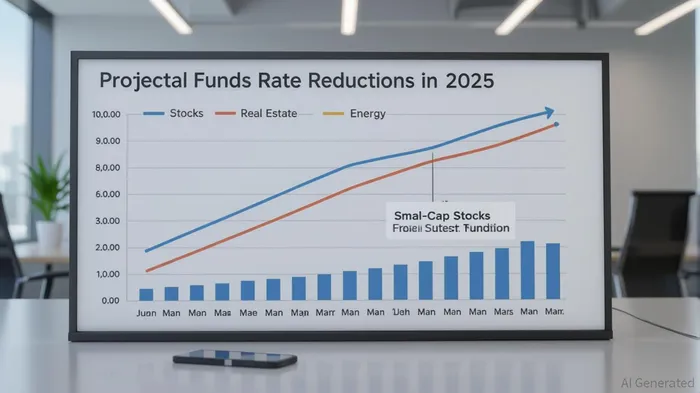
The Federal Reserve's decision to cut rates in September 2025 marked a pivotal shift in monetary policy, signaling a pivot from inflation containment to labor market stabilization. With two more rate cuts anticipated in October and December, investors now face a critical juncture: how to navigate the volatility of a transitioning policy environment while capitalizing on undervalued sectors poised to benefit from lower borrowing costs.
Undervalued Sectors: Opportunities in a Fed Easing Cycle
The September rate cut has already triggered a reevaluation of sector valuations, with several industries emerging as compelling long-term opportunities. Small-cap stocks, for instance, trade at a 15% discount to fair value, a historically attractive entry point during periods of monetary easing[1]. These companies, often reliant on external financing for growth, stand to gain from reduced interest rates, which lower debt servicing costs and enhance capital availability[1].
Value stocks, which have lagged growth counterparts for much of the year, are also undervalued, trading at a 3% discount to fair value[1]. Within this category, real estate and communications sectors are particularly compelling. Real estate investment trusts861104-- (REITs) are priced 7% below fair value, offering attractive dividend yields and potential earnings growth as borrowing costs decline[1]. Energy stocks, meanwhile, trade at a discount despite bearish oil price assumptions, with midcycle forecasts of $55/barrel suggesting upside potential as demand stabilizes[1].
Healthcare, the worst-performing sector year-to-date, presents a contrarian opportunity. While August saw a rebound, its relative weakness suggests it may outperform in a rate-cut environment, where discounted cash flow models favor sectors with long-term earnings visibility[1].
Strategic Asset Allocation: Balancing Volatility and Growth
The path forward requires a nuanced approach to asset allocation. As the Fed signals further easing, investors should consider extending bond durations to capture higher yields from longer-maturity instruments. Data from BlackRockBLK-- suggests that long-term duration bonds, equity income strategies, and alternative assets like gold or commodities can provide diversification amid shifting correlations between stocks and bonds[2].
For equities, a selective tilt toward quality growth and tech ETFs aligns with the Fed's rate-cut trajectory. Lower borrowing costs amplify the present value of future earnings, a dynamic that historically benefits technology and growth-oriented sectors[3]. However, investors should remain cautious: if inflation surprises to the upside or political pressures for tighter policy resurface, maintaining short-term bond exposure and increasing allocations to value, dividend, and financial-sector ETFs can preserve capital[3].
A key consideration is the Fed's dual mandate. While the September cut prioritized employment, inflation remains stubbornly above 2%, driven by services-sector price pressures[3]. This duality necessitates a hedged approach—balancing growth exposure with defensive positions in utilities and regional banks, which have historically outperformed post-rate cuts[2].
Conclusion: Navigating the Fed's New Normal
The October 2025 rate cut is not merely a technical adjustment but a signal of the Fed's evolving priorities. Investors who position portfolios to reflect this shift—by overweighting undervalued sectors and adopting a flexible, multi-asset strategy—stand to outperform in a landscape defined by both volatility and opportunity. As Jerome Powell emphasized in Jackson Hole, the Fed's decisions will remain data-dependent[1]. In this environment, agility and discipline will be the hallmarks of successful asset allocation.







Comentarios
Aún no hay comentarios