
Positioning for Immediate Action Amid Critical Liquidation Thresholds
Ethereum's current market dynamics are defined by a precarious balance between leveraged speculation and structural resilience. As the asset approaches critical price levels—$4,000 and $3,800—investors must navigate a landscape where liquidation triggers could amplify volatility and reshape positioning strategies. Recent data underscores the urgency for proactive risk management and tactical positioning.
Critical Liquidation Thresholds: A Double-Edged Sword
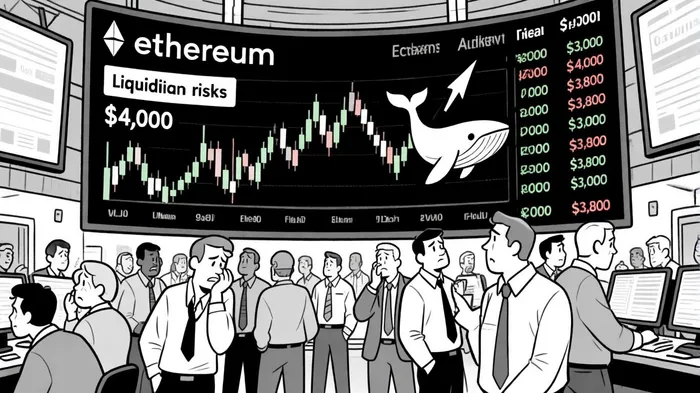
According to a report by Coinglass, EthereumETH-- faces significant liquidation risks at $4,000 and $3,800[1]. A drop below $4,254 could trigger $2.178 billion in long liquidations, while a decline to $3,800 exposes $7.87 billion in short positions to forced closures[2]. These thresholds are not arbitrary; they reflect the concentration of leveraged positions on centralized exchanges. For instance, a price breakdown below $4,000 could signal a structural shift, with cascading liquidations potentially dragging the price toward $3,200–$3,600[3].
The leverage imbalance is stark. At $4,200, $1.103 billion in long liquidations contrasts sharply with $680 million in short liquidations at $4,450[2], suggesting a bearish bias among traders. This asymmetry heightens the risk of rapid deleveraging if Ethereum breaches key support levels.
Structural Resilience vs. Short-Term Pressures
While liquidation risks dominate near-term volatility, Ethereum's fundamentals reveal a more nuanced picture. A joint report by Glassnode and CME Group highlights structural resilience, including robust staking participation (over 10% annualized yields) and growing institutional demand for regulated ETH derivatives[4]. However, the post-Dencun upgrade inflationary regime has raised questions about long-term value accrual, as issuance dynamics shift[4].
On-chain metrics further complicate the narrative. Ethereum's Total Value Locked (TVL) in DeFi protocols has surged to $84 billion—the highest since January 2022—indicating structural growth in composability and utility[5]. Yet, this optimism clashes with macro risks: whale withdrawals, ETF outflows ($216.7 million in the past week[6]), and regulatory uncertainties.
Positioning Strategies: Navigating the Volatility
For investors, the path forward requires balancing caution with opportunity. Here are three actionable insights:
Defensive Positioning Below $4,000: If Ethereum breaks below $4,000, the risk of a $5 billion liquidation event becomes acute[3]. Traders should consider stop-loss orders or hedging with short-term options to mitigate cascading losses.
Leveraging Institutional Inflows at $3,800: A rebound above $3,800 could trigger $979 million in short liquidations[7], creating a potential buying opportunity. Investors might allocate capital to Ethereum ETFs or staking products, capitalizing on institutional inflows like BlackRock's spot ETH ETF[8].
Monitoring Open Interest Dynamics: Ethereum's open interest remains at $8.4 billion on Binance[6], defying typical deleveraging patterns. A sustained increase in open interest above $132.6 billion[9] could signal renewed bullish sentiment, while a drop below $5 billion might indicate capitulation.
Conclusion: A Tipping Point for Ethereum
Ethereum's current juncture is a microcosm of broader crypto market dynamics—leveraged speculation, regulatory shifts, and structural innovation. While liquidation risks at $4,000 and $3,800 pose immediate threats, the asset's long-term trajectory hinges on its ability to absorb volatility and attract institutional capital. Investors who act decisively, leveraging both technical analysis and on-chain data, may position themselves to capitalize on the inevitable volatility ahead.






Comentarios
Aún no hay comentarios