
Portillo's Turnaround Potential: Strategic Reset and Unit Economics in Focus
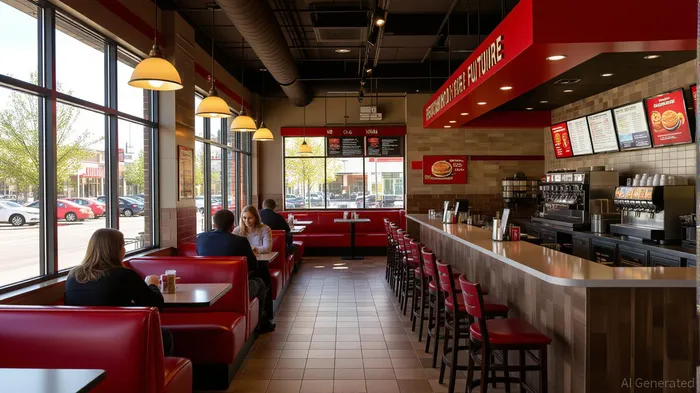
Portillo's, the Chicago-based fast-casual chain known for its Italian-inspired fare, has embarked on a strategic reset to address declining same-restaurant sales and operational inefficiencies. While 2024 delivered a 4.5% revenue increase to $710.6 million, driven by 10 new unit openings, the company faced a 0.6% decline in same-restaurant sales and a 3.2% drop in transactions [2]. This duality of growth and stagnation underscores the urgency of its turnaround efforts.
Strategic Reset: Cost Efficiency and Operational Streamlining
At the core of Portillo'sPTLO-- reset is the “Restaurant of the Future” (ROTF) concept, a 6,250-square-foot prototype designed to reduce build costs by 15–20% and labor expenses by 15% [1]. By shrinking the footprint from 7,700 to 5,500–6,000 square feet, the company aims to cut construction costs from $6.2 million to $5.2 million per unit [1]. The streamlined design includes a single production line, a grab-and-go counter, and self-serve beverage stations, which reduce staffing needs during peak hours from 34 to 27–32 employees [2]. These changes are critical for improving unit economics, particularly in a labor-cost-intensive industry.
However, progress on the ROTF rollout has been slower than anticipated. While 2025 was initially expected to see 12 new units, most featuring the ROTF model, the company revised its guidance to 8 openings and abandoned its Chicago breakfast pilot [4]. This shift reflects a pivot toward disciplined development and core-market optimization, with a focus on the Sunbelt region and a first-of-its-kind airport location planned for 2026 [3].
Unit Economics: Balancing AUVs and Cost Discipline
Portillo's has historically benefited from high average unit volumes (AUVs), but the 2024 same-restaurant sales decline signals weakening consumer demand. The ROTF concept aims to preserve AUVs while reducing fixed costs. For instance, the new design maintains high AUVs despite a 25% reduction in seating and a 20% cut in parking spaces [1]. This is a bold bet: shrinking real estate without sacrificing throughput requires flawless execution in drive-thru and off-premise dining.
Labor cost reductions are equally vital. With the restaurant industry grappling with rising wages, Portillo's 15% projected labor savings could provide a meaningful margin buffer. Commodity inflation, which stabilized at 4.2% in 2024 (down from 5.5% in 2023), further supports cost management [3]. However, the company's reliance on menu price increases—1.5% in January, another 1.5% in March, and 1% in June 2024—risks alienating price-sensitive customers [1].
Revised Guidance and Long-Term Viability
Portillo's 2025 guidance now anticipates same-restaurant sales declines of 2.0–2.5% and total revenue of $730–733 million, down from earlier optimism [3]. This adjustment highlights the challenges of balancing growth with profitability. Yet, the company's focus on positive free cash flow by 2026 and a 920-unit long-term target (up from 600 today) suggests confidence in its strategic reset [2].
The key question is whether the ROTF model can deliver on its promises. If the 8 planned 2025 openings achieve the projected cost savings and AUVs, the company could regain momentum. However, delays in implementation and the absence of ROTF units in 2025 raise concerns about execution risks.
Conclusion: A High-Stakes Turnaround
Portillo's strategic reset hinges on two pillars: operational efficiency via the ROTF model and disciplined capital allocation. While the company's 2024 net income surged 60% to $29.5 million and profit margins improved to 4.2%, these gains must be sustained amid softer consumer demand [4]. The success of the ROTF concept will determine whether Portillo's can maintain its premium AUVs while reducing costs—a critical factor for long-term profitability. Investors should monitor 2025's 8 new units and the 2026 airport location for early signals of the strategy's viability.





Comentarios
Aún no hay comentarios