
Port of Los Angeles Cargo Volume Downturn: Implications for Global Supply Chain Stocks
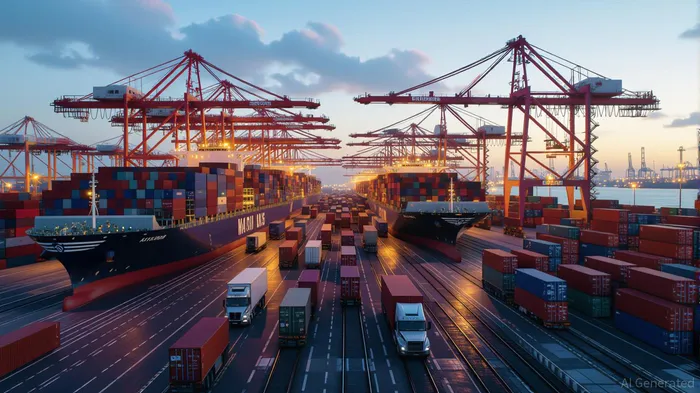
The Port of Los Angeles, a linchpin of U.S. import and export activity, has experienced a seismic shift in cargo dynamics in 2025. A combination of geopolitical tensions, trade policy upheavals, and economic headwinds has triggered a reevaluation of global supply chain strategies, with ripple effects across logistics sector stocks. For investors, understanding the vulnerabilities and rebalancing opportunities in this evolving landscape is critical.
Drivers of the Downturn
The primary catalyst for the Port of Los Angeles's cargo volume fluctuations is the U.S. tariff regime under President Donald Trump's administration. Sweeping measures, including a baseline 10% tariff on most imports and targeted duties on commodities like copper and vehicles, have disrupted traditional trade flows[1]. These policies have incentivized countries such as China to diversify their export destinations, redirecting cargo toward Europe and North America[1]. Meanwhile, the global economy's sluggish growth—projected at 2.3% in 2025—has compounded uncertainty, dampening long-term trade planning[1].
A notable short-term surge in July 2025, with the port handling 950,000 TEUs, underscores the frontloading of imports by shippers anticipating higher tariffs post-August 1[2]. However, this influx has strained middle-mile logistics networks, with inventory holding costs spiking and downstream bottlenecks looming[2].
Vulnerabilities in the Logistics Sector
The cargo volume shifts have exposed systemic vulnerabilities in global supply chain stocks. Companies reliant on trans-Pacific trade routes face margin pressures as clients restructure supply chains to avoid tariffs. For instance, the semiconductor industry has been rattled by U.S. policy pivots, such as relaxed export restrictions on AI-related chips to China—a temporary boost for U.S. firms but a long-term challenge as competitors in Taiwan and South Korea accelerate domestic manufacturing[4].
Moreover, the surge in cargo volumes has highlighted infrastructure bottlenecks. While BNSF's expedited rail service from Los Angeles to Houston has reduced transit times by 48 hours[2], such solutions are stopgap measures. The broader middle-mile logistics sector remains under strain, with inventory costs and labor shortages exacerbating operational risks[1].
Rebalancing Opportunities
Amid these challenges, rebalancing opportunities are emerging for agile logistics players. First, the adoption of generative AI in logistics management is gaining traction, enabling real-time visibility, route optimization, and predictive analytics[2]. Firms leveraging these tools can mitigate disruptions and enhance efficiency, positioning themselves as critical partners in fragmented markets.
Second, the push for supply chain resilience is creating demand for re-shoring and near-shoring solutions. Companies are prioritizing diversified supplier networks and regional hubs to reduce dependency on single points of failure[1]. For example, the Port of Los Angeles's role as a transshipment hub could evolve to accommodate shorter, more agile trade corridors if infrastructure investments align with these trends.
Third, the rail and intermodal logistics segments present untapped potential. BNSF's recent service enhancements demonstrate how infrastructure modernization can alleviate bottlenecks[2]. Investors may find value in firms investing in rail capacity, automation, and last-mile delivery innovations.
Conclusion
The Port of Los Angeles's cargo volume downturn is a microcosm of broader global supply chain fragility. While trade policy shifts and economic slowdowns pose risks, they also catalyze innovation and strategic realignment. For investors, the key lies in identifying firms that are not merely reacting to disruptions but proactively reshaping their value propositions through technology, diversification, and infrastructure resilience.







Comentarios
Aún no hay comentarios