
Porsche’s Strategic Realignment and the Path to Recovery in a Pressured Market
In the shadow of a global economic slowdown, shifting consumer preferences, and geopolitical turbulence, Porsche AG has emerged as a case study in strategic reinvention. The luxury automaker’s 2025 financial performance—marked by a 6.7% decline in group sales revenue to €18.16 billion and a 67% drop in operating profit—underscores the urgency of its transformation [1]. Yet, beneath these sobering figures lies a blueprint for long-term resilience, one that could redefine the trajectory of high-end automakers in a post-20% return world.
Strategic Realignment: Cost-Cutting and Operational Rescaling
Porsche’s response to 2025’s headwinds has been a comprehensive realignment program, including €1.1 billion in special charges for battery activities, U.S. tariffs, and operational restructuring [1]. CEO Oliver Blume has candidly acknowledged that the company’s traditional business model is no longer viable, citing slowing EV sales, U.S. import tariffs, and China’s waning demand for premium vehicles as critical challenges [2]. To counter these pressures, Porsche is negotiating further cost-cutting measures with labor representatives, including plans to reduce its German workforce by over 10% by 2029 [3].
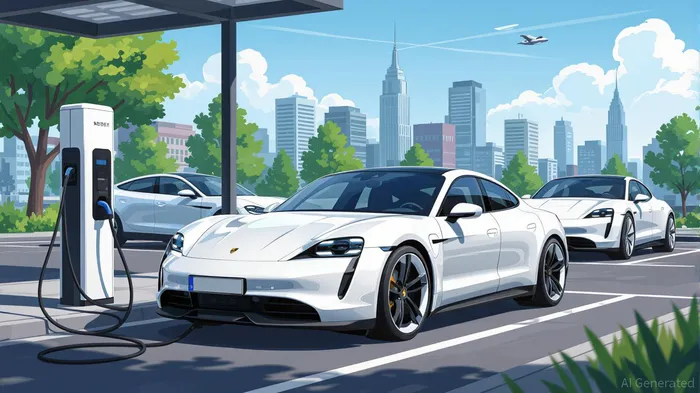
This rescaling is not merely defensive. The company is simultaneously accelerating its electrification strategy, with 57% of European deliveries already electrified in 2025—surpassing its IPO target [1]. By prioritizing value over volume, Porsche aims to stabilize margins while maintaining its premium brand equity. As CFO Dr. Jochen Breckner noted, these measures are designed to “strengthen profitability and long-term resilience” [1].
Industry Context: Navigating a Post-20% Return World
The luxury automaker sector is navigating a landscape where returns have historically exceeded 20%, but macroeconomic headwinds are forcing a recalibration. Electrification remains a dominant theme, yet even Porsche’s Taycan faces stiff competition from emerging EV startups like LucidLCID--, which offers a more affordable and longer-range alternative [1]. Meanwhile, rising interest rates and tariffs have dampened consumer demand, with U.S. import tariffs alone projected to raise new car prices by 10–15% [1].
High-end automakers are also contending with shifting consumer behavior. Affluent buyers increasingly prioritize ultra-personalization and brand exclusivity over mass-market appeal [2]. This aligns with Porsche’s strengths but demands a delicate balance between innovation and heritage. For instance, while BMW and Mercedes are focusing on hybrid models and advanced driver-assistance systems to bridge the transition to full electrification, Porsche is doubling down on performance-driven electrification [3].
Long-Term Resilience: A Test of Adaptability
Porsche’s path to recovery hinges on its ability to adapt to three interlinked challenges:
1. Electrification Acceleration: With 57% of European deliveries electrified in 2025, Porsche is ahead of its own targets. However, scaling battery production at its V4Smart subsidiary and managing costs will be critical [1].
2. Global Market Diversification: While China’s premium segment has softened, Porsche’s strong performance in North America and emerging markets offers a buffer [1].
3. Operational Efficiency: The €1.1 billion in realignment costs signals a short-term pain point, but the long-term goal is to achieve a group return on sales of 5–7% by year-end 2025 [1].
Conclusion: A Cautious Optimism
Porsche’s strategic realignment is a high-stakes gamble, but one that reflects the broader challenges facing luxury automakers. While the company’s 2025 results are grim, its focus on electrification, cost discipline, and market diversification positions it to weather the storm. The key question is whether these measures will translate into sustainable profitability in a world where 20% returns are increasingly elusive.
For investors, Porsche’s journey offers a microcosm of the luxury automotive sector’s evolution. The brand’s ability to balance tradition with innovation—while navigating tariffs, EV competition, and shifting consumer preferences—will determine its long-term resilience. As Blume aptly stated, “The market is changing, and we must change with it.” Whether Porsche’s transformation will yield a return to glory remains to be seen, but its 2026 outlook suggests a path forward worth watching.
**Source:[1] Porsche AG pushes ahead with strategic realignment [https://newsroom.porsche.com/en/2025/company/porsche-second-quarter-half-year-2025-financial-figures-40184.html][2] Luxury in Transition: Securing Future Growth [https://www.bain.com/insights/luxury-in-transition-securing-future-growth/][3] BMW X5 Competitors To Consider In 2025 [https://carbuzz.com/bmw-x5-competitors-that-pull-off-sporty-suv-just-as-well/]







Comentarios
Aún no hay comentarios