
Pony AI's Strategic Turnaround: Building a Sustainable Path to Profitability in the Autonomous Mobility Sector
The autonomous mobility sector remains one of the most capital-intensive and high-risk domains in modern technology. For companies like PonyPONY-- AI, navigating this landscape requires a delicate balance between aggressive innovation and disciplined financial stewardship. In Q3 2025, Pony AI Inc. (PONY) demonstrated a strategic pivot toward capital efficiency and revenue diversification, positioning itself as a case study in how unprofitable tech firms can lay the groundwork for long-term sustainability.
Capital Efficiency: Scaling Without the Capital Burn
Pony AI's asset-light model has emerged as a cornerstone of its financial strategy. By partnering with third-party fleet managers like Xihu Group and Sunlight Mobility, the company has expanded its robotaxi fleet without shouldering the full cost of vehicle procurement. This approach has enabled Pony AI to deploy over 2,000 Gen-7 robotaxis across key Chinese cities, achieving citywide unit economics breakeven in markets such as Guangzhou and Shenzhen.
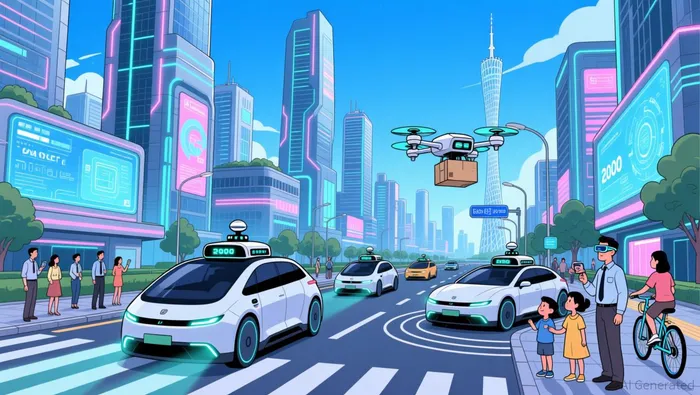
Cost reductions in hardware have further amplified this efficiency. The Gen-7 autonomous driving kit, central to Pony AI's operations, now carries a 70% lower bill-of-materials cost compared to its predecessor, with an additional 20% reduction projected for 2026 production. Such advancements are critical for scaling at a pace that aligns with the company's ambition to reach 3,000+ vehicles by late 2026.
Revenue Diversification: Beyond the Robotaxi Model
While robotaxi services remain Pony AI's flagship offering-contributing $6.7 million in Q3 2025 revenue (up 89.5% year-over-year)-the company is rapidly diversifying its income streams. Licensing and applications revenue surged by 354.6% year-over-year, driven by demand for autonomous domain controllers in industrial and logistics applications. This shift reflects a broader industry trend: autonomous driving firms monetizing their software expertise beyond mobility-as-a-service.
Fare-charging revenues from robotaxis also saw a 200% year-over-year increase, underscoring growing consumer acceptance of autonomous rides. Meanwhile, Pony AI's global expansion into markets like Qatar, Singapore, and South Korea is unlocking new revenue pools through partnerships with local transportation providers. These efforts are not merely geographic but strategic, as the company's unified AI platform, PonyWorld, allows rapid adaptation to diverse regulatory and infrastructural environments.
The Profitability Paradox: Balancing Investment and Returns
Despite these strides, Pony AI's Q3 2025 net loss of $61.6 million and a cash burn rate of $160 million highlight the inherent challenges of scaling a high-growth tech business. The company's heavy R&D spending-focused on advancing its Gen-7 platform and expanding its AI capabilities-signals a long-term play. However, investors must weigh these investments against near-term profitability.
The key lies in Pony AI's ability to leverage its capital-efficient model to accelerate breakeven timelines. By reducing hardware costs and expanding through partnerships, the company is mitigating the need for excessive capital outlays. For instance, the Gen-7's unit economics breakeven in tier-one Chinese cities demonstrates that scalability is achievable without proportional increases in cash burn.
Conclusion: A Blueprint for Sustainable Growth
Pony AI's strategic focus on capital efficiency and revenue diversification offers a compelling blueprint for navigating the autonomous mobility sector's challenges. While the path to profitability remains fraught with risks-such as regulatory hurdles and intense competition-the company's asset-light model, cost innovations, and diversified revenue streams provide a robust foundation. For investors, the critical question is whether Pony AI can maintain this balance as it scales globally. If the company continues to execute on its current trajectory, it may yet prove that profitability and innovation are not mutually exclusive in the autonomous age.





Comentarios
Aún no hay comentarios