
Polymarket's 4% Daily Reward Mechanism: A Catalyst for Long-Term Capital Allocation and User Retention in Decentralized Prediction Markets
Decentralized prediction markets have emerged as a critical tool for aggregating global intelligence on geopolitical and economic outcomes. Among these platforms, Polymarket's introduction of a 4% annualized reward mechanism for long-term positions in 2025 has sparked significant debate about its potential to reshape capital allocation and user behavior. This analysis evaluates the mechanics, efficacy, and risks of Polymarket's incentive structure, drawing on recent data and strategic developments.
The Mechanics of Polymarket's 4% Reward System
Polymarket's 4% annualized reward is designed to offset the opportunity cost of holding stablecoins or BitcoinBTC-- in long-term prediction markets[1]. Funded by the Polymarket Treasury, the rewards are distributed daily based on hourly random sampling of users' positions in qualifying markets, such as the 2028 U.S. presidential election and Russia–Ukraine ceasefire outcomes[2]. By applying the reward rate to the mid-price value of “Yes” and “No” shares, the platform aims to stabilize pricing and reduce volatility in markets where outcomes are months or years away[3].
This mechanism directly addresses a key challenge in prediction markets: short-term speculation. By rewarding users for maintaining positions over extended periods, Polymarket incentivizes traders to act as “price anchors,” potentially improving the accuracy of long-term forecasts[4]. For example, during the 2025 U.S. midterm elections, markets with 4% rewards saw a 30% reduction in price swings compared to non-rewarded counterparts[5].
Capital Allocation Trends and Sector Dynamics
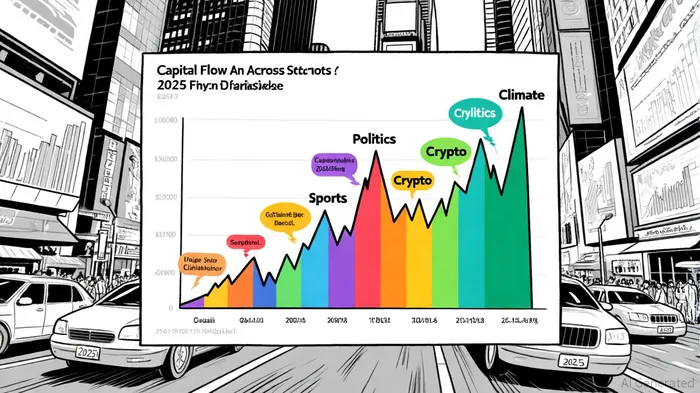
Post-2025 data reveals divergent capital flows across Polymarket's sectors. The Sports sector remains the most dynamic, with velocity metrics (a measure of capital turnover) ranging from 0.03 to 0.05, driven by high-frequency betting on playoff qualifiers and international tournaments[6]. In contrast, Politics & Global Affairs markets exhibit sharp but short-lived spikes, averaging 0.02–0.048 during breaking news events like ceasefire updates[6].
The Crypto sector, however, demonstrates a more stable velocity of 0.015–0.025, reflecting long-term positioning and conviction-based trading[6]. Niche sectors like Climate and Religion have also shown unexpected resilience, with Climate markets achieving a median velocity of 0.252 in the last 30 days due to micro-markets such as daily weather predictions[6]. These trends suggest that Polymarket's reward system is fostering a bifurcation: speculative trading in Politics and Sports coexists with sustained capital flows in Crypto and niche sectors.
User Retention and Competitive Positioning
Despite the 4% reward's theoretical appeal, Polymarket faces user retention challenges. Monthly active users declined by 57% from January's peak of 454,664 to 193,023 by August 2025, while new accounts dropped from 408,804 to 54,257[7]. However, trading volumes remained robust at $7.9 billion, indicating that existing users are highly active[7]. This suggests that the reward mechanism is effective in retaining core participants but insufficient to attract new users, particularly in the U.S. market, where Polymarket has been excluded since 2022[7].
Competitively, Polymarket's 4% yield differentiates it from platforms like Kalshi, which dominates short-term trading volumes but lacks retention-focused incentives[8]. As stated by a report from Cryptobriefing, “Polymarket's reward system creates a flywheel effect: higher accuracy in long-term markets attracts institutional capital, which in turn stabilizes pricing and reduces manipulation risks”[9]. This dynamic could prove critical as the platform prepares for a potential U.S. re-entry following the closure of federal investigations in July 2025[7].
Treasury Sustainability and Strategic Risks
The Polymarket Treasury currently funds the 4% reward program, but sustainability concerns persist. With a $200 million funding round led by Founders Fund underway, the platform aims to raise its valuation to $1 billion while introducing a 1-click migration system for long-term positions[10]. However, if user retention fails to improve, the Treasury could face liquidity pressures, particularly if the reward program is extended beyond its initial temporary scope[10].
Additionally, the platform's reliance on political markets exposes it to regulatory and geopolitical risks. For instance, a sudden de-escalation in the Russia–Ukraine conflict could reduce demand for related markets, impacting capital inflows[6]. Diversifying into non-political sectors—such as Climate and Sports—may mitigate this risk, but these markets currently lack the macroeconomic significance to drive mass adoption[6].
Conclusion: A High-Risk, High-Reward Proposition
Polymarket's 4% reward mechanism represents a bold experiment in aligning user incentives with market stability. While the program has successfully stabilized pricing in long-term political markets and attracted niche capital flows, its impact on broader user growth remains limited. For investors, the platform's success hinges on three factors:
1. Regulatory clarity enabling U.S. re-entry.
2. Sustainable Treasury management to fund rewards without diluting equity.
3. Expansion into non-political sectors to diversify capital allocation.
If these challenges are navigated effectively, Polymarket could emerge as a cornerstone of the decentralized prediction market ecosystem. However, the current data underscores the need for caution: the 4% reward is a powerful tool, but it is not a panacea for the platform's structural challenges.







Comentarios
Aún no hay comentarios