
Polygon's Token Ticker Dilemma: Can a Return to MATIC Spark a Retail and Institutional Resurgence?
Community Division: A Clash of Priorities
The rebranding has left Polygon's community deeply divided. Retail users and long-term holders of MATIC have consistently advocated for a return to the original ticker, citing its entrenched brand recognition and ease of identification in trading platforms. Sandeep Nailwal, Polygon's co-founder, initially defended the POL ticker, emphasizing the need for stability during a critical phase of technical upgrades. However, his recent openness to reconsidering the decision reflects the growing pressure from community feedback, which highlights the confusion caused by the ticker change among everyday users.
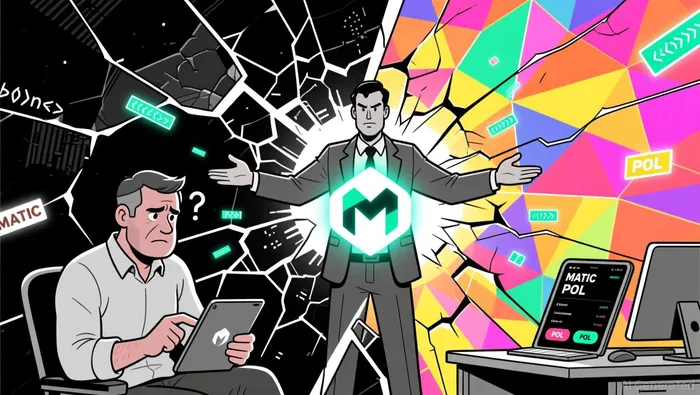
Institutional investors, meanwhile, remain cautious. While some acknowledge the potential benefits of a more recognizable brand, others view the POL ticker as a necessary evolution to support Polygon's AggLayer and multi-chain ambitions according to market analysis. This duality underscores a broader tension: the balance between preserving user trust and advancing technical innovation.
Price Performance: Volatility and Uncertainty
Polygon's price trajectory post-rebranding has been marked by volatility. Immediately after the migration, POL dropped 3% to $0.32, a reaction attributed to market uncertainty and broader crypto conditions. By late 2024, the token rebounded to $0.68, but as of June 2025, it has since retreated to $0.21 according to market reports. Analysts remain split on its future, with some forecasting a potential rise to $0.89 by year-end, driven by real-world applications like Banco Industrial's partnership and regulatory clarity in the EU.
The SEC's 2023 classification of POL as a security has further complicated the narrative, creating legal uncertainties that dampen institutional participation. Conversely, the EU's MiCAR framework offers a more favorable regulatory environment, which could stabilize investor sentiment if leveraged effectively.
Technical Migration Success: A Foundation for Growth
Despite the controversy, Polygon's technical migration has been largely successful. As of late 2025, 99% of MATIC has transitioned to POL, with the token now serving as the native gas and staking asset for Polygon PoS. The 1:1 migration ratio and a 2% emission allocation over a decade have reinforced network security and community development according to research reports. Additionally, the AggLayer Breakout Program and partnerships with entities like Nike and Starbucks Odyssey have expanded Polygon's utility beyond EthereumETH-- scaling according to industry analysis.
However, the migration's success has not translated into universal acceptance. The persistence of community demand for MATIC suggests that technical advancements alone may not be sufficient to drive adoption if they come at the cost of user experience.
The Case for Reverting to MATIC: Catalyst or Compromise?
The potential return to MATIC hinges on its ability to act as a bridge between Polygon's technical ambitions and user expectations. For retail investors, the ticker change has created friction, particularly among traders accustomed to MATIC's liquidity and recognition. Reverting could simplify onboarding and reduce confusion, potentially boosting transaction volumes and daily active addresses.
Institutional adoption, however, presents a more nuanced picture. While the POL ticker aligns with Polygon's vision for a multi-chain ecosystem, the brand recognition of MATIC could attract new institutional partners hesitant to engage with a less familiar token. The recent growth in RWA TVL ($1.13 billion) and TVL ($4.12 billion) post-2024 indicates that institutional confidence is already rising, but a return to MATIC might accelerate this trend by leveraging existing market familiarity.
Strategic Implications for Investors
For investors, the rebranding dilemma represents a critical inflection point. A return to MATIC could serve as a short-term catalyst for retail adoption, particularly if it aligns with broader market trends favoring user-friendly tokens. However, it risks undermining the technical narrative that has driven Polygon's expansion into RWAs and AggLayer.
Conversely, maintaining POL as the ticker reinforces Polygon's position as a forward-looking infrastructure provider but may struggle to retain users who prioritize simplicity over innovation. The key for investors lies in monitoring how Polygon navigates this tension-whether through a hybrid approach (e.g., dual ticker support) or a decisive pivot to one side of the debate.
Conclusion
Polygon's token ticker rebranding has exposed a fundamental challenge in blockchain projects: the need to balance technical progress with user-centric design. While the migration to POL has laid a robust technical foundation, the persistent demand for MATIC highlights the importance of brand recognition in driving adoption. For investors, the decision to revert could either reignite retail momentum or signal a compromise that dilutes Polygon's long-term vision. As the debate unfolds, the market's response will likely hinge on how effectively Polygon can harmonize these competing priorities.






Comentarios
Aún no hay comentarios