
Polygon's Rio Upgrade and Scalability in Blockchain Payments: A New Era for Global Finance
Polygon's Rio Upgrade and Scalability in Blockchain Payments: A New Era for Global Finance
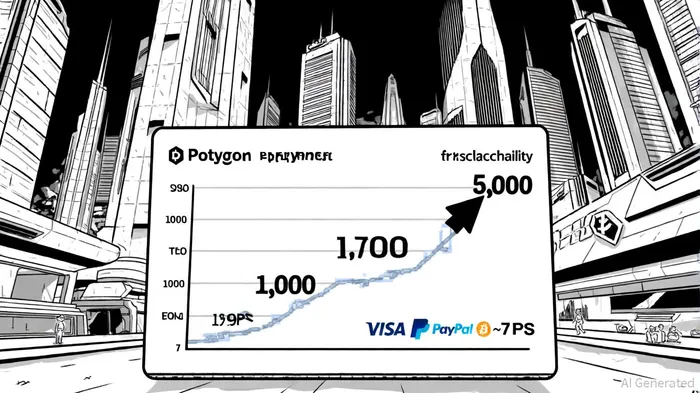
Polygon's Rio Upgrade, launched on October 8, 2025, represents a seismic shift in blockchain scalability and efficiency, positioning the network as a formidable contender in global paymentsGPN--. By achieving 5,000 transactions per second (TPS)-a 33% increase from its previous 45 million block gas limit-Polygon has redefined its role as a Layer-2 solution for high-frequency, low-cost transactions, according to a FinancialContent report. This upgrade, part of its GigaGas roadmap, introduces three architectural breakthroughs: the Validator-Elected Block Producer (VEBloP) model, stateless block verification, and optimized gas limits. Together, these innovations reduce reorg risks, lower hardware costs for node operators, and enable near-instant finality, making Polygon a viable infrastructure for real-world use cases like cross-border remittances, stablecoin settlements, and micropayments, as explained in the Polygon blog.
The TPS Arms Race: Polygon vs. Traditional Payment Systems
To assess Polygon's disruptive potential, consider its 5,000 TPS benchmark against legacy systems. Visa processes 1,700 TPS, according to Coincodex, while PayPal handles 193 TPS, per CoinLaw. Even stablecoins, which have surged in volume, lag behind Polygon's capacity-though they process 20x more annual transactions than PayPal, per Decripto. Polygon's throughput not only outpaces these systems but also aligns with the growing demand for micro-payments and real-time settlements in Web3 and fintech. For instance, the network now supports $0.0046 average gas fees, according to OAK Research, a critical factor for mass adoption in sectors like gaming, streaming, and IoT billing.
Real-World Adoption: From Nike to Stablecoins
Polygon's ecosystem has already demonstrated tangible use cases. Nike's .SWOOSH platform and Starbucks Odyssey leverage Polygon's low fees and scalability for NFT-based loyalty programs, according to AllInCrypto. Meanwhile, Reddit's 18 million NFT avatars highlight the network's ability to handle high-volume, consumer-facing transactions, as noted by BTCC. Post-Rio Upgrade, Polygon's transaction volume spiked to 22.5 million weekly transactions in Q2 2025, per SmartLiquidity, with $3.7 billion in peer-to-peer stablecoin transfers in April 2025 alone, according to EthNews. These metrics underscore its role as a backbone for stablecoin-driven payments, particularly with 2.3 million USDC wallets now active on the chain, per CryptoTimes.
Institutional Buy-In and Future Roadmap
Polygon's appeal extends beyond consumer applications. Institutional partnerships with Stripe, BlackRock, and Apollo signal confidence in its infrastructure for cross-border payroll and tokenized asset settlements, according to CryptoNewsZ. The VEBloP model further enhances this by distributing validator rewards equitably, ensuring decentralization while attracting institutional node operators, as covered by AlexaBlockchain. Looking ahead, Polygon's GigaGas roadmap aims to scale to 100,000 TPS by 2026 through phased upgrades like AggLayer interoperability and cross-chain liquidity protocols, per EtherWorld. This trajectory positions Polygon to compete with centralized payment processors while retaining blockchain's trustless advantages.
Investment Considerations: Risks and Opportunities
While Polygon's technical advancements are compelling, investors must weigh risks. Competition from other Layer-2 solutions (e.g., ArbitrumARB--, Optimism) and regulatory scrutiny of stablecoins could slow adoption. However, Polygon's $1.06 billion TVL in Q2 2025 (see CoinLaw) and strategic focus on real-world assets (RWAs)-with $270 million in tokenized value on-chain (see SmartLiquidity)-suggest a diversified growth strategy. The Rio Upgrade's stateless validation also lowers entry barriers for startups, fostering ecosystem innovation.
Conclusion: A Payments Infrastructure for the Next Billion Users
Polygon's Rio Upgrade is more than a technical milestone-it's a blueprint for blockchain's role in global finance. By combining 5,000 TPS, sub-second finality, and institutional-grade security, Polygon addresses the scalability trilemma that has long hindered mass adoption. As stablecoins and RWAs gain traction, the network's focus on low-cost, high-throughput transactions could redefine how value moves across borders. For investors, this represents a high-conviction opportunity in a sector poised for exponential growth.







Comentarios
Aún no hay comentarios