
Will Polygon (POL) Reach $1 by 2030? Assessing Ecosystem Dominance and Token Utility in the Layer 2 Market
Polygon (POL) has emerged as a pivotal player in the EthereumETH-- Layer 2 (L2) scaling landscape, rebranding from MATIC to POLPOL-- in 2025 to reflect its evolution into a multi-chain ecosystem. The question of whether POL can reach $1 by 2030 hinges on its ability to solidify ecosystem dominance, enhance token utility, and navigate competitive pressures in the rapidly evolving L2 market. This analysis evaluates these factors through the lens of recent developments, tokenomics, and expert projections.
Ecosystem Dominance: AggLayer, CDK, and Strategic Partnerships
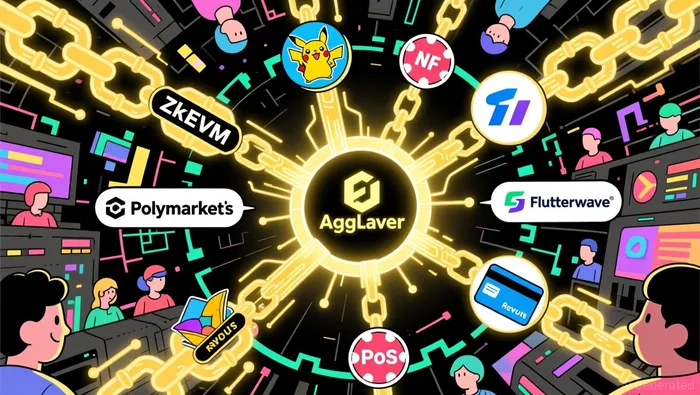
Polygon's transition to Polygon 2.0 has repositioned it as a "value layer" of the internet, with the Aggregation Layer (AggLayer) and Chain Development Kit (CDK) serving as cornerstones of its growth. The AggLayer, now fully operational, unifies liquidity and security across Polygon's zkEVM, Supernets, and PoS chains, enabling cross-chain interoperability and reducing friction for developers and users. This architectural shift has attracted major players like Polymarket, which generated $1.16 billion in monthly trading volume in June 2025, and Courtyard's Pokémon NFTs, which drove $56.5 million in sales.
Strategic partnerships have further cemented Polygon's dominance. Revolut integrated Polygon for stablecoin transfers and staking, processing $690 million in volume, while Flutterwave leveraged the network for cross-border payments in Africa. Institutional adoption, including Calastone's tokenized fund distribution solution and Mastercard's human-readable wallet aliases, underscores Polygon's appeal to enterprises seeking scalable infrastructure. By Q3 2025, Polygon's stablecoin supply had grown to $3 billion, capturing 52% of omnichain USDT0-far outpacing competitors like ArbitrumARB-- (9.4%). These metrics highlight Polygon's role as a foundational infrastructure layer for global finance.
Token Utility: Staking, Governance, and GasGAS-- Demand
POL's utility has expanded beyond a single-chain token to a hyperproductive asset securing multiple chains via unified staking mechanisms. With 3.6 billion POL tokens staked and a 1.5% combined reward rate, the token's scarcity is being elevated as demand for staking and governance participation grows. The migration from MATIC to POL also introduced a deflationary mechanism: daily burns of 1 million POL tokens through transaction fees, with projections of 3.5% supply burned by 2026 if trends continue.
Governance and gas utility further anchor POL's value. Holders now influence protocol upgrades and security models, while gas fees remain near-zero due to Polygon's 5,000 TPS throughput post-Rio upgrade. This low-cost, high-throughput environment has driven daily transactions to 5 million and active addresses to 1.4 billion in 2025. Analysts argue that as more applications and assets flow into Polygon's ecosystem, POL's demand will outpace inflation, creating upward pressure on its price.
Market Dynamics: Competition and Macro Risks
Polygon faces stiff competition from L2 rivals like Arbitrum and zkSyncZK--, but its modular architecture and AggLayer differentiate it by enabling cross-chain liquidity and shared security. For instance, the AggLayer CDK has been adopted by OKX to integrate USDT0 across multiple networks, showcasing its interoperability advantages. However, challenges remain, including regulatory uncertainties and macroeconomic headwinds. A 2026 bearish trend, with POL trading below $0.10, highlights the volatility inherent in the crypto market.
Despite these risks, Polygon's ecosystem growth metrics-such as a 31.5% TVL increase for Spiko and 68.2% surge in NFT trading activity-suggest sustained demand. If the AggLayer achieves its gigagas roadmap goal of 100,000 TPS, Polygon could dominate global financial transactions, further solidifying its market position.
Price Projections: The Path to $1
Expert forecasts for POL's price by 2030 vary widely. Conservative models predict $0.1988 (79.43% growth from 2028 levels), while bullish scenarios project $9.08, driven by mass adoption of the AggLayer and reduced inflation. A $1 target appears plausible under the following conditions:
1. AggLayer Adoption: Widespread use of the AggLayer could generate $100 million+ in annual fee revenue, increasing demand for POL.
2. Tokenomics Reforms: Proposals to eliminate the 2% inflation rate and introduce treasury buybacks could stabilize the token price.
3. Macro Conditions: A Fed rate cut and global risk-on sentiment could boost crypto markets, with Polygon's ecosystem growth amplifying returns.
However, short-term volatility-such as the 2027 dip to $0.0861-reminds investors that execution risks and competition could delay the $1 milestone.
Conclusion: A Calculated Bet on Polygon's Vision
Polygon's ecosystem dominance, token utility, and strategic partnerships position it as a strong contender in the L2 market. While $1 by 2030 is not guaranteed, the alignment of its AggLayer roadmap, deflationary mechanics, and institutional adoption creates a compelling case for long-term value appreciation. Investors should monitor key metrics like AggLayer usage, CDK-based chain development, and tokenomics reforms to gauge progress toward this target.






Comentarios
Aún no hay comentarios