
Polygon (POL)'s 51% Price Surge: A Deep Dive into Network Utility, Token Economics, and Real-World Adoption as Catalysts for Sustainable Bullish Momentum
Polygon (POL) has experienced a staggering 51% price surge in Q4 2025, driven by a confluence of strategic upgrades, deflationary tokenomics, and explosive real-world adoption. This analysis dissects the three pillars fueling this momentum: network utility, token economics, and real-world adoption, all of which position POLPOL-- as a compelling long-term investment.
1. Network Utility: Scaling to Global Infrastructure
Polygon's transition from MATIC to POL as the native token has unlocked a new era of utility. By September 2025, over 99% of MATIC had migrated to POL, enabling it to power gas, staking, and governance across the Polygon PoS chain and Layer 2s built via the Chain Development Kit. This migration was not just symbolic-it laid the groundwork for Polygon's role as a global payments infrastructure.
Key upgrades like the Bhilai hardfork and Rio have pushed transaction throughput to 5,000 TPS and reduced finality times, making Polygon competitive with traditional financial systems . The Madhugiri hardfork, activated in December 2025, further boosted TPS by 33% to 1,400 and integrated Ethereum's Fusaka security improvements. These upgrades have attracted major players: Revolut, Flutterwave, Stripe, and Avenia Pay now rely on Polygon for real-time crypto transfers and instant settlements. Notably, Avenia Pay alone processed $1 billion in payments on Polygon during Q4 2025 .
Polygon's AggLayer, launched in February 2025, is another game-changer. By leveraging zero-knowledge (ZK) proofs, it enables secure cross-chain communication and asset transfers, positioning Polygon as a hub for omnichain activity. This interoperability has driven stablecoin growth, with Polygon capturing 52% of the omnichain USDT0 supply and expanding its stablecoin volume to $3 billion by Q3 2025.
2. Token Economics: Deflationary Pressure and Institutional Confidence
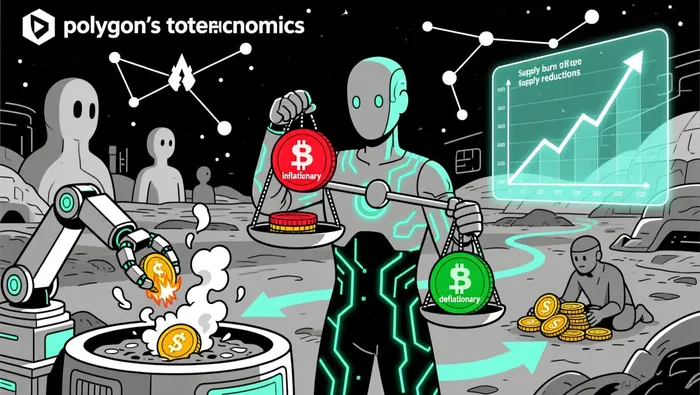
Polygon's tokenomics have shifted from inflationary to deflationary, creating a powerful tailwind for POL's price. The network now burns 1 million POL tokens daily through transaction fees, projecting a 3.5% annual supply reduction if sustained. This burn rate exceeds staking rewards (1.5% yield on 3.6 billion staked tokens) by more than double, creating a net supply contraction.
A proposed tokenomics revision aims to eliminate the 2% annual inflation and introduce treasury buybacks or burns, aligning supply dynamics with Polygon's strategic goals. These changes signal a commitment to scarcity, a critical factor in asset valuation.
Institutional confidence is also surging. Santander's Openbank now offers POL trading to German clients, while Cypher Capital provides Middle Eastern institutions direct exposure to the token. These partnerships validate Polygon's role in mainstream finance and could drive further demand.
3. Real-World Adoption: From Payments to Prediction Markets
Polygon's real-world adoption has exploded in 2025, with the network processing 1.4 billion transactions and stabilizing at 5–7 million daily transactions . This growth is driven by both consumer and institutional use cases:
- Polymarket, a prediction market platform on Polygon, processed $3 billion in bets on the U.S. election in Q4 2024, demonstrating the network's utility in decentralized finance (DeFi).
- Emerging-market stablecoins on Polygon reached $11 billion in volume, highlighting its role in bridging traditional and digital finance .
- The Open Money Stack, a stablecoin payment framework, aims to facilitate instant, interoperable money movement across DeFi, further expanding Polygon's footprint.
These developments are not just metrics-they represent a shift in how the world moves money. As Polygon's infrastructure becomes the backbone for global payments, its value proposition grows exponentially.
Conclusion: A Sustainable Bull Case
Polygon's 51% price surge is not a flash in the pan but a reflection of structural upgrades, deflationary tokenomics, and real-world adoption. The migration to POL, combined with protocol upgrades like AggLayer and Madhugiri, has transformed the network into a scalable, interoperable infrastructure. Meanwhile, daily burns and staking lockups create scarcity, while partnerships with fintech giants and institutional players validate its utility.
For investors, the key takeaway is clear: Polygon is no longer just a Layer 2 for EthereumETH--. It is a global payments network, a stablecoin hub, and a cross-chain interoperability layer. As these use cases mature, POL's price is likely to follow a bullish trajectory-provided the ecosystem continues to execute on its ambitious roadmap.






Comentarios
Aún no hay comentarios