
Poly Developments and Holdings' Upcoming Bond Issuance: Strategic Capital Allocation and Risk Assessment in a Post-Liquidity-Tightening Environment
Poly Developments and Holdings Group, one of China's largest real estate developers, is navigating a challenging post-liquidity-tightening environment with a series of strategic bond issuances. As the sector grapples with slowing sales and tightening credit conditions, the company's recent capital-raising efforts—most notably a 9.5 billion yuan convertible bond offering in August 2024 and a planned 5-year bond issuance in July 2025—highlight its attempts to stabilize its balance sheet while funding growth initiatives. However, these moves must be weighed against a deteriorating credit outlook and broader industry headwinds.
Strategic Capital Allocation: Funding Projects and Liquidity Needs
Poly's convertible bond issuance in August 2024, which raised 9.5 billion yuan, is explicitly earmarked for 15 real estate projects in key cities such as Beijing, Shanghai, and Foshan, including developments like the Shanghai Poly Haiyue and Beijing Poly Yijing Huxu complexes [1]. The proceeds will also supplement working capital, a critical need as the company reported a net cash position of -209.34 billion yuan as of 2025 [2]. Convertible bonds offer Poly a dual advantage: they provide immediate liquidity while deferring equity dilution until conversion, which could occur if the company's stock price recovers.
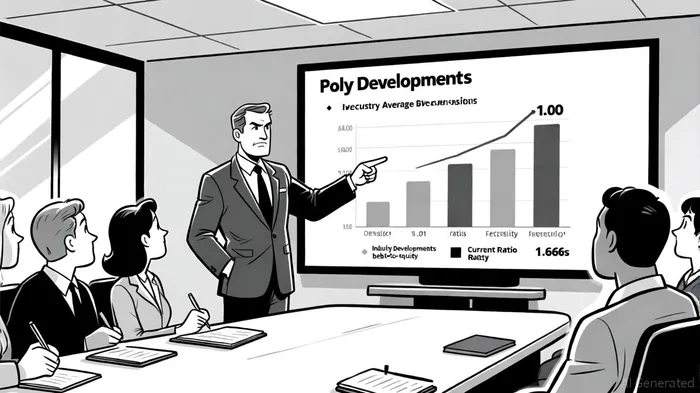
The July 2025 bond issuance, with a 2.35% annual coupon and a maturity of July 12, 2025, appears to target short-term refinancing needs [3]. Such low-yield debt suggests investor confidence in Poly's state-owned affiliations, particularly its parent company, China Poly Group Corporation, which historically provided a one-notch credit uplift [4]. However, Fitch Ratings revised its outlook on Poly to “negative” in May 2024, citing reduced parent company support and a debt-to-equity ratio of 1.01, which, while manageable, signals heightened leverage compared to pre-2020 levels [5].
Risk Assessment: Credit Pressures and Market Realities
Despite Poly's strategic use of convertible debt, its financial health remains precarious. A trailing Altman Z-Score of 0.91 indicates a significant risk of financial distress [2], while analysts now forecast a 5.3% revenue decline for 2025, far steeper than the industry's projected 2.6% contraction [6]. This pessimism is rooted in Poly's third-quarter 2024 results, which revealed a sharp drop in revenue and net income, attributed to reduced property deliveries and shrinking gross margins [7].
The company's liquidity position is further strained by interest-bearing liabilities of 358.7 billion yuan as of September 2024, against a cash balance of 127.4 billion yuan—9.3% of total assets [7]. While Poly has taken steps to mitigate risks, such as slowing land acquisitions and restructuring regional operations, these measures may not offset the broader sectoral downturn. Moody's has also flagged systemic risks for Chinese developers, noting “slowing sales growth and tight funding conditions” as persistent threats [5].
Risk Mitigation: Balancing Growth and Prudence
Poly's capital allocation strategy reflects a delicate balancing act. The convertible bond proceeds will not only fund high-potential projects but also reduce its asset-liability ratio if bondholders convert their debt into equity [1]. This aligns with the company's stated goal of optimizing its capital structure amid liquidity constraints. Additionally, Poly has restructured its debt through a 10 billion yuan bond issuance in 2024, using the funds for debt refinancing and acquisitions [8].
However, the effectiveness of these measures hinges on execution. For instance, the company's decision to merge regional subsidiaries aims to cut costs and improve efficiency, but integration risks could delay benefits. Similarly, while the 9.5 billion yuan convertible bond provides temporary relief, it does not address the root causes of Poly's liquidity challenges, such as weak demand for residential properties and regulatory curbs on speculative investment.
Conclusion: A Calculated Gamble in a Turbulent Sector
Poly's bond issuances underscore its commitment to maintaining operational continuity in a sector under siege. The strategic allocation of proceeds to high-value projects and working capital needs is prudent, and the convertible structure offers flexibility. Yet, the company's credit downgrade, declining revenue forecasts, and fragile liquidity position suggest that these efforts may not be sufficient to insulate it from broader market forces.
Investors must weigh Poly's short-term liquidity solutions against its long-term structural vulnerabilities. While the company's state-owned ties and scale provide a buffer, the real estate sector's prolonged slump and regulatory scrutiny cast a long shadow. For Poly, the path forward will require not just disciplined capital allocation but also a fundamental shift in business model to adapt to a post-liquidity-tightening era.







Comentarios
Aún no hay comentarios