
Poly Developments' 63% H1 Net Profit Drop: Strategic Pivot or Value Trap?
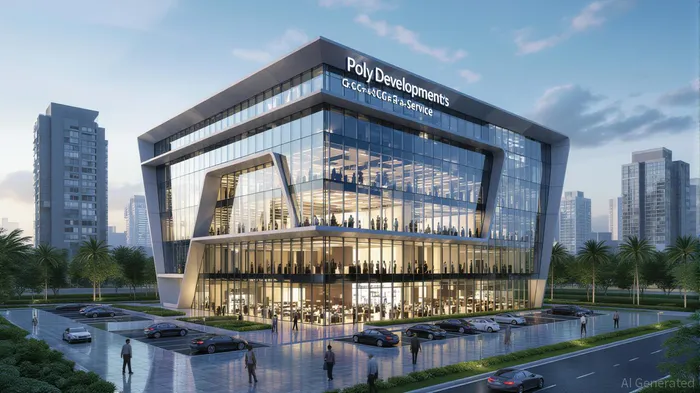
The collapse of China's real estate sector has left few untouched. For Poly Developments (600048.SS), a once-dominant player in commercial and residential property, the 63% year-over-year drop in first-half 2025 net profit is a stark reminder of the industry's fragility. Yet, the company's aggressive pivot to a GCC-as-a-Service (GCCaaS) model—bundling real estate with global corporate connectivity, compliance, and talent solutions—has sparked debate: Is this a calculated long-term strategy to future-proof the business, or a desperate attempt to mask structural decline?
The GCCaaS Model: A Strategic Reimagining
Poly's GCCaaS model is a radical departure from its traditional real estate-centric approach. By acquiring four CN¥12.8 billion real estate projects in 2025, the company is anchoring its services in physical assets while layering technology-driven offerings such as AI analytics, ESG compliance, and M&A support for global corporations. The goal is to capture 15% of revenue from this segment by 2026, a figure that, if achieved, could stabilize cash flows and diversify margins.
This pivot aligns with global trends. As companies increasingly rely on Global Capability Centers (GCCs) to access talent and reduce operational costs, Poly's bundled solutions—offering 30% cost savings compared to traditional offshore models—position it to tap into a $200 billion corporate real estate market in India. Cities like Bengaluru and Hyderabad, with their tech ecosystems, are prime targets. Collaborations with Indian developers like Embassy Group and Bhartiya Urban further underscore the model's scalability.
Financial Metrics: A Tale of Two Sides
Poly's balance sheet tells a mixed story. While the company maintains a CN¥148.59 billion liquidity buffer and a 6.9x interest coverage ratio, its 105.6% debt-to-equity ratio and CN¥985.43 billion in total liabilities remain red flags. The Q2 2025 net profit margin of 1.5%—a 51.5% drop from the prior year—highlights the strain of transitioning to a capital-intensive, unproven model.
The company's RMB10 billion bond issuance in 2025 underscores its reliance on debt to fund this pivot. While this provides short-term liquidity, it raises questions about long-term sustainability. For context, Poly's 8.5x P/E ratio and 3.2% dividend yield suggest undervaluation, but its declining revenue and profit margins (down 63% in H1 2025) indicate structural risks.
Market Sentiment and Policy Tailwinds
Poly's strategy is not without tailwinds. China's RMB4 trillion loan program for stalled projects and RMB300 billion housing purchase initiative aim to stabilize urban renewal and luxury residential demand, sectors where Poly has a presence. Meanwhile, India's GCC-as-a-Service market is gaining traction, with developers offering modular, cost-effective solutions for global firms.
However, execution risks loom large. The GCCaaS model requires long-term client retention and efficient scaling across geographies. Poly's ability to monetize its AI and compliance services at scale remains unproven. Regulatory shifts in both China and India—such as sudden policy changes or increased compliance costs—could further complicate operations.
Strategic Pivot or Value Trap?
The answer hinges on Poly's ability to execute. If the GCCaaS model can generate consistent revenue and improve profit margins, it could transform the company into a diversified global services provider. The 15% revenue target by 2026 is ambitious but achievable if client adoption accelerates.
Conversely, if the model fails to scale or if debt burdens become insurmountable, Poly risks becoming a value trap. The company's declining dividends and annual revenue drop in 2024 already signal investor skepticism.
Investment Thesis: Cautious Optimism
For long-term investors, Poly presents a high-risk, high-reward opportunity. The GCCaaS model is innovative and aligns with global trends in distributed work and digital transformation. However, the company's financial metrics—particularly its debt load and margin compression—demand close monitoring.
Key watchpoints for Q3 2025 and beyond:
1. GCCaaS revenue contribution: Has the model begun to materialize as a meaningful revenue stream?
2. Debt management: Can Poly reduce its debt-to-equity ratio without sacrificing growth?
3. Client retention: Are multinational corporations committing to long-term partnerships?
If Poly can demonstrate progress on these fronts, the stock's 8.5x P/E and 3.2% yield may justify a cautious long-term position. For now, however, the 63% H1 net profit drop serves as a stark warning: this is a high-stakes bet on a volatile industry.
In conclusion, Poly's GCCaaS pivot is a bold attempt to redefine its role in a post-real estate world. Whether it succeeds will depend not on the ambition of its vision, but on the execution of its execution.







Comentarios
Aún no hay comentarios