
Polkadot's Stagnation and Phala's Strategic Shift to Ethereum L2: A Fork in the Blockchain Investment Road
In the ever-evolving blockchain landscape, the tension between multi-chain strategies and ecosystem-specific loyalty has become a defining debate for decentralized finance (DeFi). Two recent developments-Polkadot's (DOT) struggles to maintain momentum and Phala Network's migration to EthereumETH-- Layer 2 (L2)-highlight this divergence. These cases offer a lens to evaluate which approach better aligns with the long-term viability of DeFi projects in 2025 and beyond.
Polkadot's Stagnation: The Cost of Ecosystem Loyalty
Polkadot, once heralded as a cross-chain interoperability pioneer, has faced headwinds despite significant technical upgrades. Elastic Scaling and the JAM protocol have enhanced its scalability, enabling 143,000 transactions per second during stress tests, according to a Coinpaper report. Yet, DOT's price has fluctuated between $3.30 and $5 since March 2025, with a 27% quarterly drop in market capitalization to $6.3 billion in Q3 2024, as noted in a Q3 report. Analysts attribute this stagnation to declining transaction activity, whale sell-offs, and competition from Ethereum's Layer 2 solutions and SolanaSOL--, according to Coinbuzz.
Polkadot's ecosystem-specific loyalty-rooted in its parachain model-has also proven a double-edged sword. While the network supports over 50 parachains, including high-growth projects like PEAQ and MoonbeamGLMR--, its constrained infrastructure and high inflation rate have deterred institutional adoption, per CoinLaw data. Critics argue that Polkadot's focus on self-contained innovation has left it vulnerable to broader market shifts, such as the rise of Ethereum's L2s and the prioritization of enterprise-grade scalability, as covered in a Cryptopolitan article.
Phala's Exodus to Ethereum L2: A Multi-Chain Bet
Phala Network, a PolkadotDOT-- parachain focused on confidential computing, has chosen a different path. In a community vote, Phala decided to fully migrate to Ethereum L2 by November 20, 2025, as detailed in the Phala proposal. This move is driven by the need to align with Intel's TDX and GPU-based computing roadmaps, reduce operational overhead, and tap into Ethereum's liquidity and tooling, according to an OKX guide. By consolidating staking, governance, and confidential compute on Ethereum L2, Phala aims to streamline operations and expand its role in AI-driven DeFi applications, as discussed in a CoinCentral article.
Phala's migration underscores a growing trend: projects prioritizing liquidity aggregation and interoperability over ecosystem-specific loyalty. Unlike Polkadot's parachain model, which requires significant resource allocation, Ethereum L2 offers a plug-and-play infrastructure with access to a mature developer ecosystem. Phala's 1:1 ERC-20 token conversion ensures continuity for stakeholders while positioning the project to capitalize on Ethereum's evolving L2 landscape, according to a Phemex report.
Multi-Chain vs. Ecosystem Loyalty: A DeFi Case Study
The contrast between Polkadot and Phala mirrors a broader industry shift. Multi-chain DeFi platforms like 1inch1INCH-- Network and SushiSwapSUSHI--, which operate across 50+ and 40+ chains respectively, have demonstrated resilience through diversified liquidity and reduced slippage, as summarized in The Block report. In Q4 2024, decentralized exchanges (DEXs) processed $1.76 trillion in trading volume, with Solana and Base emerging as key players, according to KuCoin research. Meanwhile, cross-chain solutions like LayerZeroZRO-- and WormholeW-- have become foundational infrastructure, enabling secure asset transfers and unified smart contracts, per a Brave New Coin analysis.
Ecosystem-specific loyalty, however, remains viable for projects with niche use cases. AaveAAVE--, for instance, maintains distinct governance and tokenomics across Ethereum, AvalancheAVAX--, and other chains, leveraging chain-specific advantages (see The Block report). Yet, even Aave's success relies on interoperability-its cross-chain capabilities allow users to access liquidity pools optimized for different environments.
The Long-Term Viability of Each Approach
For investors, the choice between multi-chain and ecosystem-specific strategies hinges on risk tolerance and market dynamics. Polkadot's struggles highlight the risks of over-reliance on a single ecosystem: while its parachain model fosters innovation, it also creates bottlenecks in scalability and adoption. Phala's migration to Ethereum L2, by contrast, reflects a pragmatic embrace of multi-chain realities, prioritizing liquidity and operational efficiency, as noted in Coinotag coverage.
Data from 2025 supports this trend. Total Value Locked (TVL) in multi-chain DeFi platforms grew 300% year-over-year, outpacing ecosystem-specific projects by a 2:1 margin, according to a Forcefield post. This growth is driven by universal liquidity pools and hybrid trading models that aggregate assets across chains, as described in a Stablecoin Insider article. However, multi-chain strategies are not without challenges: security risks from cross-chain bridges and regulatory uncertainties remain critical hurdles (Stablecoin Insider).
Conclusion: Navigating the Fork in the Road
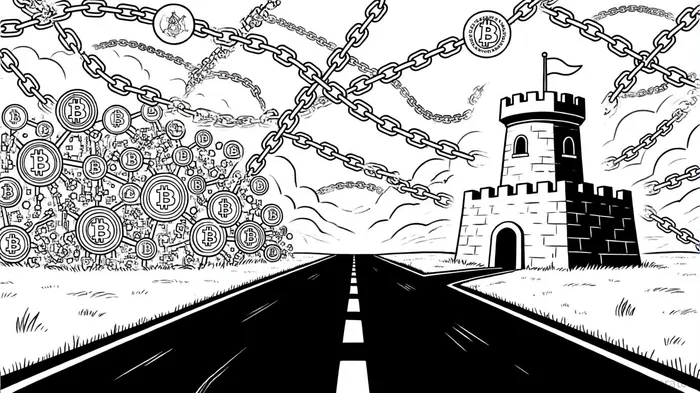
The blockchain investment landscape in 2025 is defined by a fork: one path prioritizes ecosystem-specific innovation, while the other embraces multi-chain liquidity and interoperability. Polkadot's stagnation and Phala's migration illustrate the trade-offs of each approach. For projects like Polkadot, the key to long-term viability lies in addressing scalability bottlenecks and aligning with broader market trends. For Phala and others adopting multi-chain strategies, success depends on leveraging Ethereum's infrastructure while mitigating cross-chain risks.
As DeFi evolves, investors must weigh these dynamics carefully. The future likely belongs to projects that balance specialization with interoperability-those that can innovate within an ecosystem while remaining adaptable to a multi-chain world.






Comentarios
Aún no hay comentarios