
Polkadot's Path to $10 and Beyond: Analyzing DOT's Long-Term Value Proposition
The Case for Polkadot: A Multifaceted Value Proposition
Polkadot (DOT) has long been positioned as a cross-chain interoperability solution, but 2025 marks a pivotal inflection pointIPCX--. With the rollout of Polkadot 2.0, the network is transitioning from a niche infrastructure play to a mainstream blockchain contender. This analysis examines how ecosystem growth, network utility, and cross-chain innovation are converging to create a compelling long-term value proposition for DOT, potentially propelling its price toward $10 and beyond.
Ecosystem Growth: From 38 Teams to a $500M TVL Ecosystem
Polkadot's ecosystem has seen exponential growth in 2025, driven by the JAM technical upgrade and the introduction of agile coretime. By replacing the auction-based parachain model with on-demand blockspace rental, PolkadotDOT-- has slashed entry barriers for developers. Over 38 development teams are now building on the network, including high-profile projects like Moonbeam, Acala Network, and peaq[1].
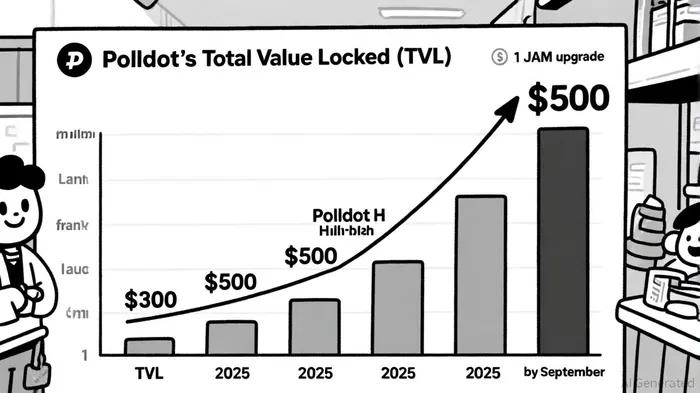
The DeFi segment alone has surged to a $500 million total value locked (TVL) as of September 2025, with platforms like Hydration ($400M TVL) and Bifrost ($19M TVL) leading the charge[4]. This growth is not just quantitative but qualitative: Acala's Sinai upgrade has enhanced DeFi security, while Elastic Scaling—launched in July 2025—has demonstrated the network's ability to handle 143,000 transactions per second on KusamaKSM--, a sister chain[4].
Network Utility: JAM Upgrade and the Death of Gas Fees
The JAM upgrade, slated for late 2025, represents a paradigm shift in blockchain economics. By eliminating gas fees and introducing modular scaling, Polkadot is addressing two of the most persistent pain points for users and developers. According to a report by Coinpaper, this upgrade will enable developers to prioritize performance over cost, fostering innovation in high-throughput applications like decentralized gaming and real-time DeFi[1].
Moreover, the Polkadot Treasury has entered a net-positive cash flow cycle, generating $2.8 million in stablecoin inflows monthly[1]. This financial health ensures sustained investment in infrastructure, further solidifying the network's utility. The Treasury's $76 million in discretionary funds is being allocated to subsidize projects that generate gas fees, creating a “use-and-burn, use-and-value” cycle that boosts DOT demand[1].
Cross-Chain Innovation: Bridging Ethereum and Beyond
Polkadot's 2025 roadmap is anchored by the Polkadot Hub, an Ethereum-compatible smart contract platform launching on the L1 layer. This initiative, led by the Web3 Foundation and Parity, aims to attract EthereumETH-- developers by allowing them to deploy Solidity contracts without overhauling their tech stack[2]. The Polkadot Virtual Machine (PVM) and EVM compatibility will become fully operational by December 2025, positioning the network as a hybrid of Ethereum's developer ecosystem and Polkadot's interoperability advantages[4].
Strategic partnerships, including collaborations with FIFA Rivals and football star Lionel Messi, are also amplifying Polkadot's public profile[1]. These moves are not just marketing gimmicks; they signal a broader effort to integrate blockchain into mainstream applications, from sports NFTs to cross-chain asset tokenization.
Financial and Governance Resilience
Polkadot's governance model has also evolved to enhance decentralization. The Decentralized Voices (DV) program now includes a “DV-Light Guardian” mode, allowing more community members to participate in decision-making with reduced voting power[1]. This expansion of representation, coupled with stricter accountability measures, strengthens the network's resilience against centralization risks.
Financially, the Treasury's $106 million in assets (31.1 million DOT) provides a buffer for strategic investments, while the 18% staking yields on ETHETH-- and BTCBTC-- further incentivize participation[1]. These metrics suggest a network that is not only surviving but thriving in a competitive blockchain landscape.
Conclusion: A $10 DOT Is Not Just Possible—It's Probable
For DOT to reach $10, it must achieve a market cap of approximately $100 billion (based on a 10x multiple of its current TVL). While ambitious, this target becomes plausible when considering Polkadot's $500M TVL, Elastic Scaling capabilities, and EVM compatibility. The JAM upgrade and Polkadot Hub will likely catalyze mass adoption by 2026, attracting Ethereum developers and institutional capital alike.
The key drivers—ecosystem growth, network utility, and cross-chain innovation—are not isolated factors but interconnected forces. As Polkadot bridges the gap between Web2 and Web3, its value proposition will only strengthen, making the $10 price point a realistic milestone rather than a speculative fantasy.







Comentarios
Aún no hay comentarios