
Polkadot's Hard Cap: A Strategic Shift Toward Institutional Adoption and Long-Term Value
The Tokenomics Revolution: From Inflation to Scarcity
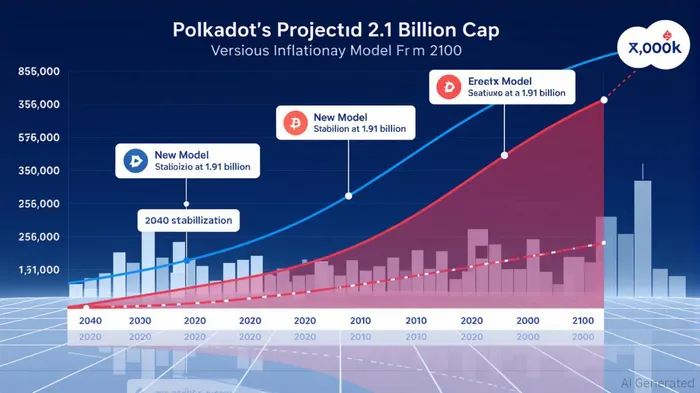
Polkadot's native token, DOT, has undergone a transformative shift in its monetary policy. On September 14, 2025, the PolkadotDOT-- Decentralized Autonomous Organization (DAO) approved Referendum 1710, capping the total supply of DOT at 2.1 billion tokens with 81% community support[1]. This decision marks the end of an era where 120 million new tokens were minted annually without a supply ceiling, a model that would have led to a projected 3.4 billion tokens by 2040[2]. Under the new framework, token issuance will decrease every two years, starting March 14, 2026 (Pi Day), with the goal of stabilizing the supply at approximately 1.91 billion by 2040[3].
This shift aligns Polkadot with the scarcity-driven economics of BitcoinBTC-- (21 million supply cap) and Ethereum's post-EIP-1559 deflationary mechanisms[4]. By introducing predictability and reducing inflationary pressure, the hard cap aims to position DOT as a store of value and a long-term asset, a critical factor for institutional investors who prioritize stability and scarcity in their portfolios[5].
Institutional Adoption: Bridging Blockchain and Traditional Finance
The hard cap is not merely a technical adjustment but a strategic move to attract institutional capital. Polkadot's Polkadot Capital Group, launched in August 2025, explicitly targets institutional investors by showcasing use cases in decentralized finance (DeFi), staking protocols, and real-world asset (RWA) tokenization[6]. Institutions, which often require predictable monetary policies and deflationary narratives, are now presented with a DOT token that mirrors the economic characteristics of Bitcoin while retaining Polkadot's unique multichain interoperability[7].
Data from the Coinbase 2025 Institutional Digital Assets Survey highlights that 72% of institutional investors prioritize assets with fixed or deflationary supply models[8]. Polkadot's hard cap directly addresses this demand, offering a framework where supply growth is mathematically constrained. This aligns with the broader trend of institutional adoption in blockchain, where projects like EthereumETH-- (via EIP-1559) and Bitcoin (via its fixed supply) have already demonstrated the appeal of scarcity-driven tokenomics[9].
Market Reactions and Long-Term Implications
While the immediate market reaction to the hard cap was mixed—DOT dropped nearly 5% post-announcement—the long-term implications are bullish. Analysts at CoinLaw note that the reduced issuance will create a scarcity narrative, potentially driving demand through staking, parachain usage, and institutional inflows[10]. By 2040, the projected supply of 1.91 billion tokens under the new model is 44% lower than the 3.4 billion under the old system[11]. This reduction in inflationary pressure could enhance DOT's utility as a reserve asset, particularly in DeFi protocols and cross-chain bridges where DOT is used for governance and staking[12].
Moreover, the hard cap reinforces Polkadot's governance maturity. The approval of Referendum 1710 through decentralized governance demonstrates the community's commitment to long-term economic sustainability—a trait that institutional investors increasingly value[13].
Conclusion: A Foundation for Institutional Growth
Polkadot's 2.1 billion DOT hard cap represents a pivotal step in its evolution from a speculative asset to an institutional-grade investment. By aligning with scarcity-driven economics, reducing inflationary risks, and launching targeted initiatives like the Polkadot Capital Group, the project is positioning itself to capture a significant share of the institutional blockchain market. While short-term volatility remains a factor, the long-term trajectory suggests that DOT's new tokenomics could drive sustained value creation, particularly as institutional adoption accelerates in the coming years.







Comentarios
Aún no hay comentarios