
Polkadot's 2025 Price Prediction and Cross-Chain Ecosystem Potential: Strategic Entry Points for the Next Bull Cycle
The Cross-Chain Catalyst: Why Polkadot's Ecosystem Matters for 2025
Polkadot (DOT) is no stranger to volatility, but 2025 has brought a unique confluence of technical upgrades, institutional interest, and cross-chain innovation. As the crypto market navigates macroeconomic uncertainty, Polkadot's focus on interoperability and modular scalability positions it as a critical player in the next bull cycle.
Ecosystem Growth and Institutional Adoption
The PolkadotDOT-- ecosystem has expanded significantly, with 38 active development teams building on the platform in 2025[1]. The upcoming JAM upgrade, set to launch in August 2025, promises gasless, modular scaling-a feature that could attract high-throughput dApps and enterprise use cases[1]. Meanwhile, the launch of Polkadot Capital Group (PCG) in August 2025 marks a strategic pivot toward institutional adoption. PCG aims to bridge traditional finance and Web3 by offering RWA tokenization, staking infrastructure, and educational resources to asset managers and banks[3]. This institutional push aligns with broader trends in crypto regulation, where clarity in the U.S. is fostering a new wave of institutional entry[3].
Real-world adoption is also gaining traction. A financial services firm recently implemented a Polkadot-based cross-chain application, improving asset transfer efficiency by 40% and boosting user satisfaction[4]. Partnerships with entities like FIFA Rivals and the University of Buenos Aires further diversify Polkadot's use cases beyond DeFi and NFTs[1]. These developments suggest that Polkadot's value proposition is no longer confined to speculative trading but is increasingly tied to tangible, cross-industry applications.
Price Predictions: A Tale of Two Scenarios
The 2025 price forecasts for DOTDOT-- are as polarizing as they are revealing. On one hand, bullish analysts like Crypto Patel and DigitalCoinPrice argue that DOT could surge to $25 or even reclaim its all-time high of $55 by year-end[1]. Their optimism hinges on the JAM upgrade's potential to drive demand and the broader adoption of cross-chain solutions. On the other hand, conservative models from Changelly and AI-based analyses project a narrower range of $3.71–$5.35[5], reflecting caution around macroeconomic headwinds and Polkadot's 7.4% annualized inflation rate[1].
Technical Indicators and Key Levels
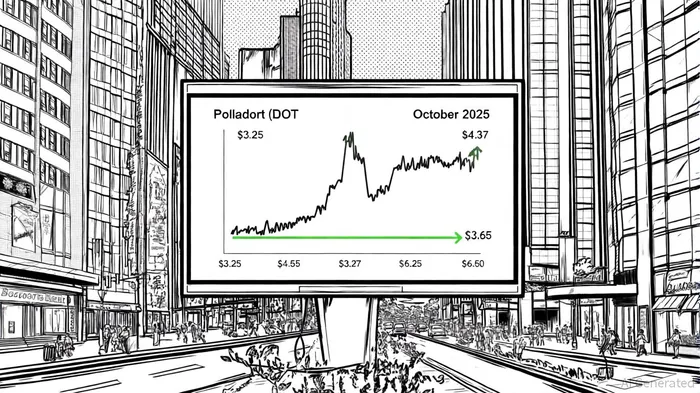
Current price action paints a mixed picture. DOT is trading near $4.36, just below its 7-day and 20-day moving averages, indicating short-term weakness[1]. However, the RSI (47.04) and MACD histogram suggest neutral to bullish momentum[1]. The critical resistance level at $4.37 is widely cited as a breakout threshold: a sustained move above this level could trigger a rally toward $6.50–$7.00[2], while a breakdown below $3.65 risks a decline to $3.25[3].
Bearish risks remain. High staking rates (currently around 15% APY) and inflationary pressures could incentivize sell-offs if yields drop due to network saturation[1]. Additionally, regulatory delays in ETF approvals-key to unlocking institutional liquidity-pose a wildcard[1].
Strategic Entry Points: Navigating the Bull Cycle
For investors eyeing the next bull cycle, Polkadot offers a nuanced entry strategy. Here's how to position for both bullish and bearish scenarios:
- Conservative Entry: Wait for Confirmation
- A breakout above $4.37 with increased volume validates the bullish case. Investors could target $6.50 as a near-term goal[2].
A breakdown below $3.61 invalidates the bullish thesis, suggesting a return to consolidation between $3.77 and $4.46[1].
Aggressive Entry: Dollar-Cost Averaging
For risk-tolerant traders, DCA between $3.77 (support) and $4.46 (resistance) could capitalize on volatility. This approach assumes the ecosystem's long-term value will outweigh short-term macro risks[1].
Long-Term Positioning: Ecosystem-Driven Growth
- The JAM upgrade and Elastic Scaling (launching on Polkadot in September 2025) are catalysts for institutional and developer adoption[1]. Investors who believe in Polkadot's cross-chain vision may find value in holding through consolidation phases.
The Bigger Picture: Why Polkadot Matters in 2025
Polkadot's 2025 trajectory is less about short-term price swings and more about its role in shaping the future of cross-chain infrastructure. The network's ability to balance scalability (via JAM and Elastic Scaling) with institutional adoption (via PCG) creates a flywheel effect: improved user experience attracts developers, which in turn drives real-world use cases and token demand.
However, success hinges on execution. If the JAM upgrade fails to deliver on its gasless promises or if regulatory headwinds stall ETF approvals, the bullish case weakens. Conversely, a surge in parachain activity-particularly in DeFi and RWA tokenization-could propel DOT beyond current forecasts.
Conclusion: A Calculated Bet on Interoperability
Polkadot's 2025 price prediction is a mosaic of technical, macroeconomic, and ecosystem-driven factors. While the $4.37 resistance level and JAM upgrade are pivotal, the broader narrative is about Polkadot's evolution from a speculative asset to a foundational cross-chain infrastructure. For investors, the key is to balance optimism with pragmatism: use technical levels to time entries, monitor ecosystem metrics for validation, and stay attuned to macro shifts.
In the next bull cycle, Polkadot's ability to connect disparate blockchain ecosystems may prove more valuable than its price chart. As always, the best investments are those made with both data and vision.






Comentarios
Aún no hay comentarios