
The Politicalization of the Federal Reserve and Its Implications for Global Markets
The Federal Reserve's independence has long been a cornerstone of U.S. economic policy, underpinning global confidence in the dollar and the stability of capital markets. However, recent political pressures-particularly under the Trump administration and its allies-have raised critical questions about the central bank's autonomy. These developments, coupled with evolving monetary policy frameworks and shifting global capital allocation strategies, present long-term risks to both U.S. economic resilience and international market stability.
Erosion of Monetary Policy Independence
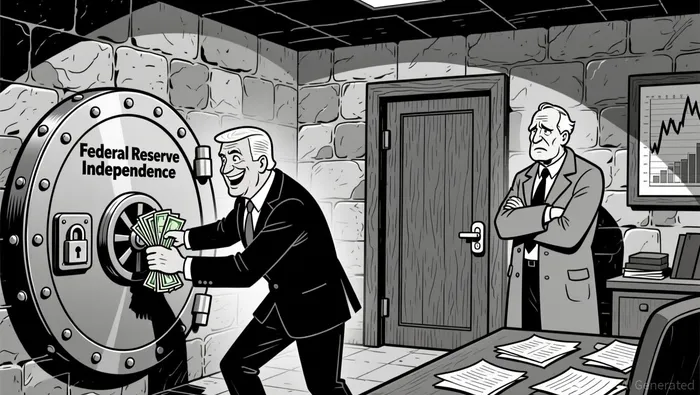
Political interference in Federal Reserve decisions has intensified since 2023, with President Trump and his allies openly criticizing the Fed's leadership and policy trajectory. Trump's public threats to remove Chair Jerome Powell and his repeated calls for rate cuts represent a stark departure from the historical norm of allowing the Fed to operate free from overt political influence according to CEPR analysis. This pressure has extended beyond rhetoric: Senator Joe Manchin and others have engaged in direct communication with the Fed, urging policy reassessments. Such actions risk undermining the Fed's institutional credibility, which is vital for anchoring inflation expectations and maintaining public trust in its independence as research shows.
The Fed's 2025 monetary policy framework update, which reaffirmed a 2% inflation target and redefined maximum employment, was partly a response to these challenges. While the revised framework aims to enhance flexibility in addressing divergent economic scenarios, critics argue that the Fed's expanded role-such as managing a large balance sheet and paying interest on reserves-has already blurred the lines between monetary and fiscal policy, inviting accusations of "mission creep". A loss of independence could exacerbate these tensions, politicizing the Fed's mandate and eroding its effectiveness in stabilizing the economy according to analysis.
Global Capital Allocation and Market Confidence
The politicalization of the Fed has broader implications for global capital allocation strategies. Morgan Stanley warns that politically driven monetary policies-such as premature rate cuts pressured by the Trump administration- could reignite inflation. These risks are amplified by the dollar's role as the world's reserve currency, which relies on the Fed's perceived independence to maintain its dominance as noted in reports. In 2025, tensions between Trump and Powell triggered market volatility, with Treasury yields spiking and the dollar weakening as investors priced in the risk of political interference according to market analysis.
Historical precedents further underscore the stakes. The 1970s inflationary spiral under Nixon and Turkey's economic instability due to repeated central bank interventions highlight the dangers. Meanwhile, research from the Federal Reserve itself notes that elevated uncertainty-such as that caused by political pressures- has cumulatively reduced industrial production. In a global economy already grappling with structural shifts in supply chains, compounding these uncertainties could force investors to prioritize risk mitigation over growth, favoring quality large-cap stocks.
The Cost of Compromised Independence
Economic projections paint a grim picture of a Fed stripped of its independence. A 2025 study by the Peterson Institute for International Economics estimates that such a scenario could slow U.S. economic growth by 1–2 percentage points annually while increasing inflation by 1.5–2 percentage points. These outcomes would not only destabilize domestic markets but also ripple across global financial systems, where U.S. monetary policy remains a key determinant of capital flows and asset valuations according to analysis.
Conclusion
The Federal Reserve's independence is not merely a domestic concern-it is a linchpin of global economic stability. Political pressures on the Fed, while not new, have reached unprecedented levels in recent years, threatening to erode the institutional safeguards that have long insulated monetary policy from partisan agendas. For investors, the implications are clear: preserving the Fed's autonomy is critical to maintaining confidence in U.S. markets, anchoring inflation expectations, and ensuring the dollar's role as a global reserve currency. As the 2025–2026 period unfolds, the interplay between political dynamics and monetary policy will remain a defining risk for capital allocation strategies worldwide.







Comentarios
Aún no hay comentarios