
The Political Volatility of Crypto: How Trump's Policies Reshape Market Dynamics and Investor Strategy
The politicization of cryptocurrency has reached a fever pitch in 2025, with Donald Trump's administration reshaping the U.S. digital asset landscape through a sweeping agenda of deregulation, institutional integration, and geopolitical positioning. While these policies have catalyzed a surge in market activity and innovation, they also expose investors to a complex web of risks and opportunities. This article dissects the long-term implications of Trump's crypto-centric governance, offering a framework for navigating a politicized market.
Policy Shifts: From Regulatory Clarity to Geopolitical Leverage
The Trump administration's 2025 executive order on digital assets marked a stark departure from Biden-era caution, prioritizing "responsible innovation" over enforcement-heavy oversight. Central to this shift was the creation of the President's Working Group on Digital Asset Markets, chaired by David Sacks, which aimed to streamline federal regulation and eliminate "burdensome" crypto rules. This group's 100+ policy recommendations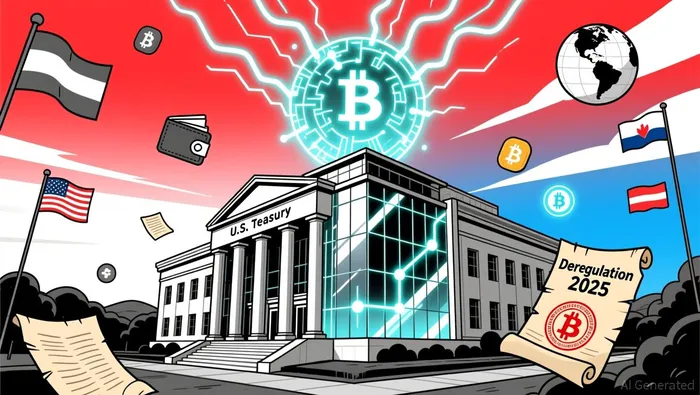 -spanning stablecoins, taxation, and market structure-positioned the U.S. as a global leader in digital asset governance.
A cornerstone of this agenda was the GENIUS Act, which mandated 1:1 reserve backing for stablecoins and allowed FDIC-supervised banks to issue payment stablecoins. This regulatory clarity spurred institutional adoption, with 80% of jurisdictions globally witnessing financial institutions launch digital asset initiatives. Meanwhile, the SEC's "Crypto 2.0" task force, led by Hester Peirce, signaled a pivot from enforcement to framework-building, issuing no-action letters for utility tokens and DePIN projects.
However, the administration's anti-CBDC stance-banning a U.S. central bankBANK-- digital currency-highlighted a strategic focus on preserving the dollar's sovereignty while leveraging stablecoins as a de facto CBDC alternative. This geopolitical calculus aligns with global efforts by the FATF and FSB to harmonize crypto regulations, further cementing the U.S.'s role as a policy arbiter.
Opportunities: Institutional Adoption and Global Leadership
The Trump-era policies have unlocked unprecedented opportunities for institutional participation. The FDIC's approval framework for bank-issued stablecoins, combined with the SEC's easing stance, has normalized crypto as a legitimate asset class. For instance, 70% of jurisdictions advanced stablecoin frameworks in 2025, with the U.S. leading in innovation-friendly regulations. This trend is amplified by the Strategic Bitcoin Reserve, a government initiative aimed at bolstering national competitiveness through digital asset holdings.
Moreover, the repeal of Biden-era policies-such as Executive Order 14067-has reduced regulatory uncertainty, attracting capital to U.S.-based crypto projects. According to a report by Pillsbury Law, the administration's "Crypto 2.0" task force and no-action letters have already spurred a 30% increase in DePIN and blockchain infrastructure investments.
Risks: Stability, Capture, and Political Volatility
Yet, the rapid integration of crypto into traditional finance carries systemic risks. The collapse of Silicon Valley Bank in 2023 and the 2025 Bybit hack underscore the fragility of crypto-adjacent institutions. The Trump administration's push for a Strategic BitcoinBTC-- Reserve, while ambitious, raises concerns about conflicts of interest and regulatory capture, particularly with high-profile entanglements like the $TRUMP memecoinMEME--.
Political volatility further complicates the landscape. The Senate's stalled market structure bill and potential shifts in 2026 elections could disrupt the current regulatory momentum. As Brookings Institution warns, the lack of a unified legislative framework may force regulators to rely on fragmented authorities, creating long-term instability.
Investor Strategy: Balancing Innovation and Caution
For investors, the key lies in hedging against political and regulatory shifts while capitalizing on institutional tailwinds. The approval of new crypto products-such as ETPs and futures-signals a maturing market, but diversification remains critical. According to Galaxy Research, investors should prioritize projects aligned with the GENIUS Act's stablecoin framework and DePIN infrastructure, which are less exposed to regulatory overreach.
However, caution is warranted. The Brookings report emphasizes the need for robust risk management, particularly in light of the Bybit hack and SVB's collapse. Investors should also monitor the Senate's market structure bill and potential executive orders, which could reshape the playing field overnight.
Conclusion: A New Era of Crypto Politics
Trump's 2025 policies have undeniably accelerated crypto's institutional adoption and global integration. Yet, the politicization of digital assets introduces a new layer of volatility-one where regulatory clarity and geopolitical strategy are as influential as technological innovation. For investors, the path forward demands a nuanced understanding of both the opportunities and risks in a landscape where politics and code are increasingly intertwined.







Comentarios
Aún no hay comentarios