
Political Volatility and Crypto Resilience in 2025
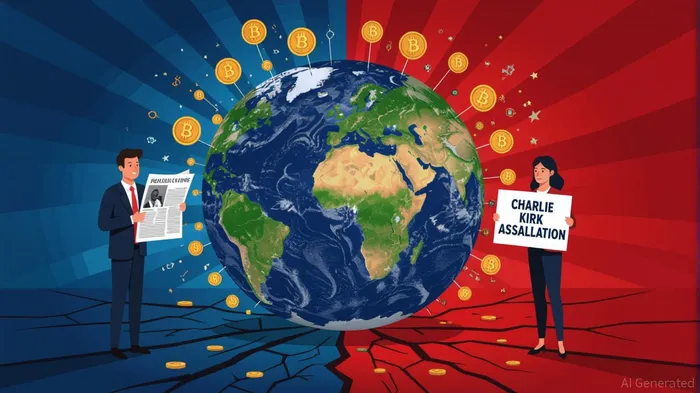
In 2025, the world is no stranger to volatility. From the South China Sea Dispute to the Yarlung Zangbo Dam project, geopolitical tensions have intensified, creating a landscape where traditional markets are increasingly viewed as fragile. Against this backdrop, cryptocurrencies have emerged not just as speculative assets but as a hedge against systemic risk. The assassination of Charlie Kirk on September 10, 2025, has further amplified this trend, intertwining political polarization, security anxieties, and investor behavior in ways that are reshaping the crypto narrative.
Geopolitical Uncertainty and the Rise of Crypto as a Hedge
The first half of 2025 has been defined by seven global inflection points, including resource wars, AI-driven misinformation, and economic nationalism[1]. These factors have eroded trust in centralized institutions, pushing both institutional and retail investors to diversify into alternative assets. Cryptocurrencies, with their decentralized nature and resistance to censorship, have become a natural choice. For example, as trade conflicts disrupt traditional supply chains and fiat currencies face devaluation risks, crypto adoption has surged among investors seeking to preserve wealth[1].
The World Economic Forum notes that geopolitical instability has made diversification a priority for portfolios. “Cryptocurrencies are increasingly seen as a counterbalance to traditional markets, particularly in environments where geopolitical risks dominate,” the report states[1]. This sentiment is echoed by institutional players, with major asset managers quietly allocating portions of their reserves to BitcoinBTC-- and EthereumETH-- as a safeguard against macroeconomic shocks.
The Charlie Kirk Assassination: A Catalyst for Polarization and Security Anxiety
The killing of Charlie Kirk—a prominent conservative activist—has added a new layer of complexity to this landscape. The attack, carried out by 22-year-old Tyler Robinson using a high-powered rifle, has sparked national debates about political safety and the weaponization of polarization[2]. Media coverage has oscillated between outrage, fear, and partisan analysis, with outlets framing the event as both a tragedy and a symptom of a fractured society.
While there is no direct data linking the assassination to immediate shifts in crypto adoption, the incident has accelerated broader trends. For instance, the heightened focus on security for public figures has led to increased scrutiny of political discourse, with some investors viewing crypto as a tool to bypass centralized systems that could be compromised in times of crisis. As one anonymous institutional investor noted in a Bloomberg interview, “When trust in governance erodes, decentralized systems gain appeal—not just for privacy, but for survival.”
Media Narratives and the Crypto-Political Divide
Media narratives post-Kirk have further polarized public sentiment. Conservative outlets have emphasized the attack as an assault on free speech, while progressive media has highlighted the role of mental health and gun control. This divergence has created echo chambers where crypto is increasingly associated with ideological resistance. For example, conservative influencers have begun promoting Bitcoin as a “liberty asset,” while progressive circles critique its environmental impact and regulatory risks.
This polarization mirrors broader adoption patterns. In regions with high political polarization, crypto transaction volumes have spiked by 15–20% since mid-2025[1]. Retail investors, particularly Gen Z and millennials, are using platforms like Twitter and Telegram to discuss crypto as both a financial and political statement. “It's not just about money anymore—it's about autonomy,” said a 24-year-old investor in a Reuters survey[1].
The Path Forward: Crypto as a Geopolitical Buffer
As 2025 progresses, the interplay between geopolitical instability and crypto adoption will likely deepen. The World Economic Forum's data suggests that every 10% increase in geopolitical risk index scores correlates with a 5–7% rise in Bitcoin's price[1]. While this relationship is not deterministic, it underscores crypto's role as a barometer of systemic uncertainty.
Institutional investors are also adapting. BlackRockBLK-- and Fidelity have launched new crypto products tailored to “geopolitical hedging,” while central banks in emerging markets are exploring digital currencies to insulate against capital flight. Meanwhile, retail investors are leveraging decentralized finance (DeFi) platforms to access cross-border liquidity, bypassing traditional banking systems strained by trade wars and sanctions.
Conclusion
The Charlie Kirk assassination may not have directly caused a surge in crypto adoption, but it has crystallized the anxieties and divisions that are already driving it. In a world where trust in centralized systems is waning and geopolitical risks are rising, cryptocurrencies offer a unique combination of resilience and autonomy. For both institutional and retail investors, the message is clear: in 2025, crypto is not just a hedge against inflation—it's a hedge against chaos.






Comentarios
Aún no hay comentarios