
Political Uncertainty and Market Volatility in the Post-Trump Era
The post-Trump era has ushered in a new era of political and judicial turbulence, with courts playing a pivotal role in reshaping U.S. policy and, by extension, global markets. From challenging executive overreach to redefining regulatory authority, recent judicial interventions have created a landscape of uncertainty that investors must navigate with precision. This article examines how these legal developments are influencing market volatility, reshaping investment strategies, and offering both risks and opportunities for forward-looking portfolios.
Judicial Interventions and Policy Reversals
The judiciary has emerged as a critical counterweight to executive power in the post-Trump period. A landmark example is the Federal Circuit's 7-4 ruling in May 2025, which declared Trump's "Liberation Day" tariffs unlawful under the International Emergency Economic Powers Act (IEEPA), according to a CSIS analysis. This decision not only curtailed the administration's ability to unilaterally reshape trade policy but also introduced economic instability. According to the CSIS analysis, the ruling contributed to a 0.3% contraction in U.S. GDP during Q1 2025 and projected a 0.9 percentage point reduction in annual growth. Such policy reversals underscore the fragility of Trump-era economic agendas and the judiciary's role in recalibrating them.
Similarly, the Supreme Court's June 2025 decision to limit nationwide injunctions-often used to broadly block executive actions-has shifted the legal landscape, as a White House article framed the ruling. While this decision was celebrated by the Trump administration as a victory, it did not resolve the constitutionality of controversial policies like the birthright citizenship order, as The Financial Analyst reported. These mixed outcomes highlight the judiciary's dual role: both constraining and enabling executive power, depending on the case.
Market Volatility and Sector-Specific Risks
The ripple effects of judicial interventions are evident in financial markets. The S&P 500, for instance, experienced heightened volatility in early 2025 as courts grappled with Trump's tariffs and immigration policies. Morgan StanleyMS-- analysts note that industries reliant on global supply chains-such as apparel, food, and technology-are particularly vulnerable to policy-driven disruptions (Morgan Stanley). Apparel prices surged 17.0% following the tariff ruling, while food costs rose 2.6%, including a 5.4% spike in fresh produce, according to the CSIS analysis. These price shocks have forced investors to reassess exposure to import-dependent sectors.
Meanwhile, the energy and financial sectors have emerged as relative beneficiaries of the post-Trump agenda. Trump's deregulatory push, including expedited natural gas permitting and reduced financial oversight, has bolstered energy producers and banks. However, the clean energy sector faces headwinds, with potential rollbacks of green tax credits creating uncertainty for long-term investments.
Investment Strategies in a Litigious Era
Financial analysts emphasize adaptability in this environment. BlackRockBLK-- and UBSUBS-- recommend diversification across sectors and geographies, with a focus on alternative assets like commodities and digital currencies to hedge against inflation and policy risks, according to BlackRock. For example, Mexico's investment freeze-triggered by U.S. tariffs and domestic judicial reforms-has prompted investors to redirect capital to emerging markets with more stable trade policies.
The Supreme Court's recent rulings in SEC v. Jarkesy and Loper Bright Enterprises v. Raimondo have further reshaped enforcement dynamics. By curtailing the SEC's administrative authority and overturning Chevron deference, these decisions have shifted regulatory power to federal courts, as a Labaton investor alert explains. As a result, investors are advised to prioritize litigation readiness, particularly in sectors prone to securities disputes. Private litigation is expected to rise, creating both legal costs and opportunities for class-action redress.
Balancing Risks and Opportunities
While the post-Trump era is fraught with uncertainty, it also presents strategic opportunities. Deregulation in energy and finance could drive short-term gains, while global trade tensions may spur innovation in nearshoring and supply chain resilience. Investors are advised to adopt a "pro-risk" stance in U.S. equities, particularly in AI and high-growth tech, while maintaining defensive positions in utilities and healthcare.
However, the path forward is not without pitfalls. The Federal Reserve's cautious approach to rate cuts-amid persistent inflation-adds another layer of complexity. Analysts warn that sectors like clean energy and healthcare could face headwinds due to conflicting policy shifts and regulatory changes.
Conclusion
The interplay between judicial interventions and market dynamics in the post-Trump era demands a nuanced investment approach. While policy uncertainties create volatility, they also open avenues for strategic positioning in resilient sectors and alternative assets. As courts continue to redefine the boundaries of executive power, investors must remain agile, leveraging both risk-mitigation strategies and opportunities in a rapidly evolving landscape.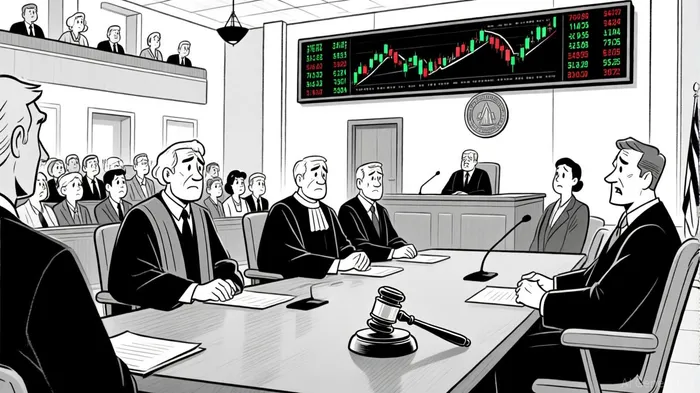







Comentarios
Aún no hay comentarios