
Political Uncertainty and Its Impact on U.S. Markets: Defensive Investing in a Polarized Climate
The U.S. stock market in 2025 navigated a treacherous landscape of political uncertainty, driven by sweeping tariff policies, unpredictable executive actions, and the lingering effects of a polarized political climate. As President Donald Trump's re-election and subsequent policy announcements triggered sharp market corrections, investors turned to defensive strategies to mitigate risk. This article examines how political volatility reshaped market dynamics and explores the efficacy of defensive investing approaches during this turbulent period.
The Volatility Surge: A Year of Political Uncertainty
Political uncertainty in 2025 reached unprecedented levels, with the U.S. Economic Policy Uncertainty Index hitting its second-highest reading in over 40 years. Tariff escalations, particularly against China, and Trump's aggressive rhetoric toward the Federal Reserve fueled market jitters. The CBOE Volatility Index (VIX), a key gauge of investor fear, surged to 52.3 in April 2025-the highest since the 2020 pandemic peak-before settling to a calmer 14–15 by year-end. This volatility was compounded by the variance risk premium (VRP), which emerged as a critical forward-looking indicator, capturing investor expectations of turbulence during major political events.
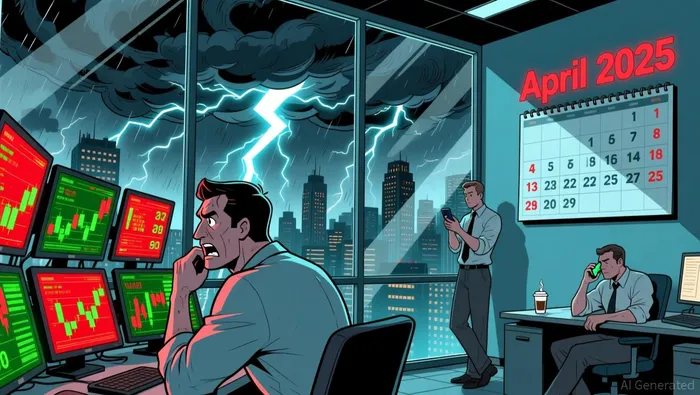
The S&P 500, while closing the year up 17%, faced near-bear market territory in early 2025 amid tariff-driven sell-offs. Similarly, the Nasdaq Composite rose 21%, but its gains were concentrated in a narrow group of high-beta tech stocks, exacerbating portfolio concentration risks. Analysts warn that unresolved trade tensions and potential leadership changes at the Fed continue to pose threats for 2026.
Defensive Investing: Strategies for a Turbulent Era
In response to this volatility, investors prioritized defensive positioning. Key strategies included:
Sector Rotation to Defensive Equities:
Sectors like utilities, consumer staples, and healthcare-known for stable earnings and low cyclicality-gained traction. These sectors historically outperform during downturns, offering downside protection while maintaining growth potential. For instance, defensive stocks with strong balance sheets and consistent dividends cushioned portfolios during the 10% two-day drop in the S&P 500 following "Liberation Day" tariff announcements.Low-Volatility and Quality Stocks:
Investors flocked to low-volatility equities and dividend aristocrats, which demonstrated resilience amid market swings. These strategies, though underperforming in bull markets dominated by high-beta tech stocks, proved critical during corrections.Diversification Beyond Traditional Assets:
The breakdown of the 60/40 portfolio's diversification logic-due to simultaneous declines in stocks and bonds-prompted a shift toward alternatives. BlackRock and JPMorgan recommended allocations to inflation-linked bonds, commodities, and international equities to reduce correlation risks. Gold and infrastructure assets also gained favor as hedges against geopolitical and macroeconomic shocks.Fixed Income Rebalancing:
Short-duration bonds and Treasury Inflation-Protected Securities (TIPS) became preferred fixed-income allocations, as persistent inflation and fiscal imbalances eroded the appeal of long-duration assets. JPMorgan further emphasized duration management, advocating for intermediate-term bonds (3–7 years) to balance yield and risk.
Performance Metrics: Risk-Adjusted Returns and Portfolio Resilience
Defensive strategies delivered superior risk-adjusted returns compared to aggressive equity allocations. A global equity portfolio targeting downside risk reduction captured 90% of the upside and 70% of the downside of the MSCI World from 1986 to 2025, achieving an average annualized return of 11.3% versus 8.3% for the benchmark. While exact Sharpe ratios for 2023–2025 are not explicitly provided, defensive factor strategies-such as quality, dividends, and low volatility-outperformed broader markets during periods of policy-driven turbulence.
Conversely, the traditional 60/40 portfolio underperformed, suffering a 17.5% loss in 2022 and failing to recover fully by 2025. This underperformance underscored the need for dynamic adjustments, such as using volatility indices (VIX for equities, MOVE for bonds) to recalibrate risk exposure.
The Road Ahead: Navigating 2026 and Beyond
As 2026 approaches, investors must remain vigilant. Persistent trade tensions, potential Fed leadership changes, and global defense spending trends will continue to shape market dynamics. BlackRock and JPMorgan recommend maintaining an overweight in bonds, selectively exposing portfolios to AI-driven sectors, and embracing non-market-cap approaches like dividend aristocrats to enhance resilience.
In this polarized climate, defensive investing is no longer a passive choice-it is a strategic imperative. By prioritizing quality, diversification, and risk management, investors can navigate uncertainty while positioning for long-term growth.







Comentarios
Aún no hay comentarios