
Political Turmoil in South Korea: Implications for Market Stability and Governance Risk in Emerging Markets
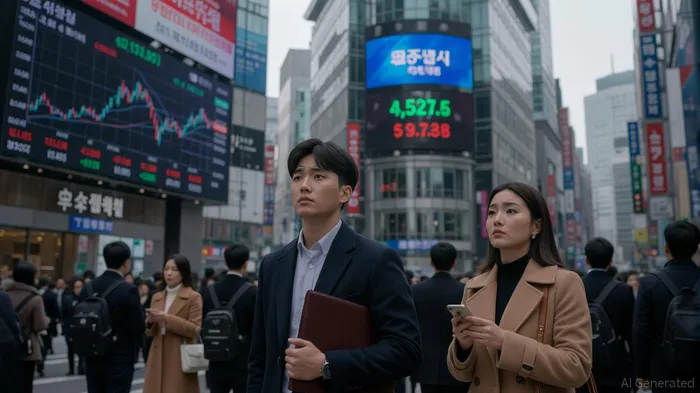
The unprecedented dual prosecution of South Korea’s former president, Yoon Suk Yeol, and his wife, Kim Keon Hee, has sent shockwaves through the country’s political and financial systems. This historic case—marking the first time a former president and first lady have faced simultaneous legal action in South Korea—has not only exposed deep-seated governance flaws but also triggered a crisis of institutional trust that threatens to reshape investor sentiment in emerging markets. As the nation grapples with the fallout, the interplay between political instability, regulatory reforms, and foreign capital flows offers a critical case study for understanding governance risks in the 21st century.
Erosion of Institutional Trust
The arrests of Yoon and Kim have accelerated a long-term decline in public confidence in South Korea’s institutions. According to the OECD Trust Survey, trust in the national government fell from 49% in 2021 to 37% in 2023, a 12-point drop that underscores growing disillusionment with political leadership [1]. Recent surveys paint an even grimmer picture: Yoon’s approval rating in February 2025 stood at a dismal 8.8%, with 76% of respondents disapproving of his performance [2]. The scandal has also eroded trust in the National Assembly, where only 14.1% of respondents expressed confidence [2].
The charges against Kim—ranging from stock price manipulation to accepting luxury gifts valued at $43,200—have further deepened public cynicism about political integrity [3]. While Yoon and Kim have denied wrongdoing, their legal troubles have become emblematic of a broader pattern of corruption and abuse of power, particularly under the previous administration [4]. This erosion of trust is not merely symbolic; it directly impacts investor perceptions of governance quality, a key determinant of capital flows in emerging markets.
Foreign Direct Investment and the “Korea Discount”
The political turmoil has had tangible consequences for foreign direct investment (FDI). In the first half of 2025, pledged FDI to South Korea fell 14.6% year-on-year to $13.1 billion, driven by global trade uncertainties and domestic instability [5]. Actual FDI inflows, however, rose 2.7% to $7.3 billion, suggesting that while investors remain cautious, some capital is still flowing into the country [5]. The divergence between pledges and inflows highlights the volatility of investor sentiment amid governance risks.
The so-called “Korea Discount”—a phenomenon where South Korean equities trade at lower valuations than their global peers—has widened in response to the crisis. The iShares MSCIMSCI-- South Korea ETF (EWY) plummeted 5.5% following Yoon’s arrest, while the South Korean won weakened by 2% [6]. These movements reflect heightened concerns about corporate governance flaws, particularly within large chaebols like Samsung and Hyundai, which have long been criticized for opaque practices [6].
Yet, the new liberal government under President Lee Jae-myung has introduced reforms aimed at addressing these issues. The revised Commercial Act, passed in August 2025, mandates cumulative voting systems and separate audit committee elections to empower minority shareholders [7]. These measures, coupled with plans to incentivize dividend payouts, are designed to reduce the Korea Discount by improving transparency and accountability [7]. While early signs are promising—KOSPI surged 33% year-to-date in 2025—long-term success will depend on judicial enforcement and resistance from entrenched business interests [7].
Regulatory Reforms and Market Stability
The Lee administration’s regulatory agenda has prioritized aligning South Korea with global governance standards. Key initiatives include the establishment of a “regulatory sandbox” to foster innovation in sectors like fintech and renewable energy, as well as the introduction of a Foreign Investment Ombudsman to streamline dispute resolution [8]. These reforms aim to counteract the reputational damage caused by the Yoon-Kim scandal and restore confidence in the business environment.
However, structural challenges persist. The 2022 National Strategic Industries Act, which restricts foreign investments in sectors deemed critical to national security, has complicated the investment landscape [6]. Additionally, U.S. protectionist policies, including proposed tariffs on South Korean exports, pose external risks that could undermine the government’s efforts [6]. While South Korean firms are diversifying production and accelerating U.S. investments under the Inflation Reduction Act, these measures may not fully offset the impact of geopolitical tensions [6].
Conclusion
South Korea’s political crisis has exposed the fragility of institutional trust in emerging markets, where governance risks can rapidly translate into market instability. The dual prosecution of Yoon and Kim has not only deepened public skepticism but also forced a recalibration of investor strategies, with capital shifting toward defensive sectors and hedging mechanisms. While the Lee government’s reforms offer a path to recovery, their success will hinge on sustained political will and the ability to navigate external headwinds. For global investors, the South Korean experience serves as a stark reminder: in an era of heightened geopolitical uncertainty, governance quality is not just a compliance issue—it is the bedrock of market resilience.
Source:
[1] OECD Survey on Drivers of Trust in Public Institutions 2024 Results Country Notes, [https://www.oecd.org/en/publications/oecd-survey-on-drivers-of-trust-in-public-institutions-2024-results-country-notes_a8004759-en/korea_ab1a95c7-en.html]
[2] As Impeachment Verdict Nears, Yoon's Public Support Remains Dismal, [https://thediplomat.com/2025/03/as-impeachment-verdict-nears-yoons-public-support-remains-dismal/]
[3] South Korea's former first lady 'sorry' about graft probe that plagued Yoon 2025-08-06, [https://www.reuters.com/world/asia-pacific/south-koreas-former-first-lady-sorry-about-graft-probe-that-plagued-yoon-2025-08-06/]
[4] The Crisis of Seoul- Fate of President Yoon Suk Yeol and ... [http://ucfglobalperspectives.org/blog/2025/01/28/the-crisis-of-seoul-fate-of-president-yoon-suk-yeol-and-south-koreas-future/]
[5] FDI Arrivals to Korea Rise 2.7% in H1 2025, [https://www.korea.net/Government/Briefing-Room/Press-Releases/view?articleId=8106&insttCode=&type=O]
[6] Political Instability in South Korea: Implications for Foreign Investors, [https://www.ainvest.com/news/political-instability-south-korea-implications-foreign-investors-2507]
[7] South Korean stocks soar on governance reform hopes, [https://www.hermes-investment.com/uk/en/institutions/insights/macro/south-korean-stocks-soar-on-governance-reform-hopes-market-snapshot/]
[8] 2024 Investment Climate Statements: South Korea, [https://www.state.gov/reports/2024-investment-climate-statements/south-korea]







Comentarios
Aún no hay comentarios