
Political Turmoil in Serbia: Navigating Risks and Opportunities in the Balkans' Emerging Markets
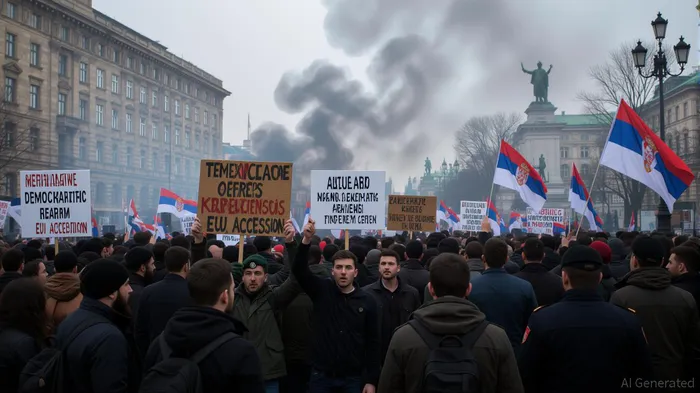
Political instability in Serbia has reached a boiling point in 2025, with anti-government protests escalating into a nationwide movement that challenges the 16-year rule of President Aleksandar Vučić. The collapse of a train station canopy in Novi Sad, which killed 16 people, ignited outrage over systemic corruption and negligence, sparking a coalition of students, farmers, and professionals to demand early elections, judicial reforms, and EU alignment. For foreign investors, this turmoil raises critical questions about asset valuations, regional investment flows, and the long-term viability of Serbia as a strategic hub in the Balkans.
The Risks: Political Volatility and EU Accession Delays
Serbia's political landscape is fraught with risks. The government's crackdown on dissent—marked by violent clashes, arrests, and accusations of foreign interference—has eroded public trust and drawn rebukes from the EU. Commissioner for Enlargement Marta Kos has emphasized that democratic backsliding could derail Serbia's EU accession, which is already delayed by unresolved tensions with Kosovo and weak judicial independence.
The European Commission's 2024 report highlighted that only 22 of 34 EU acquis chapters are open, with key chapters on rule of law and normalization with Kosovo remaining conditional. Delays in these areas could push Serbia's EU membership to 2029 or beyond, creating regulatory uncertainty for investors. Asset valuations in sectors like infrastructure, agriculture, and manufacturing are likely to face downward pressure as political risks inflate risk premiums. For example, the abrupt withdrawal of a lithium mining project in 2022 demonstrated how policy reversals can destabilize long-term investments.
The Opportunities: EU-Driven Reforms and Regional Diversification
Despite the risks, Serbia's strategic location and demographic advantages—such as a skilled, English-speaking workforce—make it a compelling long-term bet. The EU remains the largest foreign investor in the region, with 67% of inward FDI stock in North Macedonia and over 50% in Serbia. If Vučić's government meets EU benchmarks for judicial reforms and Kosovo normalization, Serbia could unlock access to EU funds and trade agreements, boosting sectors like renewable energy, automotive manufacturing, and digital infrastructure.
Regional investment flows are also shifting. While Montenegro and Albania dominate FDI inflows in the Balkans, Serbia's Special Economic Zones (SEZs) and tax incentives are attracting automotive giants like Fiat. Investors with a multi-year horizon could capitalize on Serbia's potential to become a regional logistics hub, particularly as EU accession accelerates.
Actionable Strategies for Investors
- Hedge Political Risks with Diversification:
- Allocate capital across multiple Balkan markets to mitigate country-specific risks. For instance, pair Serbian investments with exposure to Montenegro's tourism sector or Albania's renewable energy projects.
Use currency derivatives to hedge against the Serbian dinar's volatility, especially as EU accession timelines remain uncertain.
Target Resilient Sectors:
- Prioritize sectors less sensitive to political instability, such as digital infrastructure and green energy. Serbia's EU alignment could drive demand for solar and wind projects, with the government recently approving a 10-year renewable energy roadmap.
Invest in companies with strong EU ties, such as those involved in cross-border infrastructure projects (e.g., rail networks connecting Serbia to Hungary and Bulgaria).
Monitor EU Accession Milestones:
- Track progress on Chapters 23 (Judiciary) and 24 (Fundamental Rights), which are prerequisites for opening critical chapters on taxation and social policy.
Use EU accession timelines as a proxy for regulatory risk. For example, if Serbia meets 2029 benchmarks, consider increasing exposure to its banking sector, which could benefit from EU capital inflows.
Leverage Derivatives for Short-Term Gains:
- Short-term investors could use options or futures to bet on market corrections in Serbian equities, given the current political uncertainty.
- Alternatively, long-dated call options on regional indices (e.g., MSCIMSCI-- EM Europe) could capitalize on eventual stabilization and EU-driven growth.
Conclusion: Balancing Caution and Opportunity
Serbia's political instability presents a paradox for investors: high risk, but also high reward. While the immediate outlook is clouded by protests and governance challenges, the long-term potential of EU integration and regional economic synergies cannot be ignored. A disciplined approach—combining diversification, sectoral focus, and strategic hedging—can help investors navigate this volatile environment. As the EU's Marta Kos noted, “Democratic freedoms are not a luxury but a prerequisite for sustainable growth.” For those willing to weather the storm, Serbia's transformation could yield outsized returns.







Comentarios
Aún no hay comentarios