
Political Stability and Fiscal Policy in France: Implications for Investors in 2026
France's political and fiscal landscape in 2026 presents a complex tapestry of risks and opportunities for investors navigating European equities and sovereign debt. The country's governance challenges, marked by political fragmentation and fiscal uncertainty, have triggered market volatility and eroded investor confidence. Yet, amid the turbulence, there are discernible pathways for strategic positioning, particularly for those attuned to macroeconomic shifts and policy dynamics.
Political Instability: A Persistent Drag on Governance
France's political stability index, as measured by the World Bank's Worldwide Governance Indicators (WGI), has declined from 0.39 in 2022 to 0.34 in 2023 according to Credit Agricole, reflecting heightened concerns about unconstitutional threats to governance. This downward trend, though modest, underscores a broader pattern of institutional fragility. In 2024, the country experienced multiple government reshuffles, including the collapse of Prime Minister François Bayrou's minority administration, which struggled to pass the 2025 budget. Such instability has hampered the implementation of structural reforms, with public trust in institutions falling below the OECD average as reported in 2023. The lack of political consensus has also delayed critical fiscal adjustments, leaving France vulnerable to external shocks.
Fiscal Policy: A Delicate Balancing Act
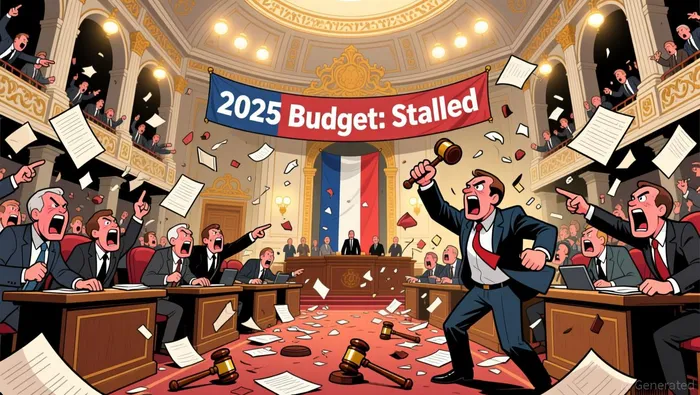 France's fiscal trajectory in 2026 is shaped by a dual challenge: reducing the deficit while managing a rising debt burden. The government deficit is projected to decline to 5.5% of GDP in 2025 and 4.9% in 2026 before rebounding to 5.3% in 2027. This uneven path reflects a mix of revenue-enhancing measures and expenditure cuts, including a EUR 44bn savings plan under Bayrou's 2026 budget as noted by research. However, public debt is expected to climb to 120% of GDP by 2027, driven by persistent primary deficits and elevated interest payments according to economic forecasts. The International Monetary Fund (IMF) has recommended a frontloaded fiscal effort of 1.1% of GDP in 2026 to stabilize the deficit, but political infighting and parliamentary gridlock threaten to derail these efforts.
Market Reactions: Volatility and Risk Premiums
The political uncertainty has had immediate and tangible effects on financial markets. In early August 2025, the CAC 40 plummeted 3.3% following Bayrou's resignation, signaling investor fears over fiscal credibility. The financial sector bore the brunt of the sell-off, with banks like Société Générale and BNP Paribas losing significant value as bond yields surged. By September 2025, French 10-year yields had climbed to 3.56%, widening the spread over German Bunds to 0.88 percentage points-a level not seen since the eurozone debt crisis. Credit default swaps (CDS) also reflected heightened risk, with investors demanding higher premiums for French sovereign debt as reported in market analysis.
The political turmoil has further exacerbated capital flight from France. Investors have reallocated assets to more stable European markets, such as Germany, where the DAX outperformed the CAC 40 in 2026 according to Janus Henderson. The euro's weakness against the dollar during this period underscored broader concerns about France's ability to manage its fiscal and political challenges.
Implications for Investors: Navigating the Crossroads
For investors, the French scenario highlights both risks and opportunities. Equity markets remain volatile, particularly in sectors sensitive to fiscal policy, such as financials and energy. However, defensive sectors like technology and gold have shown resilience, offering safe-haven appeal according to IG. Sovereign debt in France carries elevated risk, with credit rating agencies scheduled to review the country's outlook in autumn 2025 as noted by Janus Henderson. A downgrade could further widen yield spreads, but a successful fiscal consolidation-bolstered by political stability-might unlock value for long-term holders.
Conversely, investors in European equities may find opportunities in Germany and other fiscally prudent economies. The DAX's outperformance in 2026 as observed in market analysis illustrates the appeal of markets with stronger governance and fiscal discipline. Similarly, European sovereign debt with lower risk premiums, such as German Bunds, could serve as a hedge against French volatility.
Conclusion: A Call for Prudence and Agility
France's 2026 political and fiscal landscape demands a nuanced approach. While the risks of prolonged instability are real, the potential for policy turnaround-should a stable government emerge-cannot be ignored. Investors must remain agile, balancing short-term caution with long-term strategic positioning. As the autumn of 2025 unfolds, the key will be monitoring political developments and fiscal reforms, which could either deepen the crisis or pave the way for renewed confidence.







Comentarios
Aún no hay comentarios