
Political Shifts in U.S. Congressional Control and the Renewable Energy Sector: Policy Uncertainty and Investment Dynamics in 2025
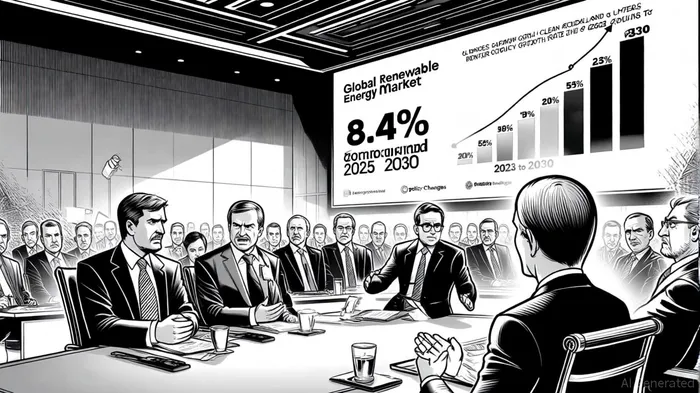
The 119th U.S. Congress, marked by a Republican trifecta of control over the House, Senate, and presidency, has ushered in a new era of energy policy that prioritizes fossil fuels and regulatory rollbacks. This shift has introduced significant uncertainty for the renewable energy sector, with direct implications for stock valuations and long-term investment strategies.
Policy Shifts Under the 119th Congress
The administration's focus on “America First” energy policies has led to the suspension of new offshore wind leases and the rescission of federal support for clean energy permitting[1]. A pivotal legislative move—the “One Big Beautiful Bill” (OBBB) passed in July 2025—phases out key Inflation Reduction Act (IRA) tax credits for wind and solar projects not commenced by mid-2026 or online by 2027[3]. Analysts estimate this could reduce clean capacity additions by 59% between 2025 and 2035, forcing utilities to rely more on natural gas and raising household electricity bills by 18% over the same period[3].
Regulatory complexity has further compounded these challenges. The rescission of the Council on Environmental Quality's (CEQ) National Environmental Policy Act (NEPA) regulations has replaced a unified framework with agency-specific guidelines, creating legal uncertainties for developers[1]. Simultaneously, executive orders have mandated senior-level federal oversight for all stages of wind and solar projects on public lands, adding bureaucratic delays at a critical juncture for project timelines[3].
Market Reactions and Stock Valuations
The immediate market response to these policy shifts was stark. In early July 2025, clean energy stocks dipped 3–5% as investors recalibrated expectations for subsidy-driven growth[3]. Companies like NextEra Energy and Brookfield RenewableBEP-- Partners, which had previously benefited from IRA incentives, now face pressure to accelerate project timelines or pivot to alternative financing models[4].
However, the sector's long-term fundamentals remain resilient. Demand from data centers, AI infrastructure, and manufacturing is projected to drive 44 GW of additional power demand by 2030[2]. This has spurred innovation in energy storage and grid modernization, with Tesla and Plug Power expanding their hydrogen and battery production capabilities[4].
State-Level Mitigation and Investment Opportunities
While federal policies have introduced headwinds, states like California and Texas are stepping in to stabilize the renewables market. California's wind, solar, and storage groups are advocating for expedited environmental reviews to counter federal rollbacks[3], while Texas faces potential delays of 77 GW in new capacity by 2035 due to deteriorating tax incentives[3]. These regional efforts highlight the sector's adaptability and the importance of localized policy engagement for developers.
Investors prioritizing ESG criteria continue to favor renewable energy stocks, with the sector projected to grow at a 8.4% CAGR from 2023 to 2030[4]. Companies that diversify into cleantech manufacturing, AI-driven grid optimization, and carbon capture are well-positioned to navigate the shifting regulatory landscape[2].
Conclusion
The 119th Congress's energy agenda has created a volatile but not insurmountable environment for renewable energy. While short-term policy uncertainties and regulatory bottlenecks pose risks, long-term demand drivers and state-level interventions offer a counterbalance. For investors, the key lies in identifying firms that can adapt to subsidy constraints while leveraging emerging technologies and regional policy opportunities.





Comentarios
Aún no hay comentarios