
Political Risk and Regulatory Compliance: How Policy Enforcement Shapes Media and Political Asset Valuations
The intersection of political risk and regulatory compliance has become a defining factor in the valuation of media and political assets. As governments worldwide recalibrate rules governing campaign finance, media ownership, and content moderation, investors are increasingly scrutinizing how these policies reshape corporate strategies, shareholder value, and market dynamics. From the EU's Digital Services Act (DSA) to U.S. campaign finance reforms, regulatory enforcement is no longer a peripheral consideration-it is a central determinant of asset performance.
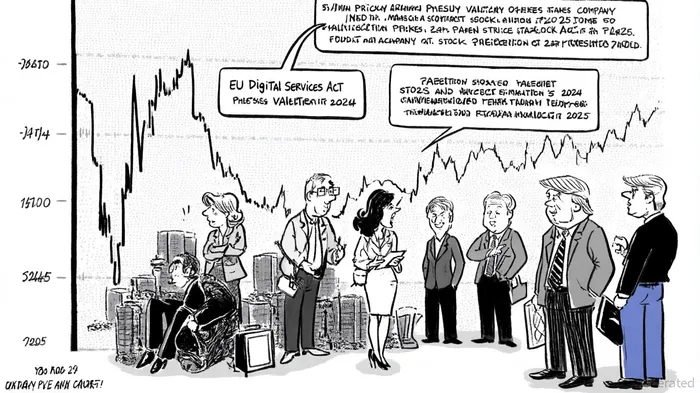
Media Ownership and M&A: Regulatory Scrutiny as a Strategic Catalyst
Regulatory frameworks governing media ownership have directly influenced corporate valuations and merger activity. For instance, Groupe M6's 2023 divestiture of nonvideo websites to focus on core TV and streaming assets reflects a strategic response to tightening regulatory environments, according to Bain's media M&A report. Similarly, the consolidation of media giants like Disney-Fox and Warner BrosWBD--.-Discovery has been constrained by antitrust concerns, forcing firms to pivot toward joint ventures (e.g., ESPN's partnership with Penn National Gaming) to expand market reach, the Bain report notes. These shifts underscore how regulatory restrictions can both constrain and redirect capital allocation, with valuation impacts tied to compliance costs and operational flexibility, according to a FasterCapital analysis.
The re-election of President Trump in 2024 further illustrates this dynamic. Deregulation of traditional media sectors (e.g., broadcasting) has created opportunities for legacy firms to reduce compliance burdens, while tech companies face intensified scrutiny over content moderation practices, a Harvard Law report noted. This bifurcated regulatory landscape has led to divergent valuation trends: traditional media stocks have seen modest gains, whereas tech platforms like Meta grapple with heightened uncertainty, as discussed in a Morningstar analysis.
Content Moderation Mandates: Balancing Compliance and Brand Equity
Content moderation regulations, particularly the EU's DSA and the UK's Online Safety Act, have introduced operational and financial risks for digital platforms. Meta's recent shift from third-party fact-checking to user-driven "Community Notes" has drawn criticism for potentially amplifying misinformation, leading to a 16% stock decline in 2025, the Bain report found. Analysts warn that such policies could trigger advertiser attrition, regulatory fines (e.g., up to 6% of global turnover under the DSA), and reputational damage, the Bain report cautions.
The content moderation market itself is projected to grow to $23.2 billion by 2030, according to the Morningstar analysis. This growth highlights a paradox: while regulatory compliance increases costs, it also creates new revenue streams for platforms that can monetize moderation tools and services. However, the long-term valuation impact hinges on a delicate balance between regulatory alignment and user trust.
Campaign Finance Laws: Transparency as a Market Signal
U.S. campaign finance regulations, shaped by landmark cases like Citizens United v. FEC, have introduced volatility into politically active firms' valuations. Research indicates that companies with historical political contributions saw positive stock reactions around Supreme Court decisions favoring deregulation, as the Morningstar analysis observed. Conversely, firms misaligned with regulatory expectations-such as Tesla and Target-have faced stock volatility and reputational backlash due to poorly governed political spending, the Morningstar analysis also notes.
Shareholder activism has further amplified this dynamic. A 2021 record of 40% adoption rate for shareholder proposals on corporate political spending signals growing investor demand for transparency, according to a Skadden analysis. Firms that fail to disclose political expenditures risk not only regulatory penalties but also loss of investor confidence, as evidenced by the Harvard Law report showing positive stock reactions to successful transparency initiatives.
The Role of Political Risk in Valuation Models
Political risk is no longer an abstract concept but a quantifiable variable in valuation models. For media companies, this includes assessing the likelihood of regulatory fines, shifts in content monetization rules, and geopolitical tensions (e.g., media capture in emerging markets), the Harvard Law report emphasizes. For political assets-such as PACs or lobbying firms-the valuation depends on the stability of regulatory frameworks and the alignment of corporate political strategies with public sentiment, the FasterCapital analysis argues.
The 2024 U.S. election cycle exemplifies this interplay. The nationalization of campaign fundraising, driven by super PACs and online donation platforms, has created a winner-takes-all dynamic where firms with strong political ties see valuation boosts, while those without face marginalization, the FasterCapital analysis finds. This trend is compounded by the rise of ESG (Environmental, Social, and Governance) investing, which increasingly penalizes opaque political spending, the Skadden analysis observes.
Conclusion: Navigating the New Regulatory Paradigm
Investors must now treat regulatory compliance as a core component of risk assessment. The examples of Groupe M6, Meta, and politically active firms demonstrate that policy enforcement can either catalyze growth or erode value, depending on a company's preparedness. As the EU's DSA and U.S. campaign finance reforms evolve, the ability to adapt to regulatory shifts-through strategic partnerships, transparency initiatives, or technological innovation-will determine which firms thrive and which falter.
In this environment, the mantra for investors is clear: regulatory agility is valuation agility.





Comentarios
Aún no hay comentarios