
Political Risk and Municipal Bonds: Trump-Related Uncertainty Reshapes Credit Spreads and Investor Sentiment
The municipal bond market in 2025 has become a barometer for political risk, as Trump-related policy shifts-particularly federal funding cuts, tariff actions, and uncertainty over tax-exempt bond structures-reshape credit spreads and investor behavior. These developments underscore the growing interplay between national politics and local fiscal health, with municipalities like Kansas and Washington, D.C., serving as case studies for the sector's vulnerabilities and resilience.
Credit Spreads and the Shadow of Trump 2.0
The Trump administration's 2025 policies, including abrupt tariff hikes and reductions in federal grants, have introduced volatility into municipal bond markets. For instance, the cancellation of $4.6 billion in FEMA Building Resilient Infrastructure and Communities (BRIC) grants-a lifeline for rural towns like Rising Sun, Maryland, and Kamiah, Idaho-has left municipalities scrambling to address infrastructure gaps, according to a Cumber market commentary. Such cuts have directly impacted credit spreads, with investment-grade (IG) and high-yield (HY) municipal bonds experiencing pronounced widening during periods of policy uncertainty. In April 2025, credit spreads expanded by over 11 basis points following Trump's tariff announcements, reflecting investor fears of retaliatory trade measures and economic slowdown, as noted in a Ninety One report.
The District of Columbia provides a stark example. Moody's downgraded D.C.'s credit rating from "Aaa" to "Aa1" in April 2025, citing projected losses of 40,000 federal jobs (21% of the workforce) and declining Medicaid funding, according to NBC Washington. This downgrade coincided with a 30-basis-point widening in D.C.'s municipal bond spreads, as investors priced in heightened default risks, according to D.C. Bonds data. Similarly, Kansas faced a negative credit outlook from S&P due to federal policy shifts that threatened its tax relief-driven revenue model, as outlined in the Cumber market commentary.
Investor Sentiment: Flight to Stability and Liquidity
Political uncertainty has also reshaped investor behavior. Fund flows data reveals a $15.01 billion outflow from long-term mutual funds in late 2025, as investors prioritized liquidity and safer assets like Treasuries, per an ICI release. High-yield municipal bonds, in particular, have seen declining risk appetite, with corporate defaults rising amid weaker fundamentals. For example, the expiration of pandemic-era aid and rising operational costs have strained K-12 and higher education sectors, prompting rating agencies to scrutinize budgets more closely, a trend also discussed in the Ninety One report.
The SALT deduction cap-a legacy of the 2017 Tax Cuts and Jobs Act-remains a wildcard. While its potential expiration could boost demand for tax-exempt munis among high-income investors, weaker issuers face steeper borrowing costs. This bifurcation is evident in Kansas, where municipalities with strong credit fundamentals have accessed capital markets at favorable rates, while those with weaker fiscal profiles have seen spreads widen by 20–30 basis points, as the Cumber market commentary explains.
Case Studies: Kansas and Washington, D.C.
Washington, D.C.'s downgrade highlights the cascading effects of federal workforce reductions. The city's $1.1 billion budget crisis, exacerbated by lost federal contracts and a struggling commercial real estate market, has forced it to rely on short-term borrowing-a costly proposition in a high-interest-rate environment, as reported by NBC Washington. Meanwhile, Kansas's reliance on federal education and healthcare funding has left it vulnerable to policy reversals. Schools and social service providers there are bracing for cuts to Title I and IDEA programs, which could trigger further credit stress, according to a Kansas.com article.
The Road Ahead: Navigating Political Risk
While the muni market faces headwinds, its structural strengths-such as strong liquidity in healthcare and airports sectors-offer a buffer, as the Cumber market commentary notes. However, investors must remain vigilant. The interplay between federal policy and local fiscal health is likely to persist, with credit spreads remaining sensitive to trade tensions, budget negotiations, and regulatory changes. For municipalities, proactive fiscal planning and diversified revenue streams will be critical to mitigating risks.
In this environment, the municipal bond market's role as a "safe haven" is being redefined. While it retains its tax advantages, the growing influence of political risk demands a more nuanced approach to credit analysis-one that weighs federal policy shifts as rigorously as local governance.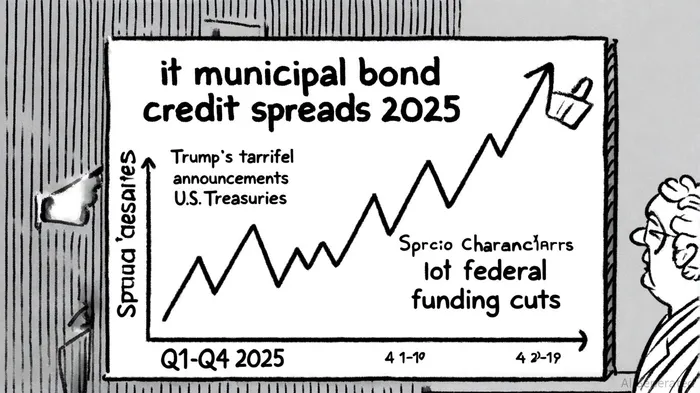







Comentarios
Aún no hay comentarios