
Political Risk and Market Volatility: Navigating the Trump-Era Pardon Landscape
The re-election of Donald Trump in 2024 has reignited debates about the intersection of political risk and financial markets, particularly as his administration moves to issue pardons for allies and figures tied to the January 6 Capitol events. While direct market data on pardon announcements remains sparse, the broader context of Trump's trade policies, deregulatory agenda, and legal maneuvers has already triggered significant volatility. Investors must now grapple with the dual challenges of hedging against both explicit policy shifts and the implicit erosion of institutional trust.
The Historical Precedent: Political Uncertainty and Market Resilience
Historical data suggests that U.S. equity markets often weather political disruptions with surprising resilience. For example, government shutdowns since 1976 have averaged a 0.3% gain during closures, with the S&P 500 rebounding 12–17% in the following 12 months, according to a Landmark Wealth analysis. However, these patterns assume a baseline of predictable uncertainty. Trump's pardons-particularly those targeting high-profile allies or controversial cases-introduce a new layer of legal and political ambiguity. Unlike shutdowns, which are cyclical and policy-driven, pardons are discretionary acts that can signal a breakdown in perceived accountability, potentially eroding public trust in governance, as a Justia Verdict essay explains.
Trump's Trade Policies: A Case Study in Volatility
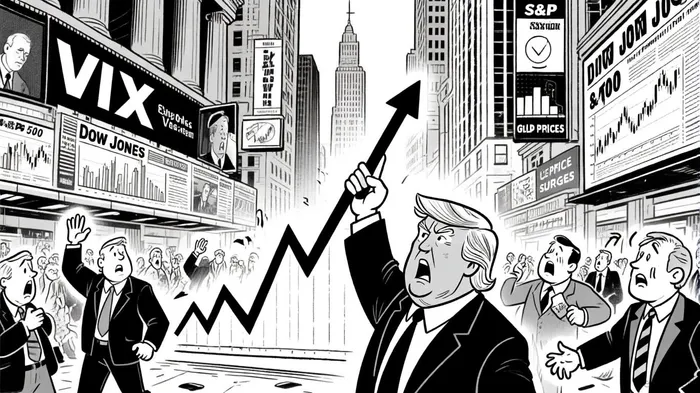
The most immediate market impacts under Trump's second term stem from his aggressive tariff policies. The April 2025 "Liberation Day" announcement-imposing 125% tariffs on Chinese imports and 25% tariffs on Mexico and Canada-triggered an 18.9% drop in the S&P 500 from its February 2025 peak, according to a Forbes analysis. The VIX, or "fear index," surged to levels not seen since the 2008 financial crisis, reflecting investor anxiety over retaliatory trade measures and supply chain disruptions, according to an iShares analysis. These tariffs also disrupted traditional diversification strategies, as both equities and bonds fell simultaneously, undermining the 60/40 portfolio model, according to the same Forbes analysis.
While the market rebounded after a temporary tariff pause, the underlying volatility persists. The Economic Policy Uncertainty (EPU) index has reached pandemic-era levels, signaling a heightened risk of further corrections, as noted in a Forbes column. This environment has forced investors to rethink hedging strategies, with gold emerging as a critical non-correlated asset. By April 22, 2025, gold prices surged to over $3,500 per ounce, outperforming equities and Treasuries, as highlighted in the Forbes analysis.
Hedging Against Legal and Political Risk
Investors seeking to mitigate risks tied to Trump-era pardons and policies must adopt a multi-pronged approach:
Safe-Haven Assets: Gold and inflation-protected bonds have proven resilient amid policy-driven uncertainty. Gold's 2025 surge underscores its role as a hedge against geopolitical and legal instability, a point emphasized in the Forbes analysis. Similarly, Treasury Inflation-Protected Securities (TIPS) offer protection against inflationary pressures from tariffs, as noted in the iShares analysis.
Options-Based Strategies: Defined-risk put spreads in the S&P 500 ETF (SPY) have gained traction, allowing investors to capitalize on price dips while capping losses, a strategy covered in the Forbes column. These strategies are particularly effective in high-volatility environments, though they require careful cost-benefit analysis.
Diversification Beyond Borders: International markets, such as the European DAX, have outperformed U.S. equities in 2025, partly due to increased military spending and less exposure to Trump's trade wars, as discussed in the Forbes column. A global portfolio can reduce reliance on U.S.-centric political risks.
Dynamic Hedging Tools: Forward-starting receive-fixed swaps and interest rate floors have been used to manage currency and rate volatility, outlined in a Derivative Path guide. These instruments are critical for corporations exposed to cross-border trade disruptions.
The Pardon Economy: Legal Anomalies and Market Sentiment
While direct market data on pardons is limited, their indirect effects are palpable. Trump's pardons of January 6 defendants and corporate figures like Trevor Milton (who avoided $676 million in restitution) have fueled perceptions of a "two-tiered justice system," according to a CNBC report. This erodes public trust, which in turn can depress long-term investor confidence. The "pardon economy"-where lobbying firms charge millions to secure clemency-further exacerbates these concerns, as the CNBC report describes.
Conclusion: Preparing for the Unpredictable
The Trump-era landscape demands a shift from passive to proactive risk management. Investors must balance short-term hedging (e.g., gold, options) with long-term diversification (e.g., international equities, TIPS). As the VIX remains elevated and EPU levels persist, adaptability will be key. The market's ability to price in uncertainty will ultimately depend on how effectively investors can separate signal from noise in an era of unprecedented political volatility.







Comentarios
Aún no hay comentarios