
Political Risk and Market Volatility in the Crypto Sector: Trump Pardons and Investor Sentiment in 2025
The crypto sector in 2025 has become a battleground for political risk and regulatory uncertainty, with former President Donald Trump's pro-crypto agenda reshaping investor sentiment and asset valuations. At the heart of this transformation lies a paradox: while Trump's pardons and deregulatory policies have signaled optimism for the industry, broader geopolitical and economic factors have amplified volatility, leaving investors in a tug-of-war between short-term panic and long-term hope.
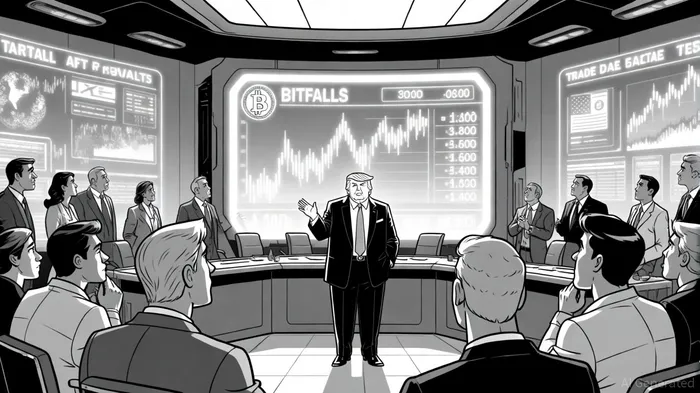
Trump's Pardons: A Regulatory Reset or a Political Gamble?
In March 2025, Trump's decision to pardon BitMEX co-founders Arthur Hayes, Benjamin Delo, and Samuel Reed-along with the company itself-marked a historic shift in U.S. crypto policy. By nullifying a $100 million fine and two years of probation imposed under the Biden administration, Trump effectively erased a landmark enforcement action and signaled a preference for leniency over punitive measures [3]. This move, coupled with the establishment of a Strategic BitcoinBTC-- Reserve and the rescinding of Biden-era crypto regulations, positioned the U.S. as a "crypto capital" [1].
However, the market's response was muted. Despite the perceived regulatory relief, Bitcoin and other cryptocurrencies continued to decline amid broader macroeconomic headwinds, including Trump's 100% tariff on Chinese software imports and escalating trade tensions with China [1]. The pardons, while symbolic, failed to counteract the immediate impact of these macroeconomic pressures, which triggered a $19 billion liquidation event in October 2025, wiping out 1.6 million traders [4].
Political Risk as a Double-Edged Sword
Trump's pro-crypto policies have introduced a duality of risk. On one hand, the administration's focus on deregulation-such as repealing SAB 121 to allow banks to custody crypto and banning U.S. CBDCs-has attracted institutional interest and spurred growth in tokenization and stablecoins [5]. On the other, the same policies have exposed the sector to political volatility. For instance, Trump's endorsement of the TRUMP memecoinMEME-- caused a 60-fold price surge followed by a 70% collapse, highlighting how retail investors are increasingly exposed to hype cycles tied to political figures [2].
The administration's broader economic agenda further complicates the picture. Tariffs on China, Canada, and Mexico have disrupted global supply chains, exacerbating fears of a trade war and pushing investors toward safer assets like gold [3]. This duality-between regulatory optimism and macroeconomic pessimism-has created a fragmented investor sentiment landscape. While institutional players are cautiously optimistic about tokenization and AI-driven blockchain projects, retail investors remain wary of leveraged positions and politically driven price swings [5].
Investor Sentiment: Optimism vs. Skepticism
Data from Q2 2025 reveals a mixed bag of investor behavior. The establishment of the Strategic Bitcoin Reserve and the GENIUS Act's stablecoin framework were initially seen as bullish catalysts, with USDC's market cap surging 78% in six months [1]. Yet, these gains were offset by the October crash, which erased $540 billion in crypto market value and forced a reevaluation of risk tolerance [4].
Retail investors, in particular, face a precarious balancing act. While Trump's pardons and deregulation have lowered entry barriers, the same policies have also normalized speculative behavior. For example, the TRUMP memecoin's volatility underscores how political endorsements can create short-term hype but lack long-term fundamentals [2]. Meanwhile, institutional investors are increasingly prioritizing stablecoins and tokenized assets to mitigate the risks of leveraged trading and geopolitical shocks [5].
The Road Ahead: Navigating Uncertainty
For investors, the key takeaway is clear: political risk in the crypto sector is no longer confined to regulatory shifts but extends to macroeconomic and geopolitical factors. Trump's pardons and pro-crypto agenda have laid the groundwork for innovation, but the sector's volatility remains tied to broader uncertainties.
A would illustrate this interplay. Similarly, a could highlight the systemic risks of political-driven volatility.
Conclusion
The 2025 crypto market has been defined by a collision of political ambition and economic fragility. Trump's pardons and deregulatory policies have undeniably reshaped the industry's trajectory, but their impact on investor sentiment and asset valuations remains contingent on broader macroeconomic stability. As the sector moves forward, investors must balance the allure of regulatory clarity with the realities of geopolitical risk-a challenge that will define the next chapter of crypto's evolution.






Comentarios
Aún no hay comentarios