
Political Risk Hedging in U.S. Equities: Navigating Trump's 6% Resignation Probability and Market Volatility
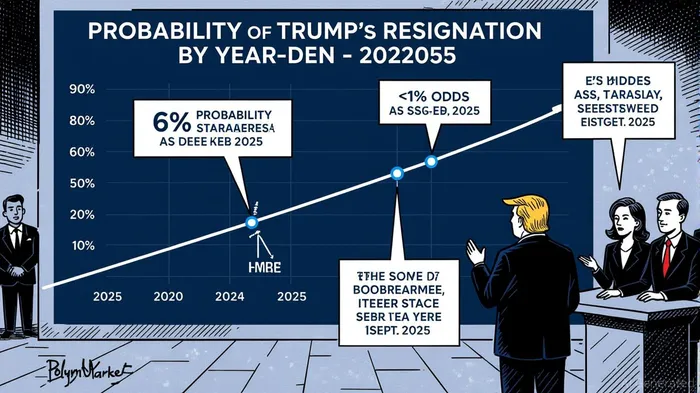
The U.S. equity market is increasingly exposed to political risk volatility, driven by the interplay of speculative betting markets and real-world policy dynamics. A critical focal point is the 6% probability assigned to President Donald Trump stepping down in 2025 by prediction markets like Polymarket, a figure that starkly contrasts with the <1% odds observed in late September 2025 for the same event [1]. This discrepancy underscores the importance of understanding how political risk metrics are constructed—and how investors can hedge against potential turbulence.
The 6% Probability: A Year-End Bet with Market Implications
The 6% probability stems from Polymarket’s year-end contract, which resolves “Yes” if Trump announces resignation by December 31, 2025, regardless of actual implementation [1]. This timeframe distinction is critical: while September 2025 data reflects near-term confidence in Trump’s stability (e.g., public appearances, golfing near Washington, D.C.), the 6% figure incorporates broader uncertainties, including the Epstein scandal and ongoing tensions with the Federal Reserve [2]. These factors have led bookmakers to price in a 30% chance of Trump leaving office early via resignation, impeachment, or health issues [2].
The market’s pricing of political risk is further complicated by Trump’s public clashes with the Fed. For instance, his demands for interest rate cuts and calls for the resignation of Fed Governor Lisa Cook have raised concerns about central bank independence. As of July 2025, the probability of Trump removing Fed Chair Jerome Powell had risen to 20%, up from 10% in early July [2]. While current financial indicators remain stable, prolonged political interference could erode investor confidence, triggering inflationary pressures and market instability [5].
Strategic Hedging: Defensive Sectors and Political Derivatives
Given these risks, investors must adopt a dual strategy: positioning in defensive sectors and leveraging political derivatives to mitigate exposure.
Defensive Sectors as a Buffer
Defensive stocks—such as utilities, healthcare, and consumer staples—historically outperform during periods of political uncertainty. For example, healthcare equities benefit from consistent demand, while utilities remain insulated from cyclical economic shifts. Recent data shows that healthcare ETFs have outperformed tech-heavy indices by 2.3% year-to-date amid heightened political volatility [3]. Similarly, consumer staples firms with strong balance sheets (e.g., Procter & GamblePG--, Coca-Cola) offer predictable cash flows, reducing downside risk in a polarized political climate.Political Derivatives: A New Frontier in Hedging
Prediction markets like Polymarket provide a novel tool for hedging political risk. By purchasing shares in contracts tied to events like Trump’s resignation or removal from office, investors can offset potential losses in equities. For instance, a $10,000 investment in the “Trump resigns in 2025” contract at 6% odds would yield $1,000 if the event occurs, effectively acting as insurance against market sell-offs. These instruments also allow for directional bets: investors can short the contract if they believe the 6% probability is overpriced, capitalizing on market inefficiencies.
The Broader Context: Market Sentiment and Sectoral Exposure
The interplay between political risk and sectoral performance is further amplified by Trump’s approval ratings. As of late 2025, his approval stands at 40% (Reuters/Ipsos), with disapproval at 56% (Economist/YouGov) [4]. This polarization creates a volatile environment where policy shifts—such as aggressive tariff adjustments or regulatory rollbacks—could disproportionately impact sectors like manufacturing, energy, and financials. For example, a sudden reversal of Trump-era tax cuts could weigh on corporate earnings, while a Fed rate hike amid political pressure might exacerbate borrowing costs for leveraged industries.
Conclusion: Balancing Speculation and Prudence
While the 6% probability of Trump’s resignation may seem low, it reflects the market’s acknowledgment of systemic risks in a highly polarized administration. Investors must move beyond binary outcomes and consider the cascading effects of political instability—on the Fed’s credibility, regulatory frameworks, and sectoral dynamics. A diversified approach, combining defensive equities with targeted political derivatives, offers a robust hedge against both idiosyncratic and systemic shocks.
As the 2025 election cycle intensifies, the ability to navigate political risk will become a defining factor in portfolio resilience. The key lies in leveraging data-driven hedging tools while maintaining a long-term perspective on macroeconomic fundamentals.
**Source:[1] Polymarket, “Will Trump resign in 2025?” [https://polymarket.com/event/will-trump-resign-in-2025][2] Economic Times, “Bookies slash Trump’s odds of completing second term” [https://m.economictimes.com/news/international/us/bookies-slash-trumps-odds-of-completing-second-term-epstein-drama-sends-betting-markets-reeling/articleshow/122909485.cms][3] FXTrendo, “A Comprehensive Review Of Recent Developments Between Trump and the Fed” [https://fxtrendo.com/trump-powell-recent-developments/][4] Reuters/Ipsos, “Trump approval rating at 40%” [https://www.audacy.com/knxnews/news/national/as-newsom-attacks-trump-his-approval-rating-rises][5] The Globe and Mail, “Donald Trump’s fresh Fed attack simmers in markets” [https://www.theglobeandmail.com/investing/article-donald-trumps-fresh-fed-attack-simmers-in-markets/]







Comentarios
Aún no hay comentarios