
Political Risk and Asset Recovery in Crypto Collapses: The Trump Pardon Speculation's Impact on FTT Valuation
Political Risk and Asset Recovery in Crypto Collapses: The Trump Pardon Speculation's Impact on FTTFTT-- Valuation
The Intersection of Politics and Crypto Markets
The collapse of FTX in 2022 and the subsequent legal saga of Sam Bankman-Fried (SBF) have created a unique case study in how political risk intersects with cryptocurrency valuations. In 2025, speculation about a potential presidential pardon for SBF from former U.S. President Donald Trump has become a dominant narrative influencing FTX TokenFTT-- (FTT) valuation. This phenomenon underscores a broader trend: in crypto markets, where regulatory frameworks remain fluid, political developments can act as both catalysts and destabilizers for asset prices.
Trump Pardon Speculation and FTT's Volatility
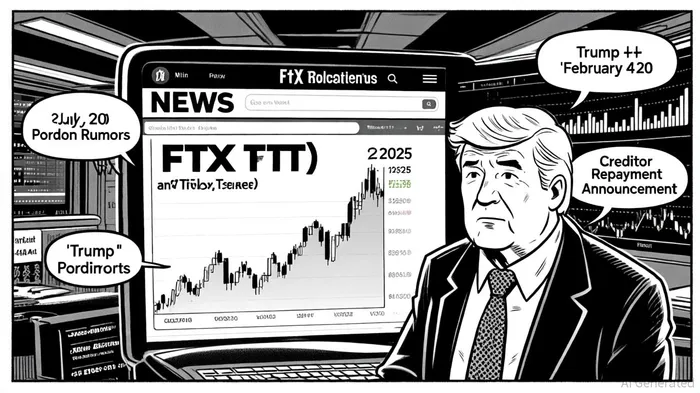
The most dramatic example of this dynamic occurred on July 20, 2025, when FTT surged approximately 43% to $1.30 following unverified reports that SBF had received a pardon from Trump[1]. Despite the absence of any official confirmation or evidence on the Justice Department's website, the market reacted with fervor, driven by SBF's active clemency campaign and his family's lobbying efforts[2]. This volatility highlights a critical insight: in crypto, sentiment often outpaces reality.
Political figures like Senator John Kennedy have criticized such speculation, arguing it undermines legal accountability[3]. Meanwhile, industry observers like Elon Musk have fueled rumors, suggesting SBF's pardon is "possible" despite experts noting Trump's transactional clemency history and SBF's Democratic affiliations as obstacles[4]. The result is a market in which FTT's price becomes a barometer for political uncertainty rather than fundamental metrics.
Market Mechanics: How Political Events Drive Token Valuation
FTT's price movements in 2025 reveal a dual influence:
1. Creditor Repayment Plans: In February 2025, FTX's announcement to begin repaying creditors spurred a 4.5% price increase, with FTT trading near $2[5]. This development, while positive, was overshadowed by the July 2025 pardon rumors, which created a more immediate but speculative tailwind.
2. Technical and On-Chain Indicators: On-chain data showed a $2.05 million outflow of FTT from exchanges, signaling long-term investor accumulation[5]. However, technical indicators like overbought RSI levels and Fibonacci resistance at $1.08–$1.43 suggested short-term volatility[3].
Price predictions for FTT varied widely, with bullish forecasts projecting a $6.50 target under favorable market conditions[1], while bearish analyses warned of sell pressure as creditors liquidated holdings[3]. This divergence reflects the token's precarious position between optimismOP-- over asset recovery and skepticism about its long-term utility.
Historical backtests from 2022 to the present show that strategies combining RSI overbought signals and resistance levels have improved risk management and trading accuracy, aligning with the observed price dynamics in FTT's case[3]. For instance, during periods when FTT approached its $1.43 resistance level, overbought RSI readings (above 70) often preceded sharp corrections, reinforcing the value of these technical signals in managing exposure[3].
Broader Implications for Investor Sentiment
The FTT case illustrates how political risk can dominate investor psychology in crypto markets. Unlike traditional assets, cryptocurrencies often lack the institutional safeguards of equity or bond markets, making them hyper-sensitive to external shocks. For instance, SBF's July 2025 X post-a surprise message from his account-triggered a 60% price spike, only for gains to reverse quickly[4]. Such events erode trust, as investors struggle to distinguish between genuine progress and noise.
Moreover, the interplay between asset recovery and political speculation complicates valuation models. While FTX's creditor repayment plan represents a tangible step toward stabilizing FTT's ecosystem, the token's price remains tethered to SBF's legal fate. This duality raises questions about whether FTT can transition from a speculative asset to one with intrinsic value.
Conclusion: Navigating the Political-Crypto Nexus
For investors, the FTT saga serves as a cautionary tale. Political risk in crypto is not abstract-it is a force capable of reshaping markets overnight. While SBF's pardon prospects remain dim, the mere possibility has demonstrated the power of narrative in driving asset prices. As 2025 unfolds, FTT's trajectory will hinge on its ability to overcome key resistance levels and decouple from the volatility of its founder's legal drama.
In an industry where regulatory clarity is still emerging, the lesson is clear: political developments must be treated as both an opportunity and a threat. For FTT, the path to recovery will require more than clemency rumors-it will demand a reimagining of its role in a post-FTX world.






Comentarios
Aún no hay comentarios