
The Political and Regulatory Risks and Opportunities in U.S. Crypto Legislation
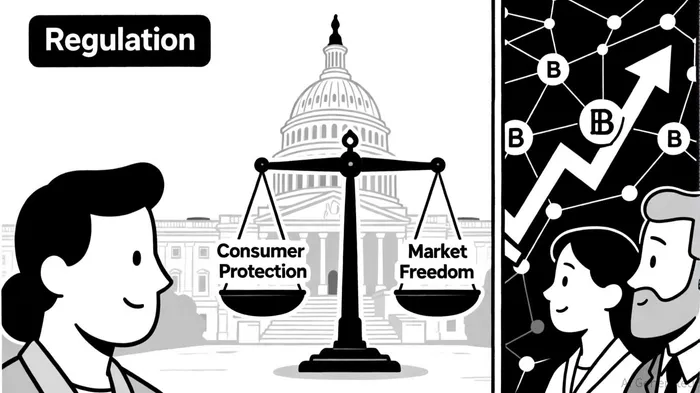
The U.S. crypto market stands at a crossroads, with Senate Democrats' newly unveiled crypto market structure plan poised to reshape institutional adoption and long-term market stability. As regulatory frameworks evolve, investors must navigate a complex interplay of political agendas, enforcement priorities, and technological innovation. This analysis examines the implications of the Democrats' proposal, contrasting it with Republican alternatives and assessing the risks and opportunities for market participants.
Key Provisions and Institutional Implications
The Senate Democrats' framework centers on seven pillars, including assigning the Commodity Futures Trading Commission (CFTC) exclusive jurisdiction over non-security crypto markets and the Securities and Exchange Commission (SEC) over securities. This division aims to eliminate regulatory arbitrage but risks creating jurisdictional friction, particularly for hybrid assets. For institutions, clarity on these boundaries could reduce compliance costs and litigation risks, fostering greater participation in crypto markets.
A critical provision requires digital asset platforms to register as financial institutionsFISI-- under the Bank Secrecy Act, subjecting them to anti-money laundering (AML) and sanctions enforcement. While this strengthens oversight, it may also increase operational burdens for smaller platforms, potentially consolidating market power among larger players. Decentralized finance (DeFi) remains a gray area, with the framework calling for oversight but leaving unresolved questions about whether protocol developers must register. This ambiguity could deter institutional investment in DeFi, which relies on decentralized governance models.
Market Stability and Political Dynamics
Market stability hinges on the balance between regulation and innovation. The Democrats' plan includes bipartisan rulemaking mandates and increased funding for regulators, aiming to prevent partisan capture of the regulatory process. However, critics argue that the GOP's competing Clarity Act, which emphasizes a regulatory sandbox for innovation, might better preserve market dynamism. The House's recent passage of the GENIUS Act for stablecoin oversight and the CLARITY Act highlights a fragmented legislative landscape, where conflicting priorities could delay comprehensive reform.
Political tensions further complicate the outlook. Democrats have criticized the GOP's draft for creating AML loopholes, particularly for offshore stablecoins like Tether. Senator Elizabeth Warren's vocal opposition to the GOP bill—calling it a threat to U.S. capital markets—underscores the high stakes. For investors, these debates signal a prolonged period of uncertainty, with market stability contingent on whether a bipartisan compromise emerges.
Risks and Opportunities for Investors
Regulatory Risks: Overly rigid frameworks could stifle innovation, particularly in DeFi and tokenized assets. The Democrats' focus on AML compliance, while laudable, may inadvertently burden protocols with compliance costs that outweigh their utility. Conversely, the GOP's emphasis on decentralization could leave gaps in consumer protection, increasing exposure to fraud and market manipulation.
Opportunities: A well-crafted regulatory regime could unlock institutional adoption by reducing legal uncertainty. The House's FIT21 Act, which addresses accounting challenges for cryptocurrencies, and the GENIUS Act's stablecoin framework demonstrate how targeted reforms can attract traditional investors. Additionally, the Democrats' ban on elected officials profiting from crypto projects may restore public trust, indirectly boosting market legitimacy.
Conclusion
The Senate Democrats' plan represents a significant step toward stabilizing the crypto market, but its success depends on resolving jurisdictional conflicts and aligning with GOP priorities. For investors, the path forward involves hedging against regulatory volatility while capitalizing on sectors likely to benefit from clarity—such as stablecoins and institutional-grade custody solutions. As the 2025 legislative cycle unfolds, the ability to adapt to shifting political winds will separate resilient portfolios from speculative bets.
Source:
[1] Senate Democrats unveil crypto market structure framework [https://www.theblock.co/post/370018/senate-democrats-crypto-market-structure-framework]
[2] House passes FIT21 Act [https://www.financialplanningassociation.org/learning/publications/journal/SEP24-politics-bitcoin-open]
[3] GENIUS Act and CLARITY Act analysis [https://chavanette.com/news/tickertape-137/]
[4] GOP's Clarity Act details [https://coincentral.com/senate-pushes-draft-bill-to-clarify-crypto-rules-and-strengthen-bitcoin-regulation/]






Comentarios
Aún no hay comentarios