
Political and Regulatory Risks: How Congressional Scrutiny of Musk and Thiel Could Reshape Tech Stock Valuations
The tech sector is facing a perfect storm of political and regulatory risks as congressional investigations into figures like Elon Musk and Peter Thiel intensify. These probes, coupled with their expanding influence in government and corporate spheres, are not just reshaping public perception but also sending shockwaves through investor sentiment and stock valuations. For investors, the stakes are clear: understanding how these dynamics play out could mean the difference between capital preservation and catastrophic losses.
Musk's Balancing Act: Government Power vs. Corporate Accountability
Elon Musk's appointment to lead the Department of Government Efficiency (DOGE) under President Trump has ignited a firestorm of ethical and legal concerns. According to a report by the Los Angeles Times, Musk's companies—Tesla, SpaceX, and Neuralink—face at least $2.37 billion in potential federal penalties due to alleged conflicts of interest[1]. This figure grows when considering the $38 billion in government contracts and subsidies these firms have already secured[1].
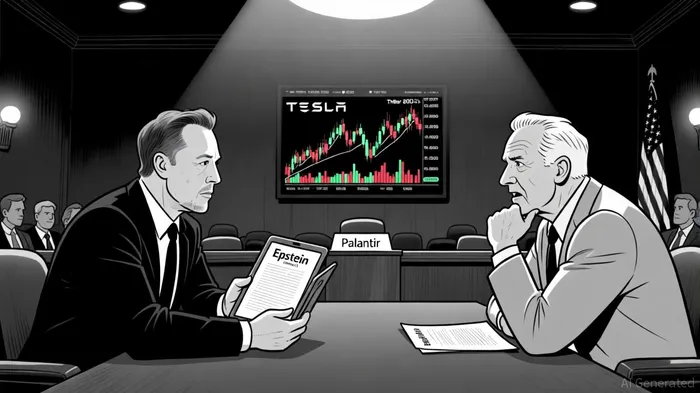
The House Oversight Committee's recent release of Jeffrey Epstein estate documents has further complicated Musk's position. While no evidence confirms Musk or Epstein exchanged direct knowledge of criminal activities, the 2014 notation of a planned visit to Epstein's private island has fueled partisan outrage[2]. As stated by Senator Richard Blumenthal's subcommittee, Musk's dual role as a government official and CEO creates a “self-enrichment loop” that could undermine federal oversight[1].
Investor sentiment reflects this unease. A Morgan Stanley survey found 85% of respondents believe Musk's political activities are harming Tesla's fundamentals, with 40% of investors describing the impact as “extremely negative”[3]. Tesla's stock has plummeted nearly 40% year-to-date, mirroring a broader sell-off in high-valuation tech stocks[3]. Consumer backlash, including protests and vandalism at TeslaTSLA-- showrooms, has compounded these challenges[3].
Thiel's Shadow: Palantir Profits and Political Leverage
Peter Thiel's influence extends beyond his libertarian ideology. As a key Trump ally, Thiel has funneled over $850,000 into GOP campaigns to secure the House majority, while his company, Palantir, reaps the rewards of a privatized federal government[4]. Palantir's contracts—ranging from a $795 million Department of Defense deal to a $29.9 million ICE system for deportation prioritization—have drawn sharp criticism for enabling mass surveillance and eroding privacy rights[4].
Thiel's political donations align with his corporate interests. By backing candidates who advance policies like Project 2025—a far-reaching conservative governance plan—Thiel ensures favorable regulatory environments for Palantir and other tech firms[4]. This symbiotic relationship has raised alarms among Democrats, with Rep. Alexandria Ocasio-Cortez and Sen. Ron Wyden demanding transparency over potential conflicts of interest[4].
The market has taken notice. While Palantir's stock remains resilient, its valuation is increasingly tied to the political fortunes of Trump-aligned policies. A Mother Jones investigation highlights how Thiel's financial support of Republicans could backfire if regulatory scrutiny over data privacy or war crimes allegations intensifies[4].
Market Reactions: A Tech Sector on Edge
The “Magnificent Seven” tech stocks—Alphabet, Amazon, Apple, Meta, Microsoft, Nvidia, and Tesla—now account for 37% of the S&P 500's market cap, creating systemic risks[5]. Congressional scrutiny of Musk and Thiel is exacerbating fears of overvaluation, particularly for Tesla and Palantir. Nvidia's P/E ratio of 57 and Broadcom's 110 are already drawing comparisons to the dot-com bubble[5].
Investor behavior is shifting. A Financial Content analysis notes a rotation out of high-valuation tech stocks into defensive sectors like utilities and consumer staples[5]. The S&P 500's tech sector recently suffered its worst day since 2020, dropping 5.6% amid fears of regulatory crackdowns and Trump-era tariffs disrupting global supply chains[5].
Strategic Implications for Investors
For investors, the lesson is clear: diversification and regulatory vigilance are paramount. Musk's and Thiel's entanglements highlight how personal and political ambitions can destabilize corporate value. Tesla's struggles underscore the risks of tying a company's fate to a CEO's political persona, while Palantir's success demonstrates the rewards—and dangers—of aligning with privatized governance.
In this climate, investors should:
1. Monitor regulatory developments closely, particularly around DOGE's oversight of Musk's companies.
2. Reassess exposure to high-valuation tech stocks, favoring firms with less political entanglement.
3. Bolster portfolios with defensive assets, given the likelihood of broader market corrections.
The tech sector's future hinges on whether Congress can rein in the unchecked power of billionaires—or whether figures like Musk and Thiel will continue to blur the lines between governance and self-interest. For now, the market is betting on the latter, but history suggests that regulatory gravity always wins in the end.





Comentarios
Aún no hay comentarios