
The Political and Regulatory Crossroads of U.S. Crypto Markets in 2025
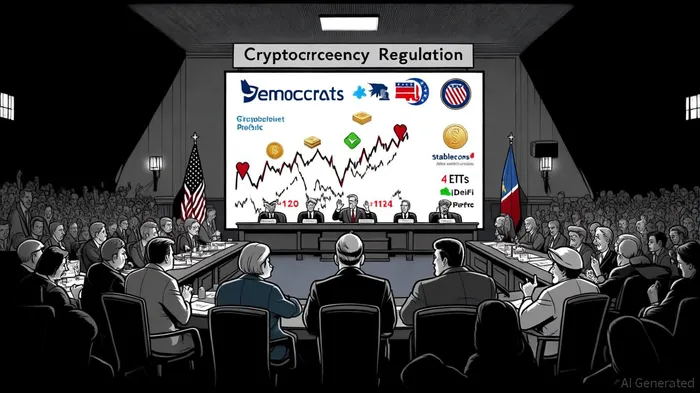
The U.S. crypto market in 2025 stands at a pivotal juncture, where bipartisan legislative efforts are reshaping the regulatory landscape and unlocking strategic investment opportunities. With the Senate Banking Committee's Responsible Financial Innovation Act of 2025 (RFIA) and the House's CLARITY Act advancing in parallel, the industry is witnessing a rare alignment of political will to address long-standing uncertainties. These developments are not just regulatory milestones—they are catalysts for innovation, institutional adoption, and capital reallocation.
Bipartisan Frameworks: A New Era of Clarity
The RFIA, a 182-page discussion draft released by the Senate Banking Committee, seeks to define critical terms like “Ancillary Assets” and “Decentralized Governance Systems” while establishing a regulatory framework for digital asset market participants [1]. This bill aims to streamline compliance by assigning clear roles to the SEC and CFTC, reducing the jurisdictional ambiguity that has plagued the sector for years. Meanwhile, Senate Republicans' updated Market Structure Bill proposes a unified regulatory path for digital asset businesses, eliminating the need for a patchwork of state licenses [2].
The House's CLARITY Act complements these efforts by categorizing digital assets into distinct tiers—digital commodities, investment contracts, and permitted payment stablecoins—each with tailored regulatory obligations [3]. This tiered approach, combined with the SEC's recent Project Crypto initiative to modernize securities laws, signals a shift from enforcement-heavy tactics to structured compliance pathways [4].
Strategic Opportunities in Stablecoins and ETFs
The GENIUS Act, signed into law on July 18, 2025, has already transformed the stablecoin market. By mandating 1:1 reserves of U.S. dollars or short-term Treasurys for payment stablecoins, the law has bolstered institutional trust and accelerated adoption in cross-border transactions [5]. For investors, this creates a unique opportunity to capitalize on stablecoin-driven liquidity solutions and tokenized securities markets.
Simultaneously, the SEC's expedited approval process for crypto ETFs is gaining momentum. Exchanges like Cboe BZX, Nasdaq, and NYSE Arca have submitted filings proposing standardized listing criteria for ETFs, mirroring the 2019 ETF Rule in traditional equities [6]. Ten tokens—DOGE, BCH, LTC, LINK, XLM, AVAXAVAX--, SHIBSHIB--, DOT, SOL, and HBAR—currently meet these criteria, with ADAADA-- and XRPXRP-- poised to join soon. This fast-track system could unlock billions in institutional capital, particularly as banks adapt to SAB 122, which simplifies crypto custody services [7].
DeFi's Regulatory Momentum
The DeFi sector is also experiencing a renaissance, driven by the GENIUS Act and the SEC's recalibration of enforcement priorities. The Senate's stablecoin framework has provided clarity for decentralized finance protocols, enabling institutional participation in yield-generating platforms and tokenized lending markets [8]. Meanwhile, the SEC's 60-day pause of its Binance lawsuit suggests a pivot toward collaboration over confrontation, fostering a more predictable environment for DeFi innovators [9].
Navigating Risks and Challenges
Despite these advancements, challenges persist. The Trump family's involvement in memecoins and DeFi platforms like World Liberty introduces political risks that could delay bipartisan consensus [10]. Additionally, Democrats' push for restrictions on elected officials' crypto profits and enhanced anti-money laundering safeguards may add friction to regulatory negotiations [11].
Conclusion: Positioning for Long-Term Gains
The 2025 regulatory crossroads present a golden opportunity for investors to align with sectors poised for explosive growth. Stablecoins, ETFs, and DeFi are not just surviving the regulatory spotlight—they are thriving under it. By leveraging the clarity provided by the GENIUS Act and CLARITY Act, investors can strategically allocate capital to platforms and tokens that benefit from institutional adoption, cross-border utility, and structured compliance.
As the U.S. Congress races to finalize these frameworks before the 2026 elections, the key takeaway is clear: the future of crypto is being written in Washington, and those who act now will reap the rewards of a newly defined digital asset ecosystem.






Comentarios
Aún no hay comentarios