
Political Polarization and Market Volatility: Navigating the New Normal in Investment Strategies
Election Cycles and Volatility: A New Paradigm
The 2020–2024 election cycle has underscored how political polarization amplifies market volatility. According to a report by Research Affiliates, abnormal volatility peaks during pre-election months and election weeks, particularly in close, contentious races. This volatility is driven by partisans adopting risk-off strategies ahead of elections-fearing a loss of their preferred outcome-and pivoting to risk-on positions post-election as uncertainty dissipates according to the report. For example, during the 2024 presidential race, value stocks outperformed growth stocks, while small-cap equities rebounded sharply after Election Day as research shows. These patterns suggest that investors are pricing in political uncertainty more than policy specifics, a shift that challenges traditional market analysis.
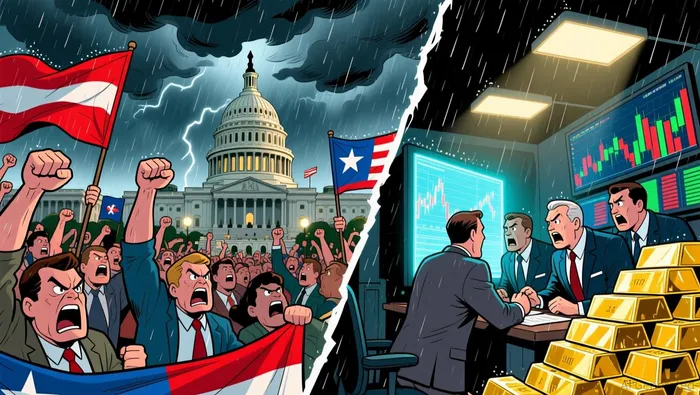
The 2025 government shutdown, the longest in U.S. history, further illustrates this trend. During the 43-day impasse, gold prices fluctuated between $3,900 and $4,200 per ounce, reflecting safe-haven demand amid political instability. Meanwhile, silver exhibited even greater volatility, with intraday swings exceeding $2 per ounce according to market analysis. Such events highlight how legislative gridlock-rather than policy substance-can dominate market psychology.
Sector-Specific Impacts: Policy Divergence and Investor Behavior
Political polarization has also reshaped sector dynamics. A 2025 study by Tidewater Financial notes that anticipated tax cuts under a Trump administration could boost corporate profits and equity valuations, particularly in small-cap and banking sectors. Conversely, a Harris-led policy agenda-emphasizing infrastructure and green energy-might favor utilities and renewable energy stocks.
Geopolitical tensions further complicate these dynamics. For instance, Trump's proposed tariff cuts on food imports aim to alleviate inflation but risk retaliatory measures from trading partners, potentially destabilizing emerging markets. Meanwhile, U.S.-China trade disputes have pushed investors toward diversified international portfolios and alternative assets like commodities according to financial analysis.
Partisan Portfolios: The Rise of Ideological Investing
The ideological alignment of portfolios has become a defining feature of modern investing. A University of Washington study introduced the Partisan Portfolio Disagreement (PPD) metric, revealing that by 2019, 20% of portfolios had diverged along party lines. Democratic-leaning investors gravitate toward tech giants like Microsoft and Amazon, while Republican-leaning portfolios favor energy and industrial stocks like ExxonMobil. This trend is exacerbated by ESG investing and personalized indexing, which allow investors to align portfolios with political values.
Economist Barry Eichengreen warns that such polarization risks entrenching fiscal gridlock, complicating efforts to manage the $38 trillion national debt. Without bipartisan consensus, spending cuts or tax reforms-critical for stabilizing public finances-remain elusive, creating long-term inflationary pressures and market uncertainty.
Strategic Implications for Investors
For investors, the key lies in balancing short-term opportunities with long-term resilience. In high-polarization environments, diversification into inflation-linked assets (e.g., TIPS, commodities) and defensive sectors (e.g., utilities, healthcare) can mitigate volatility. Additionally, hedging against geopolitical risks-through exposure to gold, energy, or international markets-has become essential.
The 2024 election cycle offers a blueprint: investors who anticipated Trump's deregulatory agenda overweighted energy and small-cap stocks, while those betting on Harris's policies leaned into infrastructure and green energy. However, the rapid shifts in market sentiment post-election underscore the need for agility.
Conclusion
Political polarization is no longer a background factor but a central driver of market behavior. As the 2025–2026 cycle unfolds, investors must navigate a landscape where partisanship shapes not only policy but also asset prices. The challenge lies in distinguishing between transient volatility and enduring structural shifts-a task that demands both data-driven analysis and a nuanced understanding of the political forces at play.







Comentarios
Aún no hay comentarios