
Political Polarization and the Education Sector: Navigating Regulatory Overreach and Free Speech Conflicts as Investment Risks
The education sector in 2025 is increasingly shaped by a volatile interplay of political polarization, regulatory overreach, and free speech controversies. These dynamics are not only reshaping institutional practices but also creating significant risks for public sector employment stability and institutional trust. For investors, understanding these trends is critical to assessing long-term viability in a sector already grappling with affordability crises and shifting public expectations.
Regulatory Overreach and the Erosion of DEI Frameworks
The Trump administration's Executive Order 14173, which redefined diversity, equity, and inclusion (DEI) initiatives as "illegal" if they prioritize race or gender, has triggered a seismic shift in higher education. Institutions are now forced to dismantle or rebrand DEI programs to avoid legal repercussions under the False Claims Act, as enforced by the Department of Justice's Civil Rights Fraud Initiative. This has led to the dissolution of employee resource groups, the cancellation of federal grants tied to DEI, and the loss of staff dedicated to equity-focused work according to research.
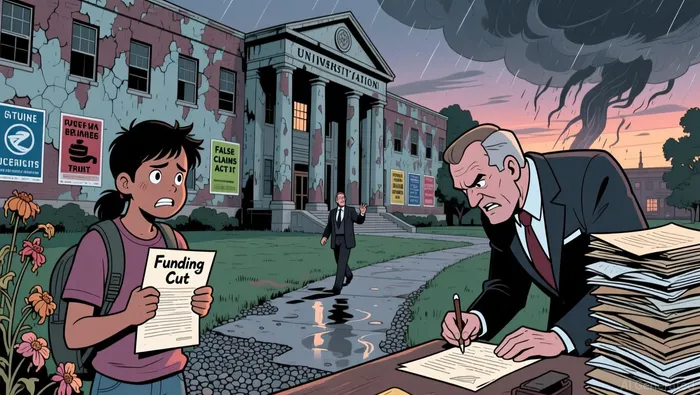 The financial and operational costs of compliance are staggering. For example, public universities have faced funding cuts to programs like TRIO, which support first-generation and underrepresented students, threatening decades of progress in diversifying enrollment. Meanwhile, gender-based admissions practices-once used to balance student demographics-are now under scrutiny, with experts predicting potential disadvantages for white male applicants. These changes create a climate of uncertainty, as institutions struggle to align with rapidly evolving federal and state directives while maintaining their missions of inclusivity according to analysis.
Free Speech Conflicts and the Fragmentation of Curricula
Parallel to DEI policy shifts, free speech controversies have intensified, particularly in states like Texas and Oklahoma. Laws restricting discussions on race, gender, and LGBTQ+ issues-such as Texas's H.B. 900 and Oklahoma's HB 1775-have led to the banning of over 1,700 books in Texas schools and legal battles over curricular content. The Supreme Court's ruling in Mahmoud v. Taylor, which allows parents to opt their children out of LGBTQ+ inclusive curricula, further complicates the balance between free speech and religious freedom.
These developments have created a patchwork of restrictions that undermine academic freedom. According to the 2025 College Free Speech Rankings by FIRE, 55% of students find the Israeli-Palestinian conflict difficult to discuss openly on campus, while 76% support limiting controversial speakers. Such polarization fosters a culture of self-censorship among faculty and students, eroding the collaborative environment essential to education.
Employment Instability and Eroding Institutional Trust
The combined impact of these pressures is evident in employment trends and public trust metrics. Universities have implemented hiring freezes and staff reductions in DEI departments, with some institutions losing critical personnel who support equity initiatives as reported. A Northeastern University survey found that 49% of Americans now express concerns about campus free speech, while 67% cite political bias as a serious problem according to findings.
Despite these challenges, public confidence in higher education has marginally increased, with 47% of Americans expressing "a great deal" or "quite a lot" of trust in institutions, according to a poll. However, this confidence is fragile. Enrollment trends reveal a growing divide: while some institutions adapt to political pressures, others face declining applications from underrepresented groups who perceive DEI rollbacks as exclusionary as noted.
Investment Implications
For investors, the education sector's stability hinges on its ability to navigate these dual crises. Institutions that proactively address regulatory risks-such as by rebranding DEI efforts as "merit-based" or leveraging private funding to offset federal cuts-may retain competitive advantages. Conversely, those failing to adapt risk reputational damage, declining enrollment, and legal liabilities.
The sector's long-term viability also depends on resolving the tension between political polarization and educational mission. As the Supreme Court continues to shape the legal landscape, institutions must balance compliance with the preservation of academic freedom. For now, the path forward remains fraught with uncertainty, demanding a strategic, data-driven approach to investment.







Comentarios
Aún no hay comentarios