
The Political and Market Implications of Trump's Biofuel Policy Shifts on U.S. Energy Markets
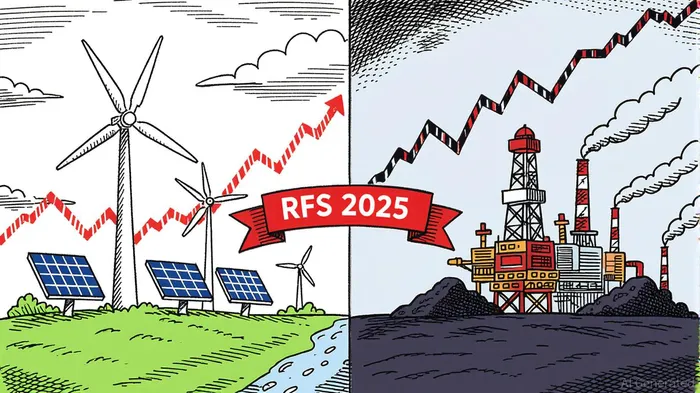
The Trump administration’s 2025 biofuel policy overhaul has ignited a seismic shift in U.S. energy markets, recalibrating the balance between renewable energy and fossil fuel equities. By prioritizing domestic biofuel production under the Renewable Fuel Standard (RFS) and advancing an "America First" energy agenda, the administration is reshaping regulatory, economic, and geopolitical dynamics. For investors, the implications are stark: renewable energy sectors face heightened risks from policy rollbacks, while fossil fuels gain a more favorable regulatory environment.
Strategic Risks for Renewable Energy Equities
The administration’s focus on domestic biofuels—such as biodiesel and ethanol—has introduced a dual-edged sword for renewable energy. While the EPA’s proposed RFS mandates for 2026 and 2027 aim to boost U.S. biofuel production, they also risk overreaching. Critics argue that the proposed volume requirements exceed domestic feedstock availability, forcing reliance on imported vegetable oils and inflating costs for consumers [3]. This tension is compounded by the administration’s decision to assign foreign biofuels only 50% of the value of domestic ones, a move that could strain supply chains and deter investment in cross-border renewable projects [3].
Moreover, the GOP energy bill’s cuts to federal tax credits for wind, solar, and electric vehicles signal a broader retreat from clean energy subsidies [4]. According to a report by Argus Media, tariffs on aluminum and steel—key materials for renewable infrastructure—have already increased project costs, deterring developers from expanding utility-scale solar and wind capacity [1]. The result? A 2% decline in new renewable capacity additions in the first half of 2025 compared to 2024 [1].
Financial metrics underscore these risks. Renewable energy companies have seen a 7.4% decline in average TOPSIS scores since Trump’s withdrawal from the Paris Agreement, reflecting eroded investor confidence [2]. Meanwhile, China’s aggressive investments in hydrogen and long-duration storage technologies are outpacing U.S. innovation, further complicating the competitive landscape [3].
Opportunities for Fossil Fuel Equities
Conversely, the administration’s pro-fossil fuel policies are creating a more hospitable environment for traditional energy sectors. Executive orders promoting oil, gas, and coal development—coupled with reduced environmental regulations—have lowered compliance costs for producers. For instance, the reclassification of coal as a "strategic national asset" and streamlined permitting for LNG exports are expected to bolster margins for companies like ExxonMobil and ChevronCVX-- [4].
The EPA’s recent decision to limit small refinery exemptions under the RFS has also shifted compliance burdens to larger refiners, indirectly supporting biofuel producers while reducing regulatory friction for fossil fuel firms [6]. Additionally, the administration’s rollback of climate-focused policies, including the revocation of Executive Order 13990, has reduced uncertainty for oil and gas operators, prompting a 12% rebound in E&P sector valuations year-to-date [5].
However, investors must remain cautious. Global trends show fossil fuels underperforming the broader market over the past decade, and structural shifts toward decarbonization persist [2]. BP’s 2025 strategy—prioritizing oil and gas while allocating only $1.5–2 billion annually to renewables—exemplifies the sector’s precarious balancing act [1].
Navigating the Policy-Driven Energy Transition
The interplay between Trump’s biofuel policies and broader energy agenda creates a fragmented landscape. While domestic biofuels may benefit from RFS mandates, the administration’s emphasis on fossil fuels risks undermining long-term decarbonization goals. For example, Aemetis’ expansion into India’s biodiesel market highlights the potential for niche renewable players to thrive under supportive regional policies, even as federal incentives wane [2].
Investors must also weigh geopolitical risks. The U.S. retreat from energy innovation—evidenced by $3.7 billion in canceled industrial demonstration projects—has ceded ground to China, which now leads in hydrogen and steel decarbonization technologies [3]. This shift could erode U.S. competitiveness in emerging clean energy markets.
Conclusion
Trump’s 2025 biofuel policy shifts present a high-stakes recalibration of U.S. energy markets. For renewable energy equities, the risks are acute: reduced federal support, supply chain bottlenecks, and global competition. Fossil fuels, meanwhile, enjoy a temporary tailwind from regulatory easing and strategic policy priorities. Yet, the long-term trajectory remains uncertain, as market forces and state-level climate initiatives continue to drive decarbonization. Investors must adopt a nuanced approach, hedging against policy volatility while capitalizing on sector-specific opportunities.
Source:
[1] Tariffs, policy shifts hold back US renewables [https://www.argusmedia.com/en/news-and-insights/latest-market-news/2728768-tariffs-policy-shifts-hold-back-us-renewables]
[2] The impact of U.S. political decisions on renewable and fossil energy companies [https://www.sciencedirect.com/science/article/abs/pii/S1544612324011942]
[3] Trump's Energy Innovation Retreat Is a Win for China, Loss for Climate [https://www.cfr.org/expert-brief/trumps-energy-innovation-retreat-win-china-loss-climate]
[4] How the G.O.P. Bill Will Reshape America's Energy [https://www.nytimes.com/2025/07/03/climate/congress-bill-energy.html]
[5] Power Moves: How Trump's Agenda Will Shape a Fossil [https://capstonedc.com/insights/energy-2025-preview/]
[6] Trump Hands Biofuel Producers and Farmers Another Win with EPA Mandates [https://www.bloomberg.com/news/newsletters/2025-08-27/trump-hands-biofuel-producers-and-farmers-another-win-with-epa-mandates]





Comentarios
Aún no hay comentarios