
Political Instability Risks in U.S. Equities: Executive Overreach, Insurrection Rhetoric, and the Rise of Defensive Allocations
The U.S. equity market in 2024-2025 has been defined by a volatile interplay between political instability and investor behavior, driven by executive overreach and insurrection rhetoric. As former President Donald Trump's administration escalated aggressive trade policies and normalized emergency governance, market participants recalibrated their strategies to mitigate risks. This analysis examines how these political dynamics have reshaped market volatility and spurred a shift toward defensive stock allocations.
Executive Overreach and the Normalization of Crisis Governance
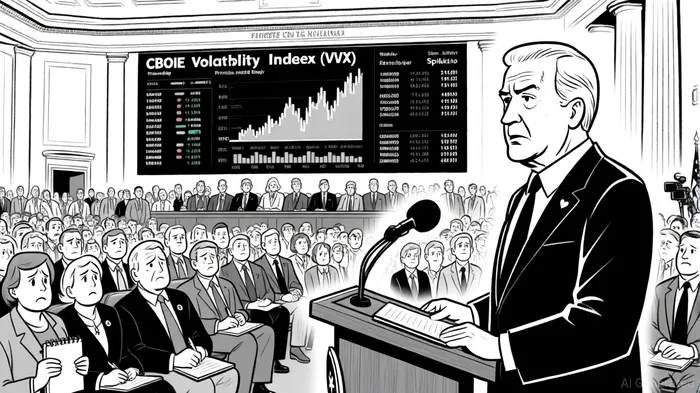
Executive overreach has become a defining feature of the Trump administration's tenure, with policies framed as existential threats to national security. According to a report by The Herb Paine Substack, the administration's use of crisis rhetoric-such as labeling immigration as a "national emergency"-has eroded institutional checks and balances, normalizing emergency governance as a default response to political challenges [1]. This erosion of democratic norms has directly contributed to market uncertainty. For instance, Trump's unilateral imposition of tariffs on Canada, Mexico, and China in April 2025, justified under the International Emergency Economic Powers Act (IEEPA), triggered a 74% surge in the VIX on December 19, 2024, the second-largest spike in the index's history [2].
The administration's defiance of judicial rulings further exacerbated instability. A U.S. Court of International Trade decision in May 2025 invalidated Trump's "Liberation Day" tariffs, citing unconstitutional executive overreach [3]. While the ruling temporarily stabilized markets, the administration's announced appeal underscored the fragility of institutional trust, keeping volatility elevated.
Insurrection Rhetoric and Sector Beta Shifts
Insurrection rhetoric has amplified market jitters, particularly around Trump's threats to invoke the 1807 Insurrection Act to deploy military forces in Democratic-leaning cities. As The New York Times reported, Trump's March 2025 congressional speech, which doubled down on tariffs and framed immigration as a "war from within," caused the VIX to surge from under 15 to over 23 within days [4]. Such rhetoric not only heightened fears of civil unrest but also triggered sector-specific beta shifts. For example, consumer discretionary stocks, sensitive to economic slowdowns, saw sharp declines, while utilities and healthcare sectors, with lower betas, outperformed [5].
The April 2025 "national emergency" tariff announcement pushed the VIX to a peak of 60.13, reflecting investor anxiety over retaliatory trade measures and inflationary pressures [6]. During this period, defensive assets like long-term Treasuries (TLT) and gold (GLD) gained traction, though gold's performance remained inconsistent amid broader uncertainty [7].
Defensive Stock Allocations: A New Paradigm
As volatility intensified, investors increasingly turned to defensive equities. Morningstar highlighted utilities and healthcare as prime allocations, citing their stable cash flows and low sensitivity to macroeconomic cycles [8]. Companies like NextEra Energy (NEE) and UnitedHealth Group (UNH) became cornerstones of resilient portfolios, offering yields of 3–4% amid GDP growth projections of 1.4–1.6% [9].
Healthcare stocks, bolstered by demographic trends and innovation, demonstrated particular strength. Pfizer (PFE) and Johnson & Johnson (JNJ), with strong economic moats and undervalued metrics, attracted capital as investors sought stability [10]. Similarly, consumer staples like Procter & Gamble (PG) and Coca-Cola (KO) benefited from steady demand, with Morningstar noting their pricing power and dividend reliability [11].
The shift extended to alternative strategies. Morgan Stanley advised investors to overweight minimum volatility indices and inflation-protected bonds, while T. Rowe Price emphasized macro-resistant equity portfolios focused on quality businesses [12]. Tactical allocations to defensive ETFs, such as the iShares 20+ Year Treasury Bond ETF (TLT), also gained traction, reflecting a broader trend toward capital preservation [13].
Implications for Investors
The interplay of political instability and market behavior underscores the need for adaptive investment strategies. As JPMorgan noted, policy uncertainty-particularly under a Trump administration-could trigger periodic volatility spikes, even if the overall trend remains muted [14]. Investors must balance defensive allocations with tactical flexibility, leveraging tools like buffered ETFs and active management to hedge against downside risks [15].
Moreover, the erosion of institutional trust and normalization of crisis governance pose long-term challenges. As The Federal Reserve highlighted, rising uncertainty correlates with delayed corporate spending and tighter credit conditions, compounding economic headwinds [16]. For now, defensive sectors and safe-haven assets remain critical to navigating a landscape where political rhetoric increasingly shapes market outcomes.







Comentarios
Aún no hay comentarios