
Political Instability in Kosovo: A Looming Threat to Regional Investment and Emerging Market Valuations
A Perfect Storm of Political Stalemate
According to a Bloomberg report, Kosovo's parliament failed to elect a prime minister in October 2025, despite multiple attempts, leaving the country without functioning governance for over six months. This deadlock followed inconclusive February elections, where Kurti's party secured the largest share of votes but fell short of a majority. Opposition parties, citing concerns over Kurti's handling of ethnic tensions in the Serb-majority north and his alignment with Western allies, have refused to form a coalition, according to Reuters. The resulting vacuum has left state agencies underfunded and paralyzed, with critical reforms delayed and EU accession negotiations stalled, as reported by .
The situation has been exacerbated by external pressures. The European Union has imposed sanctions on Kosovo over its failure to normalize relations with Serbia, while the U.S. has suspended high-level diplomatic engagement, Ekathimerini reports. These developments underscore a broader pattern: political instability in Kosovo is no longer an isolated domestic issue but a regional contagion with global investment implications.
Regional Investment Risk: A Ticking Time Bomb
, according to the World Bank's . This slowdown is directly tied to Kosovo's instability, which has deterred foreign direct investment (FDI). , , , Kosovo Online reports. Analysts attribute this gap to the lack of policy continuity and the government's focus on over structural reforms.
The ripple effects extend beyond Kosovo. Regional investment trends are increasingly influenced by the perception of . For instance, the prolonged stalemate has led to a de facto suspension of cross-border trade initiatives and delayed infrastructure projects funded by international lenders. As Reuters notes, the risk of a within weeks adds further uncertainty, with investors recalibrating their .
Emerging Market Equity Valuations: Risk Premiums on the Rise
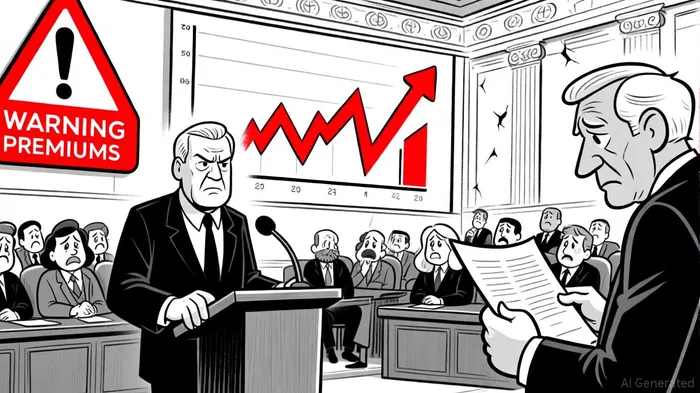
Political instability in Kosovo is not just a regional concern-it is a stress test for . Emerging markets are inherently sensitive to governance risks, and Kosovo's crisis exemplifies how can drive up risk premiums. Ekathimerini reports that the inability to form a stable government has eroded , leading to higher for equities in the region. This dynamic is particularly acute in markets with similar , where investors demand larger compensation for exposure to .
While specific data on (P/E) ratios for Kosovo-linked equities is scarce, broader trends in the Western Balkans suggest a pattern of declining valuations. For example, companies reliant on cross-border trade or EU subsidies have seen earnings forecasts revised downward, reflecting heightened , according to Kosovo Online. The lack of clarity around EU accession timelines-a critical factor for long-term growth-has further dampened sentiment.
Pathways to Stability: A Call for Pragmatism
The window for resolving Kosovo's political crisis is narrowing. Kurti must either secure within two weeks or face another election, which would deepen , Ekathimerini warns. For investors, the priority should be to monitor developments in EU-mediated dialogue and the implementation of .
In the broader context, the Western Balkans must address systemic issues such as , , and reliance on volatile . As the World Bank emphasizes, accelerating -particularly those facilitating cross-border trade and digital infrastructure-could mitigate some of the region's vulnerabilities.
Conclusion
Kosovo's political instability is a microcosm of the challenges facing in politically fragile regions. The interplay between , regional tensions, and investor behavior highlights the need for a nuanced approach to . While the immediate focus remains on Kosovo's , the long-term implications for emerging market equity valuations and regional investment flows are clear: stability is not a luxury-it is a prerequisite for .







Comentarios
Aún no hay comentarios