
The Political Instability of the U.S. House and Its Impact on Legislative Productivity and Market Sentiment
The U.S. House of Representatives has become a microcosm of the broader political dysfunction plaguing Washington, with Speaker Mike Johnson's tenuous grip on leadership exacerbating legislative gridlock and eroding investor confidence. As internal GOP fractures deepen, the consequences ripple beyond Capitol Hill, influencing market volatility and economic predictability. This analysis examines how Johnson's challenges reflect systemic instability within the House GOP, the resulting impact on policy outcomes, and the strategies investors can adopt to hedge against this uncertainty.
Legislative Gridlock and the Erosion of GOP Cohesion
Speaker Mike Johnson's leadership has been under constant siege from within his own party. House Republicans, divided between hard-line conservatives and moderates, have increasingly resorted to procedural tactics like discharge petitions to bypass leadership and force contentious measures onto the floor. These maneuvers-used to advance bills on issues ranging from Affordable Care Act subsidies to federal worker union protections-highlight a party struggling to maintain unity.
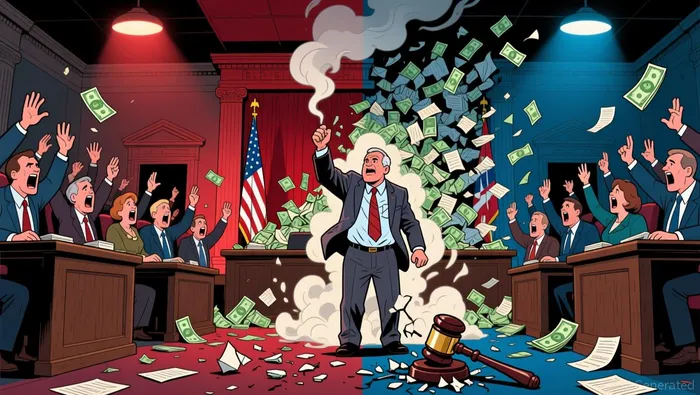 The consequences for legislative productivity are stark. House GOP's win rate on "party unity" votes has plummeted to 63.7%, the lowest since 1982. In 2023, the House passed only 27 bills that became law despite holding 724 votes-a far cry from the efficiency required to address pressing economic and fiscal challenges. This dysfunction is compounded by a narrow five-seat majority and the growing influence of hard-line factions, which have forced compromises on spending measures and procedural votes. Even allies like Rep. Kevin Kiley have criticized Johnson for failing to rein in dissent, arguing that his leadership style undermines legislative effectiveness.
Market Volatility and Investor Anxiety
The political instability in the House has not gone unnoticed by investors. Political gridlock, epitomized by a 19-day government shutdown in 2024 and repeated debt ceiling crises, has become a recurring source of market turbulence. According to a report by Discovery Alert, such dysfunction has eroded confidence in U.S. fiscal sustainability, with policy-related news accounting for a significant portion of volatility spikes.
Investor sentiment reflects this unease. As of 2025, 60% of U.S. investors expressed concern about market volatility, with 28% describing their anxiety as "very high". The partisan divide further amplifies this sentiment, as Democratic investors, in particular, have shown heightened concern over policy uncertainty. This volatility has prompted behavioral shifts: 31% of investors now review their portfolios more frequently, while 21% have sought professional advice to navigate the uncertainty.
Academic research underscores the link between policy uncertainty and market dynamics. Studies indicate that fiscal and regulatory policy news-such as trade disputes or debt ceiling negotiations-can trigger sharp volatility spikes. For instance, the Trump administration's aggressive tariff policies and trade disruptions have historically caused fluctuations in key metrics like the S&P 500 and consumer confidence. While current leadership under Johnson has not yet replicated such overtly confrontational policies, the persistent threat of government shutdowns and budget impasses continues to cast a shadow over investor sentiment.
Hedging Strategies for Political Uncertainty
Investors navigating this environment must adopt strategies to mitigate the risks of political instability. Diversification across asset classes remains a cornerstone approach, spreading exposure to reduce the impact of sector-specific shocks. Defensive sectors such as utilities and consumer staples, which tend to perform more consistently during market turbulence, have gained favor.
Options strategies also offer tools to manage downside risk. Selling covered calls or implementing collars can generate income while providing a buffer against sharp declines. Additionally, adjusting equity exposure in response to policy signals-such as debt ceiling negotiations or budget deadlocks-can help investors preempt volatility.
Monitoring policy developments is equally critical. Early indicators of political dysfunction, such as frequent procedural votes or rising intra-party dissent, can serve as red flags for market instability. For example, the growing use of discharge petitions by House Republicans suggests a lack of cohesion that could escalate into broader legislative failures. Investors who track these signals may gain an edge in adjusting their portfolios ahead of market reactions.
Conclusion
Mike Johnson's leadership challenges and the broader GOP fractures are not merely political theater-they are tangible forces shaping legislative outcomes and investor behavior. As the House struggles to pass meaningful legislation, the resulting uncertainty has become a drag on economic predictability and market stability. For investors, the path forward lies in proactive hedging strategies and a keen awareness of the interplay between political dynamics and market fundamentals. In an era where governance itself is under scrutiny, adaptability will be the key to navigating the turbulence ahead.







Comentarios
Aún no hay comentarios