
Political Instability and Fiscal Reform: Implications for Romanian Sovereign Debt Markets
Romania’s sovereign debt market in 2025 is a study in contrasts: high yields attract investors, but political fragmentation and fiscal uncertainty loom large. The country’s coalition government, formed after a protracted crisis following the annulment of the 2024 presidential election, is grappling with internal divisions over austerity measures and administrative restructuring. Prime Minister Ilie Bolojan’s push for a 10% reduction in administrative expenses and a 20% cut in public sector employment has faced resistance from coalition partners, forcing compromises that delay critical fiscal reforms [1]. These tensions, coupled with a budget deficit of 9.3% of GDP in 2024—the highest in the EU—highlight the precarious balance between political survival and economic stabilization [2].
Political Dynamics and Fiscal Deadlock
The coalition, comprising the National Liberal Party (PNL), Social Democratic Party (PSD), Save Romania Union (USR), and Democratic Union of Hungarians in Romania (UDMR), operates under a rotating premiership agreement, a structure that risks future instability [3]. Internal disagreements over revenue strategies, such as the PSD’s proposed “solidarity tax” on high wages, have stalled consensus on deficit-reduction measures [3]. Meanwhile, the far-right Alliance for Uniting Romanians (AUR) has threatened multiple no-confidence votes, labeling the government’s reform package “legislative terrorism” [1]. This political fragmentation not only delays fiscal consolidation but also raises the specter of policy reversals, particularly if a far-right president emerges in future elections [4].
Credit Ratings and Market Confidence
Despite these challenges, Romania’s sovereign debt market has shown resilience. Fitch maintains its “BBB-” investment-grade rating, citing the government’s deficit-reduction efforts, while MorningstarMORN-- DBRS assigns a “BB (high)” rating with a stable outlook [1][2]. Investors have responded positively to measures like a 5% corporate tax hike and public sector cost-cutting, driving a bond market rally [1]. However, the 10-year bond yield remains elevated at 7.62% in June 2025, a 500-basis-point premium over German Bunds, reflecting lingering fiscal vulnerabilities [1]. The National Bank of Romania has kept its benchmark rate at 6.50% to curb inflationary pressures, but political uncertainty continues to weigh on market sentiment [2].
Investment Risks and Opportunities
For investors, Romania’s bonds offer a compelling yield of 8.25%, but this comes with elevated risks. The government’s debt-to-GDP ratio rose to 55.8% in Q1 2025, up from 51.7% in Q1 2024, as austerity measures strain public finances [3]. Over 50% of Romania’s debt is foreign currency-denominated, exposing it to leu depreciation risks, though the leu has appreciated 9.91% year-to-date against the dollar [1]. The government’s plan to refinance 2026-maturing eurobonds and absorb EU recovery funds adds complexity to its fiscal path [2].
A 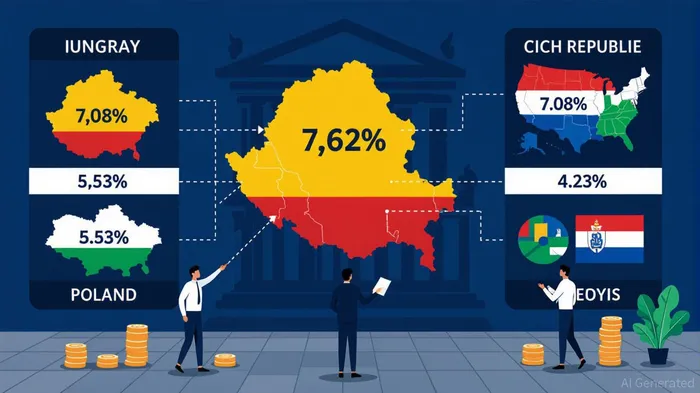 would underscore the country’s unique risk-return profile. could further highlight the narrowing spread as fiscal reforms take hold.
Conclusion
Romania’s sovereign debt market remains a high-risk, high-reward proposition. While political instability and fiscal reforms create volatility, the government’s commitment to deficit reduction and credit rating agency optimism suggest a path to stabilization. Investors must weigh the potential for yield resilience against the risks of policy reversals and public backlash. For those with a long-term horizon, Romania’s bonds could offer attractive returns if the coalition manages to implement reforms without fracturing.
Source:
[1] Romanian government to face multiple no-confidence votes over deficit-lowering reforms, [https://www.reuters.com/world/romanian-government-face-multiple-no-confidence-votes-over-deficit-lowering-2025-09-01/]
[2] Romania considers debt liability management to switch 2026 maturing eurobonds, [https://www.reuters.com/markets/europe/romania-considers-debt-liability-management-switch-2026-maturing-eurobonds-2025-07-18/]
[3] New Government in Romania: a Grand Coalition Facing Major Challenges, [https://www.osw.waw.pl/en/publikacje/analyses/2025-06-24/new-government-romania-a-grand-coalition-facing-major-challenges]
[4] Romania's Fiscal Tightrope: Balancing Austerity, Growth, and Political Risk, [https://www.ainvest.com/news/romania-fiscal-tightrope-balancing-austerity-growth-political-risk-emerging-market-debt-2508/]







Comentarios
Aún no hay comentarios