
The Political-Economic Risks of Trump's Potential Veto on Health Care Subsidies
The expiration of Affordable Care Act (ACA) premium tax credits at the end of 2025 has ignited a political firestorm, with President Donald Trump threatening to veto bipartisan efforts to extend them. This policy uncertainty has sent ripples through the U.S. healthcare industry, creating both risks and opportunities for investors. As the administration prioritizes market-driven reforms over government subsidies, sector-specific dynamics are emerging that demand careful analysis.
Insurance Sector: A Double-Edged Sword
The ACA subsidy expiration has already triggered a surge in premiums, with estimates suggesting costs could double for many marketplace enrollees according to analysis. This creates immediate risks for insurers, as higher premiums may deter enrollment, particularly among younger, healthier individuals. Such a trend could destabilize risk pools, exacerbating adverse selection and driving up costs further as research shows. However, insurers may also find opportunities in this environment. For instance, the push for Health Savings Accounts (HSAs) as an alternative to traditional subsidies could expand the market for high-deductible health plans, a segment where major insurers like UnitedHealth GroupUNH-- and HumanaHUM-- have significant exposure as reported.
The political standoff also introduces regulatory uncertainty. If Trump follows through on his veto threat, insurers may face a fragmented market with state-level experiments in coverage models. While this could disrupt national operations, it might also spur innovation in niche products tailored to specific regional needs.
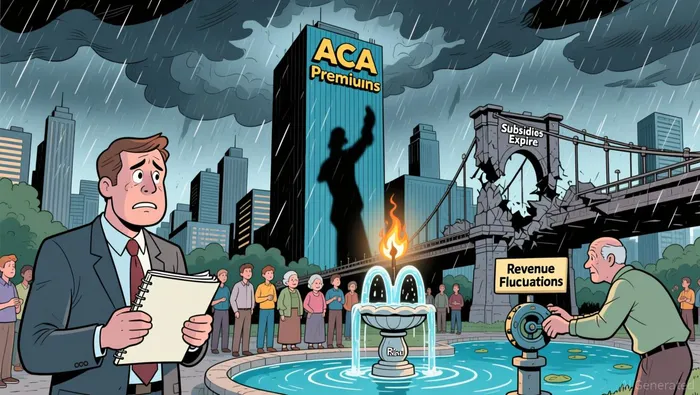
Hospitals and Providers: Revenue Pressures and Uncompensated Care
Hospitals and healthcare providers face acute financial risks if ACA subsidies remain unextended. According to a 2026 analysis, providers could lose over $32.1 billion in revenue and see a $7.7 billion spike in uncompensated care by 2026. Non-Medicaid expansion states, such as Texas and Florida, will bear the brunt of these losses, as their populations are more reliant on ACA coverage. This could force hospitals to absorb costs or reduce services, potentially compromising care quality.
However, this crisis may also drive consolidation. Larger health systems with diversified revenue streams-such as those with strong Medicare or commercial lines-could acquire smaller, struggling providers at favorable valuations. Investors should monitor how hospital networks adapt to increased uncompensated care burdens, particularly through partnerships with community health centers or telehealth expansion.
Pharmaceuticals: Navigating Pricing Pressures and Tariff Risks
The pharmaceutical sector operates in a unique regulatory limbo under Trump's policies. While the administration has abandoned the Biden-era Independent Payment Advisory Board (IPAB), it has simultaneously pursued aggressive drug pricing negotiations and tariff threats to pressure manufacturers as noted. This duality creates a complex risk profile.
On one hand, Trump's Most Favored Nation (MFN) pricing model and Medicare price caps could squeeze profit margins for top drugmakers. On the other, the administration's recent deals with companies like AstraZeneca, Novo Nordisk, and Eli Lilly-where price concessions are exchanged for tariff exemptions and manufacturing incentives-highlight a potential path forward according to policy updates. These agreements suggest that firms willing to align with federal priorities (e.g., lowering out-of-pocket costs for seniors) may secure favorable regulatory treatment.
Investors should also consider the long-term implications of Trump's focus on domestic manufacturing. The $50 billion AstraZeneca investment in U.S. biopharma production, for example, signals a shift toward reshoring supply chains-a trend that could benefit firms with scalable U.S. manufacturing capabilities as reported.
Conclusion: Balancing Uncertainty and Opportunity
Trump's potential veto of ACA subsidy extensions underscores the volatile interplay between politics and healthcare economics. While the insurance and hospital sectors face near-term revenue risks, the pharmaceutical industry's ability to navigate pricing pressures and tariff threats presents a mixed outlook. Investors must weigh these sector-specific dynamics against broader legislative uncertainties, such as the likelihood of a bipartisan compromise on subsidies.
As the 2026 midterms loom, the healthcare industry's adaptability-whether through product innovation, consolidation, or regulatory alignment-will be critical. For now, the message is clear: in a Trump-led environment, agility and strategic alignment with federal priorities will separate resilient players from vulnerable ones.





Comentarios
Aún no hay comentarios